10.08.19
Backstage Life Bareng Grrrl Gang di Episode Kelima Vindy Ngapain?
Tahun ini Grrrl Gang mendapatkan kesempatan untuk menjadi salah satu line up di We The Fest 2019, dan Vindy diperbolehkan untuk mengikuti aktivitas mereka.

For these past two decades, Wes Anderson has been one of the most prominent movie director. As we can see in all of his movies such as “The Royal Tenenbaums” (2001), “The Life Aquatic with Steve Zissou” (2004), “The Darjeeling Limited” (2007, and the most recent “Moonrise Kingdom” (2012), he has this signature, distinctive style which is put into every one of his movies. Anderson’s exquisite style apparently attracted RogerEbert.com’s Editor-in-Chief, Matt Zoller Seitz to investigate Anderson’s work. Seitz recently released his book titled that sums up all of Anderson’s movies from the first to the latest one. This book contains an in-depth overview of Anderson’s works, so that it guides the readers through Anderson’s life and career supported by previously unpublished photographs and artworks. Seitz also created a video essay series based on the book that we can watch online through RogerEbert.com’s Vimeo channel. Seitz scripted and narrated the videos by himself. These video are divided in seven chapters, in accordance with Anderson’s movie titles. In these videos, Seitz takes the watchers to take a closer look into Anderson’s creations. They are insightful as they give a broader horizon about the films and Anderson as the creator of the films. To date, there are five parts of this video essay series including Bottle Rocket, Rushmore, The Royal Tenenbaums, The Life Aquatic with Steve Zissou, and The Darjeeling Limited. The other chapters are coming as the series will be completed with a double feature of Fantastic Mr. Fox and Moonrise Kingdom which are going to be posted Friday, October 25. So make sure you keep checking back the channel because this video essay series is too good to be missed. To watch the rest of the series, visit RogerEbert.com’s Vimeo page.
In their latest edition of , presents a profile talk about Alfonso Cuaron’s latest surround sound masterpiece, . The video includes the director himself and the re-recording mixer Skip Lievsay explaining about the meticulous and masterful sound in the thrilling realistic space disaster movie. Covering lots of ground like the Dolby Atmos sound system and recording on set. Cuarón designed the film to be played in a surround sound setting. The best way to experience the movie would probably be in IMAX 3D, where you can hear the sounds coming off from different sides. It is mentioned in the interview that most of the sounds came in as “transducer recordings,” based on vibrations. All of this connects back to the visceral cinematic experience Cuarón was aiming for in the first place, to create a dramatic sound space to a dark and vast outer space environment. Gravity could probably end up winning a few technical Academy Awards, including and especially the sound categories. Usually a movie with these kinds of techniques applied to it are for the people from the industry to enjoy, but not to worry, this movie will put all kinds of audiences on the edge of their seats. This is a movie that reminds us why watching a film in the theater is the best way to enjoy the film.


Halloween is right around the corner, and what goes really well with this spooktacular holiday? Pumpkins, candy corn, and a spooktacular Movie Mystery Club night, of course! Our film-screening event is back, and if you guessed that we will screen a horror-rific film, then you are absolutely correct! And what ghoulish title will we project on our wall? Well, stop by W_Space Kemang next Wednesday the 30th at 7:30 and find out! Bring a friend and get ready to be scared by our mysterious Movie Mystery Club Selection! See you there! Whiteboard Journal Presents: Wednesday Oct 30, 2013 7: 30 PM Graha Toorak Jl. Kemang Timur Raya No. 998 Jakarta Selatan Indonesia 12730 p. 021 719 73 19 Free Admission & Popcorn! As you may know from our segments we at Whiteboard Journal love films – they can be source of great aesthetic, inspiration, and of course entertainment. To celebrate our love for the moving image we would like to invite you to join us at W_Space Kemang’s film screening event: Because you won’t know what movie we are showing until you are at the venue! Yup, that’s right, the movie is a secret. Do not be afraid, though. We have handpicked a selection of. One day it might be a hilarious comedy, the next might be a nail biting action adventure – what ever the film might be, we are sure that you will enjoy it. And what is a movie experience without delicious, buttery popcorn? An incomplete one (unless you don’t like popcorn), and with that in mind we will provide for the screening. Be sure to come with your friends early because supply is limited. So be sure to attend our second . Film starts at , don’t be late, bring your friends and pillows for extra comfort!
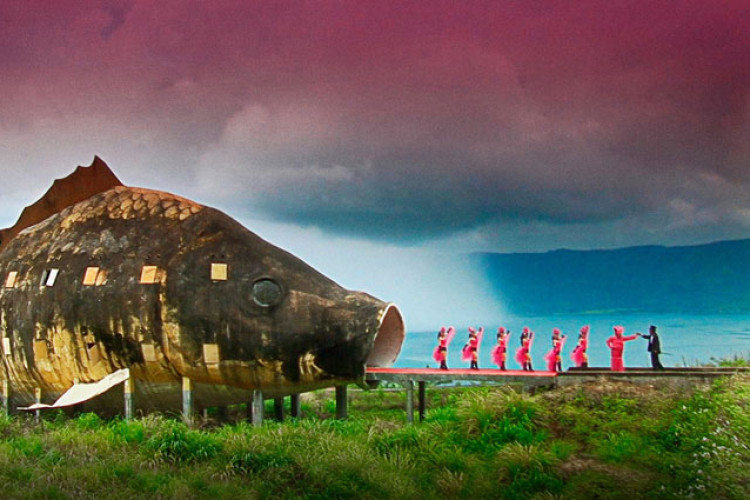
psychological documentary which has Indonesian death squad leaders re-enact their murders is now available free for Indonesians. In a statement published on their site, the filmmaker would like Indonesians to download it, discuss it, and spread the word about to . Supported by Drafthouse Films, Vice, and VHX, The Act of Killing can be downloaded via their website in regular and HD quality. Here is a review of the film by our very own Mar Galo.

Art intersects with so many different disciplines that we often forget to talk about art in relation to itself. How would we begin a conversation that is dedicated to art alone? Below is a list of recommended articles, essays, and novels that you might want to check out before We Discuss #4. The Exhibition-Machine: The Education Potential of an Exhibition by Mitha Budhyarto “The kind of leaning that takes place in an exhibition is one that – despite lacking the formality and strict regulations of institutional education – mobilizes new ways of thinking and doing. Exhibitions educate us when it ignites lines of inquiries that we never expected before, when it propels us into thinking and feeling in ways we never have. Certainly not only about art practices, but also about the way we live our lives.” Can exhibitions be an effective alternative learning platform? In what way can the “new ways of thinking and doing” be developed? Is there one kind of exhibition that is better than others? The Great Swindle by Roger Scrouton “Art must give offence, stepping out armed against the bourgeois taste for the conforming and the comfortable, which are simply other names for kitsch and cliché. The result of this is that offence itself becomes a cliché.” What is the role – if there is one – of art? Against Interpretation by Susan Sontag “Interpretation does not, of course, always prevail. In fact, a great deal of today’s art may be understood as motivated by a flight from interpretation. To avoid interpretation, art may become parody. Or it may become abstract. Or it may become (‘merely’) decorative. Or it may become non-art. The flight from interpretation seems particularly a feature of modern painting. Abstract painting is the attempt to have, in the ordinary sense, no content; there can be no interpretation. Pop Art works by the opposite means to the same result; using a content so blatant, so ‘what it is,’ it, too, ends by being uninterpretable.” In Sontag’s opinion, the act of interpretation defeats the purpose of art because it emphasizes art’s content instead of the work of art itself. The surrealist artist, Rene Magritte, thought that “questions like: ‘what does this picture mean, what does it represent?’ are only possible if one is incapable of seeing a picture .” Do you agree with Sontag and Magritte’s view on interpretation? “…to be an artist, in his view, was above all to be someone . Someone who submitted himself to mysterious, unpredictable messages, that you would be led, for want of a better word and in the absence of any religious belief, to describe as , messages which nonetheless commanded you in an imperious and categorical manner, without leaving the slightest possibility of escape—expect by losing any notion of integrity and self-respect.” What makes an artist, an artist? Does one have to have specific qualities in order to be considered an “artist”? “…we need art because we are so forgetful. We are creatures of the body as well as of the mind, and so require art to stir our languid imaginations and motivate us in ways that mere philosophical expositions cannot. Many of our most important ideas get flattened and overlooked in everyday life, their truth rubbed off through casual use. We know intellectually that we should be kind and forgiving and empathetic, but such adjectives have a tendency to lose all their meaning until we meet with a work of art that grabs us through our senses and won’t let us go until we have properly remembered why these qualities matter and how badly society needs them for its balance and its sanity.” Does this mean that good art have to shock us, that it must, as de Botton claims, “grab us through our senses”? Tuesday, October 22, 2013 7—9 pm Kinokuniya Plaza Senayan (near the language section) Jl. Asia Afrika 8 Sogo Plaza Senayan Lt. 5 Jakarta 10270 Look out for updates on our Facebook page and Twitter account! If you’d like to share your opinions, or if you have friends who’d like to share theirs, please sign up via e-mail with the subject title “We Discuss” at ! If you have comments or questions, tweet us .

It is already the second week of October! Which means that our next discussion session is coming up pretty soon. In our previous gathering, we talked about fashion and its relation to art. This month, we are going to focus exclusively on the broad topic of… What is art? But perhaps a more important question is not to know art is, but we perceive it. How do we make sense of artistic objects? Do we see them as things that are beautiful, or do we care more about what sort of ideas and emotions they could possibly stand for? The discussion will be divided into three sections, starting with the many ways in which art can be defined. - According to the ed.), the first definition of is: “skill as the result of knowledge and practice.” - In the , however, the word first and foremost means: “the expression or application of human creative skill and imagination, typically in a visual form such as painting or sculpture, producing works to be appreciated primarily for their beauty or emotional power.” - While both definitions include the word “skill,” the latter emphasizes on the creative aspect of it, along with notions of beauty and emotions. - Nowadays, however, anything that is beautiful can be called art, as if it is an excuse for things that cannot be explained or categorized. - But if art is so diverse, and so difficult to explain in one way, how do we identify “artists”? - Form is the tangible component of art, and it is therefore the thing that initially draws us to any work of art. - But can form alone our attention and interest in a particular object of art? - Is it possible for one form of art to be more “superior” than others (such as the classic example of paintings over photographs)? - The assumption is that art has a message, that it is supposed to mean something. -The Turkish writer, Orhan Pamuk, explores the notion of the message embodied in visible symbols (letters, etc.) in a clever essay entitled, “Meaning.” The narrator is the representation of meaning, which in this case is the text, and it laments over how its essence (i.e. its meaning) is not always grasped. The following line expresses that frustration: “You see, the only reason I’m here is to mean something. But you look at me as if I’m just an object. Yes, I know – I do have a body. But my body is only here to help my meaning flap its wings and take flight.” - But if art representation, one would have to it in order to uncover it. And to interpret, one has to think that within something, there is always something else. - However, Susan Sontag notes in her essay “Against Interpretation” that interpretation is “based on the highly dubious theory that a work of art is composed of items of content,” and therefore “violates art.” -This goes hand in hand with René Magritte’s disapproval of interpretation: “Questions like: ‘what does this picture mean, what does it represent?’ are only possible if one is incapable of seeing a picture .” - Should a work of art be appreciated for what it or for what it ? Tuesday, October 22, 2013 7—9 pm Kinokuniya Plaza Senayan (near the language section) Jl. Asia Afrika 8 Sogo Plaza Senayan Lt. 5 Jakarta 10270 Please look out for more #WeDiscuss updates on our Facebook page and Twitter account! If you’d like to share your opinions, or if you have friends who’d like to share theirs, sign up via e-mail with the subject title “We Discuss” at ! If you have comments or questions, tweet us .

Tahun ini Grrrl Gang mendapatkan kesempatan untuk menjadi salah satu line up di We The Fest 2019, dan Vindy diperbolehkan untuk mengikuti aktivitas mereka.