


What Slips Through Language: On Jokes, Mispronunciations, and Everything We Don’t Teach
In this Open Column submission, Rachel Yessica Anju goes over several expressions and remarks from different languages to show how it, just like the exchange of culture, could really represent something that is bigger than just the gathering of people.

Words by Whiteboardjournal
“Why don’t you ever teach us anything?” One of my friends jokingly said after dinner. “See, no one ever tells us these things.”
That night, our friend’s mother – a Filipino who has lived in Indonesia for years – managed to passionately explain both Indonesian and Filipino culture in under two hours. Meanwhile, her daughter and I had spent over a year with the same group of friends, yet we had never done the same.
For me, there’s something vulnerable about sharing your own culture. Indonesia is one thing, but sharing Batak, my own tribe, is another. It feels like dissecting an onion, layer by layer, until people reach the third or even the second-to-most internal part – close to the core. You are sharing a piece of yourself. What if they don’t understand? What if they don’t enjoy it as much as we do? What if they misunderstand the intention? What if it’s too much for them? My tribe is often misunderstood, even by fellow Indonesians. But hey, maybe that’s a story for another day.
I remember feeling oddly amused when my American friend struggled to pronounce the Indonesian curse words I taught her (to be fair, she asked me to!). She kept them in her notes app, and we would laugh every time she mispronounced every single word. I was even more surprised when I found out my French and Canadian friends already knew a few of these words – the most vulgar ones, at that. My jaw dropped in awe while they just laughed, saying they had their own “intels” who had been teaching them these cheeky expressions. Somehow, these were the words that travelled the fastest; the ones no one formally taught.
I’ve always been fascinated by the similarities that surface across languages.
“¡Aguas!”
…my friend yelled as we nearly stepped into a puddle – a word that sounded strikingly similar to the Indonesian “awas”, with almost the same meaning. I later learned that “aguas” is mainly used in Mexican Spanish and not across the rest of Latin America (confirmed by my Peruvian friend). Then there was “gratis”, which I spotted while wandering through an Aldi in Albufeira – the same word for “free” in both Portuguese and Spanish, as my Uruguayan friend confirmed. These small overlaps feel accidental at first, but they’re rarely just coincidences.
Historically, language travelled through trade and colonial routes – passed between strangers, often without much choice. In many ways, language moved through different forces. It was introduced through colonial power, sustained and expanded through trade and eventually woven into systems – becoming part of institutions, markets and everyday life. The spread of language was not always organic, nor was it a neutral medium of exchange. As Antonio de Nebrija notoriously declared in Gramática de la lengua castellana (1492), language was “the companion of empire.” It moved alongside power – carried across borders and embedded within societies, often through coercion rather than choice. The concept of colonialingualism helps make sense of this: language carries not just words, but also ways of thinking, shaping what we value, how we categorise the world and how we relate to others.
Language, in this context, wasn’t simply introduced – it was “spread” as a symbol of civilisation and as an instrument of rule, a point explored by Joseph Errington in Linguistics in a Colonial World.
Trade, however, carried language in its own way. As goods travelled, words followed – moving through interactions between traders, merchants and communities, shaping language through borrowing, simplification and wider adoption of shared terms. Even something as simple as tea carries this history; what moved from northern China as chá became chai across parts of Asia, while another route carried it into Europe as thé, tee, té, and tè, all derived from the same origin, as outlined in a World Economic Forum article on language and trade routes (2019).
In that sense, language didn’t just travel. It was imposed, circulated and maintained.
Now, it travels differently.
Culture and language move through playful interactions with friends – over a cup of coffee, at potlucks where people bring dishes from their respective countries. Sometimes, it becomes a kind of secret code, like when you spot a good-looking fellow walking past and switch languages mid-sentence with your friends. Other times, it shows up in unexpected ways.
In my friend group, we would occasionally yell “씨발!” whenever a situation turned dramatically worse, mostly for comedic effect. We picked it up from our dear Korean friend, who used it a little too often, and somehow, it stuck. We bonded through words we didn’t initially understand, yet came to use naturally. What once belonged to a certain place now slips easily between people – becoming something personal and shared.
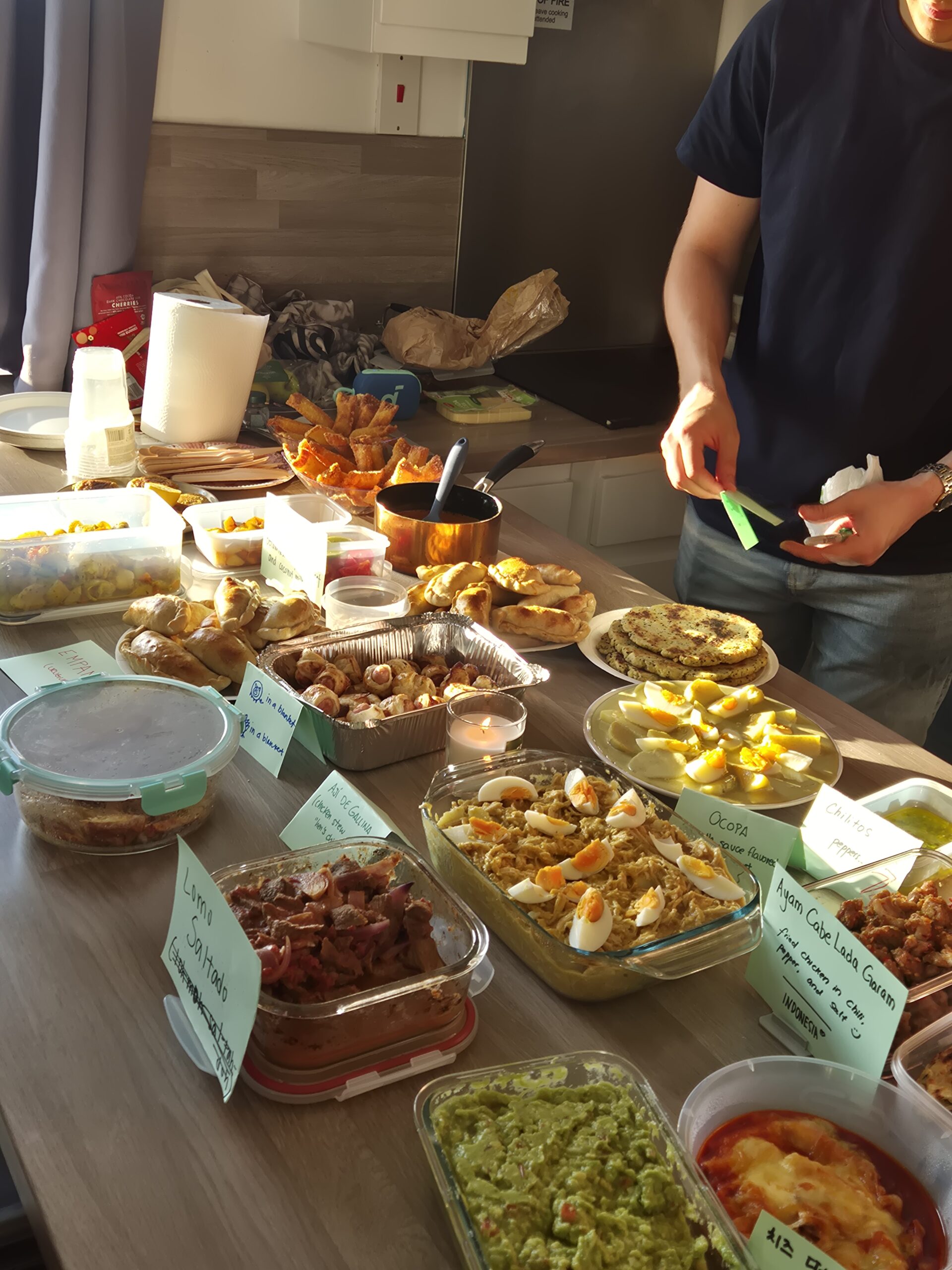
A summer potluck with friends. (Image via author's personal collection)
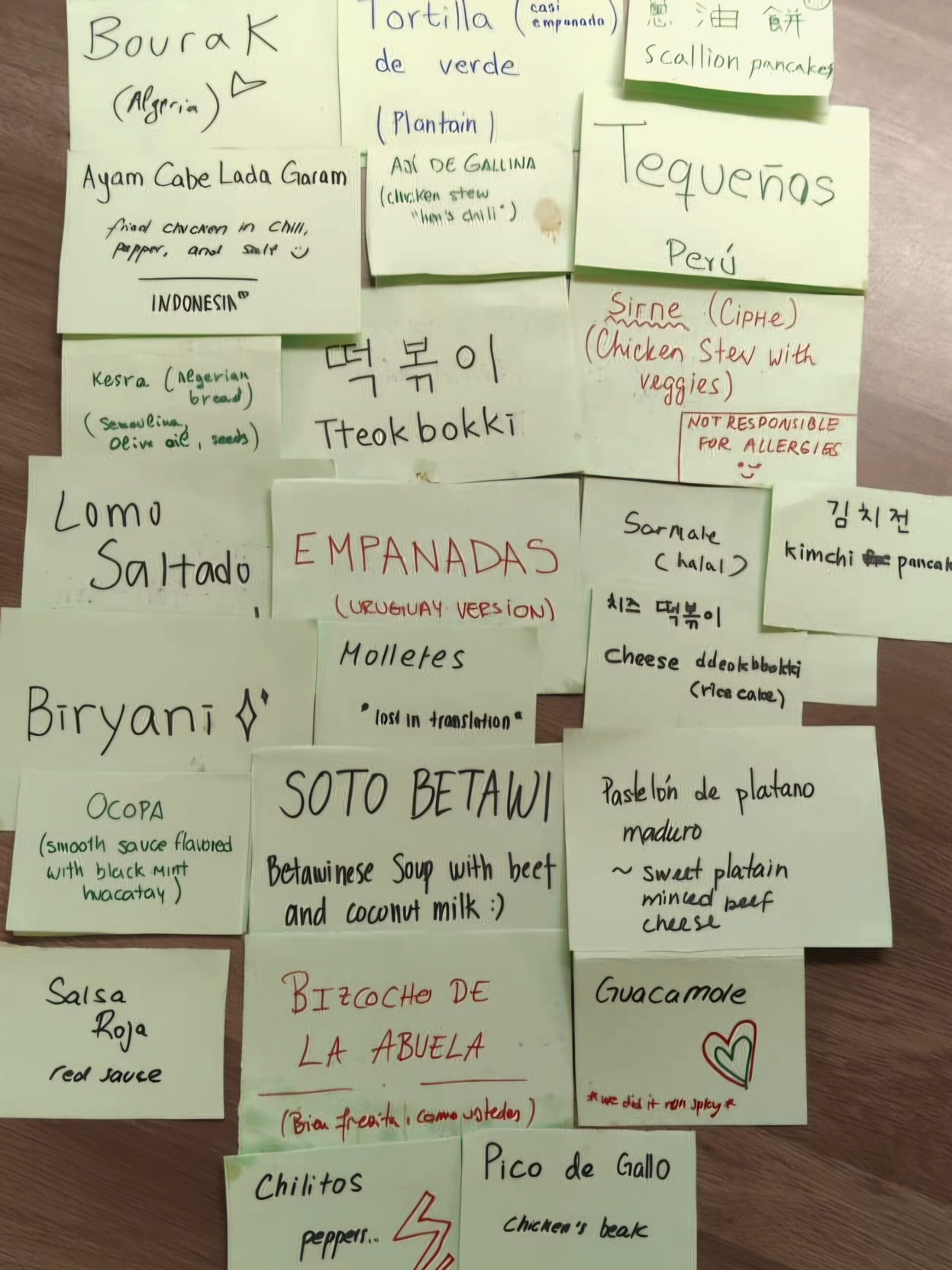
A summer potluck with friends. (Image via author's personal collection)
On the flip side, differences show up just as clearly. It’s fascinating to see the looks of surprise and disbelief when one culture is perceived differently by another. Take showering twice a day, for example, which is apparently a very “Indo” thing and a strange concept to my foreign friends. They just shook their heads, refusing to entertain the idea of showering both in the morning and again at night. But that is part of the beauty of these differences, too.
I used to think sharing culture meant explaining it – getting it right, making sure it’s understood. Maybe sharing culture doesn’t always have to feel like explaining everything all at once. But maybe it’s already happening in the smallest moments: in mispronounced words, the jokes we share, in borrowed expressions, the things that slip through without being formally taught. And maybe, in those moments, we are already representing something larger than ourselves, without even realising it.
Maybe that’s its own kind of diplomacy: subtle, unintentional, but deeply human.
Rachel Yessica Anju
“Food, media, history” is her version of “live, laugh, love.” Studied International Business but mostly made international friends (and picked up a bit of the business part along the way). A culture freak, a little too curious for her own good. Often on a nearby bench, observing – or dissociating. Sometimes there’s no in-between.