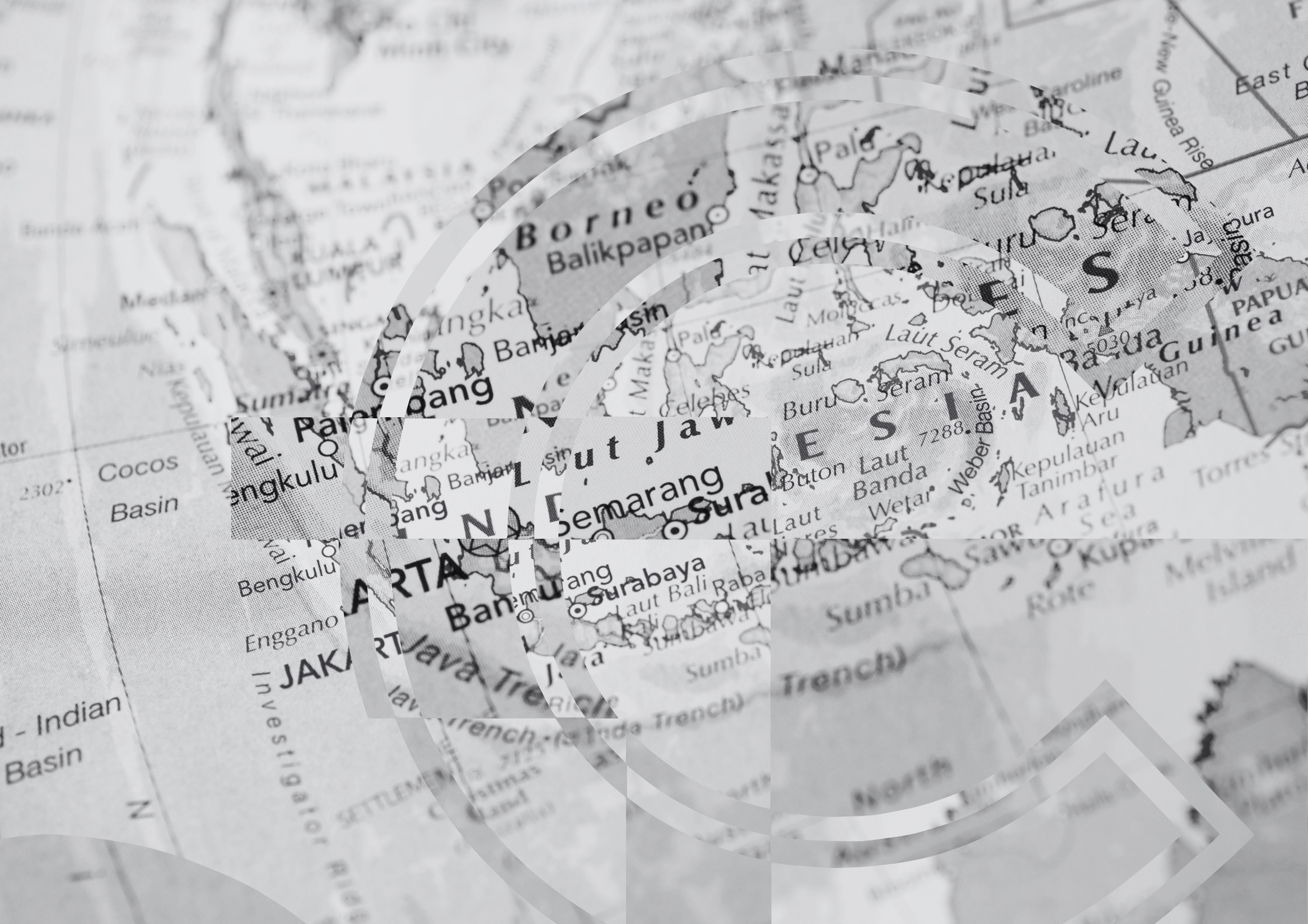


A Vision on Vernacular Governance and Hatta’s Archipelagic Federalism
In this Open Column submission, Radit Mahindro reimagines a more appropriate way to run a country home to 17,000 islands, 1,300 categorised ethnic identities, and 700 spoken regional languages spread across three time zones – in his words, a ‘vernacular governance’ – through ideas borrowed from ancient maritime empires to Mohammad Hatta’s cooperative commonwealth.

Words by Whiteboardjournal
If we spend enough time looking at maps of Southeast Asia, we notice something specific about water. In the European architectural and civic tradition, water is a void. It is a blank space on a parchment that separates one nation from another, a natural moat demanding a hard line where one kingdom ends and the next begins. But for an archipelago spanning thousands of islands, water is not a wall. It is the highway. It is the very material that connects.
For centuries, the societies of this region organised their lives around this fluid reality. They did not use the rigid, geometric borders that eventually emerged from post-medieval Europe, specifically the Westphalian system that dictates precise perimeters and centralised administration. Instead, they relied on a native framework known as the Mandala. This structural model was built not on where a territory ends, but on how strongly a centre radiates its cultural, economic, spiritual, and societal warmth.
The Southeast Asian Blueprint of the Mandala
The word mandala means a circle in Sanskrit, but in the early governance of Southeast Asia, it represented a shifting network of loyalties. Think of it less like a modern map with neat, coloured boundaries and more like a series of campfires lit across an open field. The closer we stand to the fire, the warmer we are. As we walk away, the heat fades, and eventually, we enter the warmth of a different fire altogether. There are no fences between them, only degrees of radiation.
Historically, maritime empires like Srivijaya, which flourished in Sumatra from the 7th to the 13th centuries, operated exactly this way. Srivijaya did not spend its energy policing invisible lines in the open ocean. It focused on securing the river mouths, the trading ports, and the critical shipping straits. It formed deep relationships with regional leaders across the Malacca Strait, offering shared maritime security and access to global trade networks in exchange for loyalty and steady tribute.
The Khmer Empire in 12th-century Cambodia, Sukhothai Kingdom in 12th-century Thailand, and Majapahit Empire in 14th-century Java functioned on a comparable wavelength. Power was relational, not territorial. Alliances fluctuated based on mutual benefit, familial ties, and economic flow. This vernacular system arguably allowed distinct cultures to thrive without being flattened by a uniform administrative steamroller. A small island settlement in the Maluku islands could retain its distinct customary laws, specific agricultural techniques, and provincial leaders, as long as it maintained a rhythmic relationship with the primary seat of power in Java.
The Friction of Imported Lines
When European colonial powers arrived, they brought a strict fixation on property ownership and permanent borders. They drew straight lines through dense rainforests and open seas, cutting directly through old migration routes, familial ties, and natural economic zones.
We can see the most extreme version of this mechanical mindset in the carving up of Africa during the Berlin Conference of 1884. There, colonial European powers sat in a room with rulers and pencils, slicing an entire continent into geometric pieces without any regard for native cultures, language groups, or natural river basins. This artificial separation created deep-seated cultural, ecological, and economic chaos across Africa, leaving behind structural wounds that regional societies there are still navigating today.
The modern nation-states of Southeast Asia inherited a comparable linear framework. Today, a centralised governance framework designed for compact, contiguous European landmasses is applied to a massive, scattered ocean landscape. Indonesia stretches over 5,120 kilometres from east to west. This is more than the distance from Manchester to Tehran, or from Los Angeles to New York City. Managing an area this expansive from a single bureaucratic centre in Java creates natural structural friction and risks! The European model requires legislative uniformity, but an archipelago is inherently plural. When we try to run a hyper-centralised administration over thousands of distinct islands, the distant edges often feel isolated, while the centre becomes heavily congested with administrative gridlock.
Weighing the Traditional Hearth: Pros and Cons
To use this regional philosophy today, we have to look honestly at both its historical strengths and its inherent weaknesses. The great advantage of the traditional mandala was its organic flexibility. Because it valued relational warmth over hard boundaries, it naturally protected pluralism. It allowed distinct regional groups to keep their ancestral land laws, native languages, and localised economic systems intact. The centre did not try to heavy-handedly flatten local differences, which created a peaceful coexistence rooted in mutual benefit and ecological respect.
On the downside, this reliance on personal relationships made the historical mandala deeply fragile and fundamentally feudal. Power was bound to the personal charisma of a ruler and maintained through dynastic marriages. This structure naturally bred nepotism, keeping wealth and decision-making locked within small family circles. Because there were no permanent institutions, kingdoms frequently faced succession crises or collapsed into internal conflict whenever a leader passed away.
Refining this framework for the modern world requires keeping its organic flexibility while completely removing its feudal vulnerabilities. We can achieve this by decoupling the mandala from individual personalities and anchoring it in stable, democratic institutions. Instead of personal favours and family allegiances, the radiating warmth of a modern centre must be driven by transparency, clear electoral processes, and a merit-based legal framework. By using a constitutional model to distribute responsibility, we turn what was once a system of elite families into an open, shared architecture for all citizens.
The Logic of the Federal Frame
This refined, institutional approach fits with the mechanics of a federation. A federal system divides power clearly between a central body and self-governing states. It acknowledges a simple truth: a group of villagers in the highlands of Papua understands their agricultural needs better than an office worker sitting in Jakarta (big time!), and the management of fisheries in the Banda Sea should be guided by the maritime clans who have navigated those waters for generations.
This decentralised vision already sits at the heart of Indonesia’s own revolutionary history. Mohammad Hatta, the country’s co-founding father and first Vice President, was a passionate champion of the federal idea and deep regional autonomy. Hatta was a brilliant economist and a grounded thinker who argued during the foundational constitutional debates that a nation as massive and diverse as Indonesia could not be run effectively from a single, omnipotent centre. He recognised that hyper-centralisation would ignore the unique genius of individual islands. Instead, he envisioned a cooperative commonwealth where regional economies could govern themselves while remaining tied to a shared national heart.
A federation provides the clear legal scaffolding needed to protect this regional autonomy. It ensures that decisions are made closest to the ground where their consequences are felt. When paired with the old philosophy of the Mandala, a federation stops being just a cold, legalistic contract. It becomes a living system of regional centres, each allowed to glow with its own distinct energy while remaining part of a larger, cooperative constellation.
Educating the Household: Oikos-Nomos
To truly activate this decentralised system, our approach to learning must also return to its foundational roots. The word economy finds its origin in the ancient Greek words oikos, meaning household, and nomos, meaning management or law. At its core, economics is simply the art of household management: the mindful care of the place we call home.
Indonesia is home to more than 17,000 islands, 1,300 categorised ethnic identities, and 700 spoken regional languages spread across three time zones.
An education system built for a Mandala-Federation must be realigned with this etymological truth. Instead of training young minds in standardised, urban-centric curricula that alienate them from their native landscapes, learning should be site-specific. In a maritime province, education should focus on oceanography, traditional navigation, and responsible fisheries management. In a volcanic highland, it should focus on agroforestry, soil health, and water preservation.
By training generations to manage their specific regional households, education becomes a contextual tool for true welfare. This approach creates a deep respect for both natural biodiversity and cultural variety, showing that protecting an ecosystem goes hand-in-hand with honouring the human practices that have kept it alive for generations.
Synthesising a New Vernacular
By merging the above ideas, we get a Mandala-Federation. In this structure, the central government handles shared, macro-level responsibilities such as national defense, international trade agreements, and large-scale currency stability. Meanwhile, regional hubs act as their own self-directed mandalas. They manage their own financial welfare, regional resource allocation, and daily civic life based on site-specific realities.
This synthesis directly protects biodiversity and cultural variety. Southeast Asia holds some of the most delicate ecosystems on Earth. Indonesia alone contains the heart of the Coral Triangle and vast expanses of tropical rainforest. These biological systems do not thrive under standardised, distant mandates. They require regional stewardship. Under a Mandala-Federation, regional laws can be written to match the specific ecology of the nearby soil and sea, allowing regional societies to practice ancestral land management without bureaucratic interference from a distant capital.
The Factual Grounding
Indonesia is home to more than 17,000 islands, 1,300 categorised ethnic identities, and 700 spoken regional languages spread across three time zones. Despite this immense human landscape, the island of Java holds roughly 56 percent of the total population and commands the vast majority of the nation’s economic and political output. This heavy concentration leaves the outer islands, which often produce the bulk of the country’s natural wealth through agriculture, minerals, and maritime resources, in an unbalanced position.
A decentralised Mandala-Federation corrects this distribution. When regional states retain a significant portion of their regional revenue, financial wealth stays where it is generated. This economic autonomy allows for the direct funding of regional schools, the preservation of regional languages, and the construction of infrastructures that suit the regional climate and landscape. It creates regional economic hubs, reducing the pressure on young talent to migrate to an overcrowded capital city just to find a livelihood. It keeps the lifeblood of each province within its own borders.
A Welcoming Architecture for the Future
Adopting a vernacular system is not about turning back the clock or ignoring modern realities. It is about choosing an architecture of governance that fits the physical shape of the land. It is an acknowledgment that a nation of 17,000 islands cannot be governed effectively like a single piece of flat European farmland.
When we look at governance through the lens of the Mandala and the federation, the future looks remarkably human, natural, grounded, and deeply connected to the rhythm of the islands. It is a way of organising our shared life that respects both the soil beneath our feet and the water that carries us forward.
“Indonesia tidak akan besar karena obor di Jakarta, tapi akan bercahaya karena lilin-lilin di desa.” – Mohammad Hatta

Radit Mahindro
Currently serves as the Senior Marketing + Commercial Director at Potato Head. In 2020, alongside Balinese art director and gallerist Krisna Sudharma, he co-founded Paras, an online platform dedicated to documenting tourism destinationism in Bali. He launched his 336-page book, Paras: Documenting 100 Years of Hospitality and Hotel Architecture in Bali, in 2025. Radit has previously worked with and consulted for Alila, Aman, Begawan, Regent, Soori, Space Available, and Tandjung Sari, among others. In his spare time, he shares stories through publications such as Travel + Leisure Asia, Manual Jakarta, the Whiteboard Journal, and Eastside Asia, documenting how design and travel reflect the wider culture and society vice-versa. instagram.com/raditmahindro/