

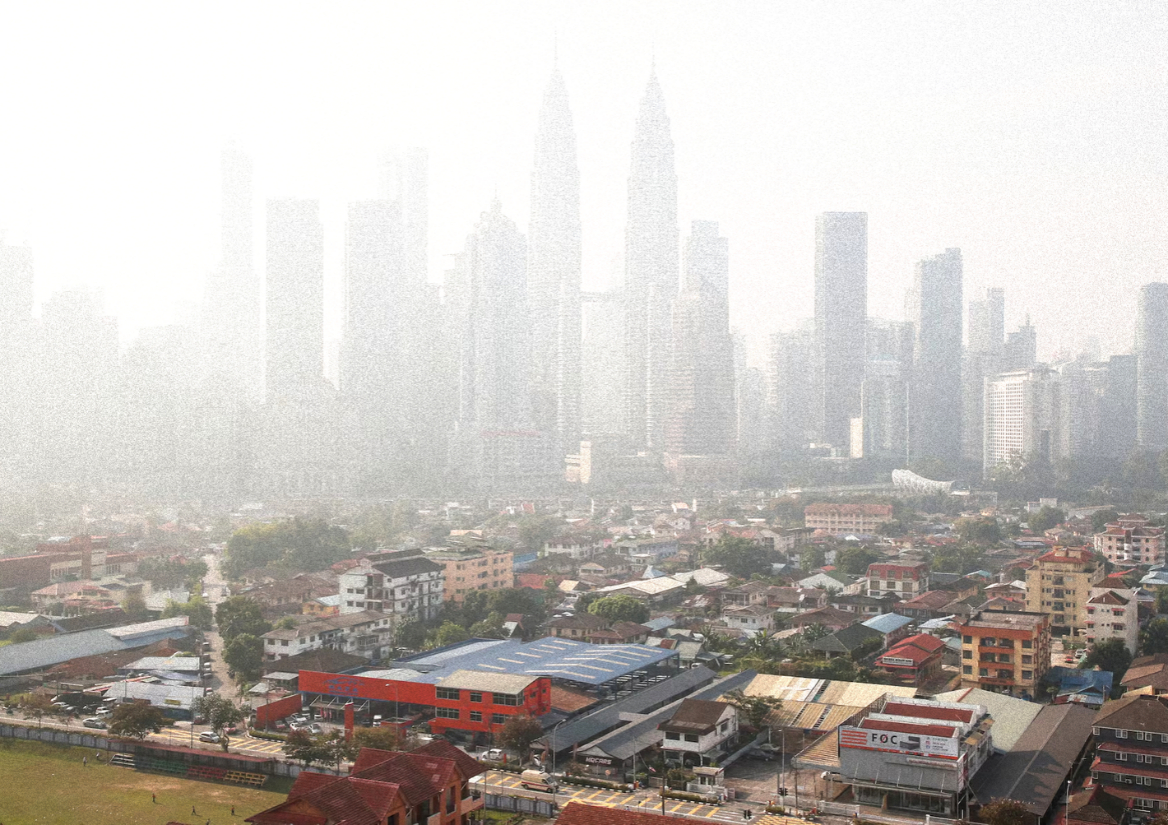


As we Indonesians are sorry for the haze, what do Singaporeans, Malaysians, Thais, and Filipinos have to say about it?
We asked our SEAblings what they have to say (and felt) about the haze from the Indonesian widespread forest fire.

Words by Whiteboardjournal
Image via Hasnoor Hussain/Reuters
We’re well months into the worsening of the haze and forest fires, and beneath all the murk and haze, it’s starting to be less of a ‘wildfire’ and more of a smoke and mirrors by those that are… well, our SEAblings have touched upon this in their account of what they have felt for the past few weeks.
Read what they have to say about the ongoing haze that have choked our SEAblings in Malaysia, Singapore, Thailand, to The Philippines down below.
B. | Artist, MY
What are your views on Indonesia and its government over the past few years – based on what you’ve read and understood?
Understanding a nation can only fully happen through knowing the people that inhibit it. Media and journalism gives us a glimpse and some extent of understanding but it is through having friends from Indonesia and conversing with local communities who are firsthandedly impacted by this bureaucracy that gives me a better understanding. Like Malaysia, Indonesia also experiences this mismatch between mass public opinion and the competence of the majority of representatives elected to speak and act on the issues.
As a SEAbling, what’s the news coverage around the endless wildfires like in there? And what are conversations around it like there?
The news extensively covers the open burning and independent media and even ministers are coming forward with statements calling it what it is – an open burning by irresponsible corporations backed by the lack of enforcement to curb this issue by the Indonesian government. In discussing this issue, there are a plenty of hateful and racist individuals online who stereotype this issue into a Malaysia vs Indonesia angle with simplistic mindsets through statements like “Boycott the Ayam Gepuk restaurants” when the reality of the situation is that this isn’t a natural disaster or one caused by the 288 million Indonesians; on the contrary, this is a calculated action and repeated offence by a handful of greedy individuals who seem immune and invincible to law and scrutiny under the reign of capitalism while Indonesians especially the people of Kalimantan are the victims in this situation. Most Malaysians are aware of this fact. At the end of the day, it is a class war and further dividing ourselves into classifications outside of castes will further hurt the hopes of progress.
To what extent does the smoke from Indonesia disrupt your daily activities?
Since I was in school until now, when I am at an age where I can already plan to have my own children who will attend school, it has been a recurring problem every year. It has been said that Malaysia has three seasons – Monsoon, tropical hot sun and haze. Seeing my more vulnerable family members get sick due to weather conditions becomes more dystopian as the years go by. It’s only getting worse because of money and the never ending hunger for it, lots of it, all the time until your values are what’s at stake.
Despite the crisis dragging on for months and affecting communities across the region, Indonesia has yet to declare it a national disaster. From your perspective, how do you see this decision, and what does it say about how the crisis is being handled?
It frightens me to think that those who have been given trust in positions of power to decision make, to take action and create an actual difference have selfish agendas that don’t bring forward actionable and impactful enough change that benefits the nations. With the current news coverage, I am seeing writings and art made by Malaysian artists regarding this problem. One that particularly stood out to me was this two-panel comic by Lat, drawing the KL tower imagined with a large fan propelling and acting as a ventilation system.
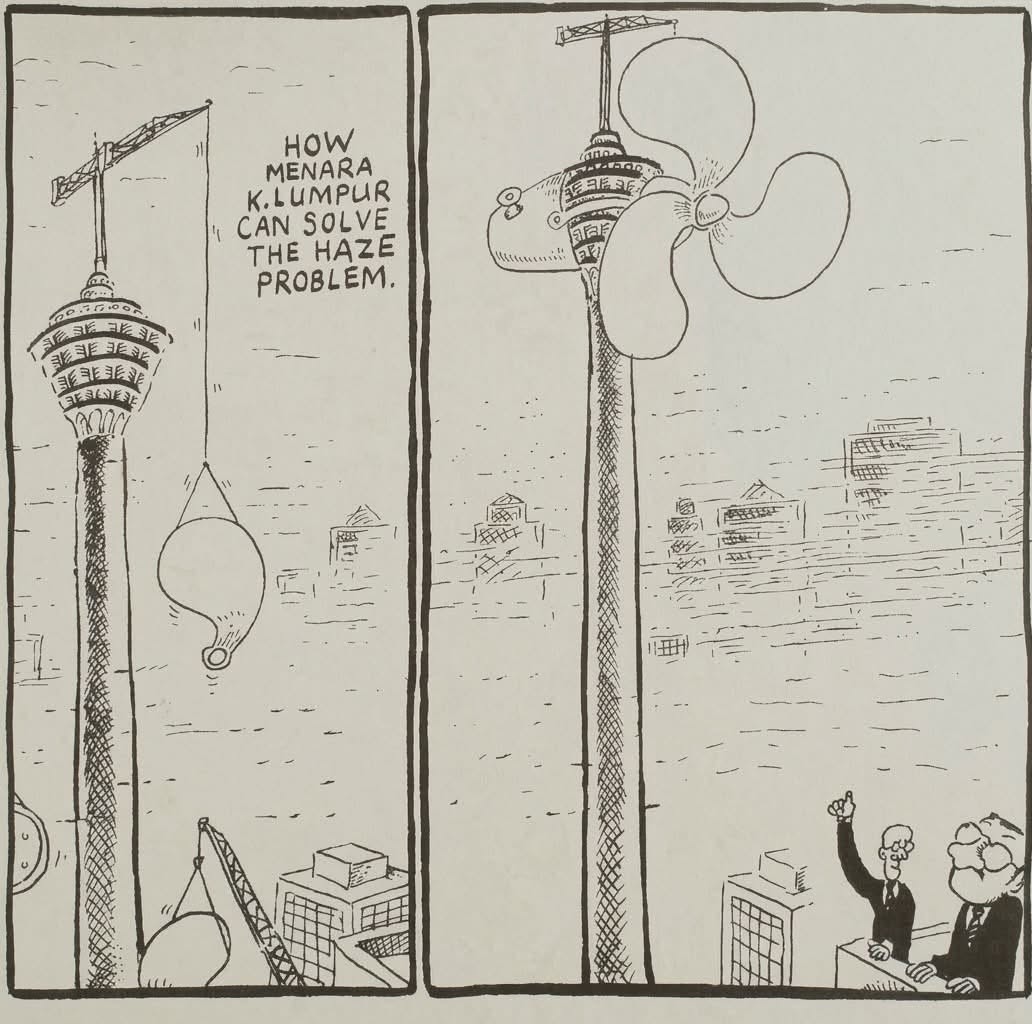
Datuk Lat’s two-panel comic from the 90s. (Image via Facebook)
This is a medium to point towards the helplessness we face during this period that was drawn in the 1990’s, almost 30 years later, we are still discussing this as a current issue and not one of the past. This shouldn’t even be a conversation between us, but information is power and through sharing and reinforcing these facts, we become the collective statistic of individuals who are making it known that we see things for what they are. ‘Wildfire’ insinuates that it isn’t planned, which isn’t what this is. It is a targeted arson against nature and serious violation towards the local public workers, firefighters, volunteers, children and communities whose lives are at stake fighting for survival and an end to this rerun of a crime.
G. | Journalist, SG
What are your views on Indonesia and its government over the past few years – based on what you’ve read and understood?
Every Indonesian I’ve spoken to has profusely apologised on behalf of their government, which they regard as incompetent and unwilling to lose face in its current (mis)handling of the forest and peatland fires leading to the haze. From my understanding, while the wildfires have been exacerbated by dry weather brought about by the El Niño, the main causes are from the draining of peatlands – which increase fire risk – and the state cutting of the budget for the National Disaster Mitigation Agency in favour of other priorities, such as its flagship free meal programme and defense spending.
As a SEAbling, what’s the news coverage around the endless wildfires like in there? And what are conversations around it like there?
To be honest, Singaporeans only started caring about the wildfires because of the haze. I don’t think many people knew about the forests and peatlands that have been burning for months in Kalimantan, until it started affecting them.
The news coverage here very much focuses on what people can do to adapt to the current haze episode, including wearing N95 masks and getting air purifiers. Lately, there’s also been discussions about how Singapore could potentially take legal action against the companies responsible for causing or condoning the fires, under a law we passed in 2014.
To what extent does the smoke from Indonesia disrupt your daily activities?
Now my days are planned around the haze. I love being outdoors, whether it’s tending to my garden, running in a park or picnicking at the beach, so those are things I haven’t done in the past few weeks.
I also work part-time as a barista for an outdoor coffee cart, so operations there have been uncertain. Our boss just introduced a new haze protocol where we monitor the PSI levels the night before and the hourly PM2.5 levels in the morning to determine if we open that day.
I’ve been relying on air conditioning more than usual as well, because my windows are now perpetually closed to keep the haze out.
Despite the crisis dragging on for months and affecting communities across the region, Indonesia has yet to declare it a national disaster. From your perspective, how do you see this decision, and what does it say about how the crisis is being handled?
It’s heartbreaking, as I know many people and animals in the forests have already died because of the fires. If it’s already making our air so unhealthy hundreds of kilometres away in Singapore and Malaysia, causing respiratory illnesses to climb and schools to close, I can’t imagine how bad it must be for those nearest to the fires in Indonesia. I’ve seen people in Indonesia post apocalyptic images of skies that have turned a deep orange due to the haze that now blanket parts of the country.
Meanwhile, the Indonesian government has trivialised the current haze crisis, with Prabowo calling it a “temporary Instagram filter” and another official calling the fires “beyond human error”, claiming also that Indonesia’s forests supply oxygen to Singapore and Malaysia when there’s no haze. It just shows that Indonesia’s authorities prioritise how they are perceived on the world stage more than the health and well-being of their people (much less their neighbours).
Ironically, while Indonesia wants to appear competent and strong by refusing to declare a national emergency, it has had the opposite effect. It’s clear to everyone that the endless wildfires are a result of state failure, including inadequate preparedness and decades of forest-clearing permits and peatland drainage.
As SEAblings, we often talk about the solidarity that connects us across Southeast Asia. In moments like this, what do you think that solidarity should look like in practice?
Pressuring the Indonesian government to declare the ongoing fires a national disaster so that more funding and resources can be mobilised to put out the fires.
It’s also about realising our own complicity in the haze as well, given that certain financiers of the companies linked to the haze and buyers of the commodities produced on their lands are based in Singapore or Malaysia as well.
M. C. | Design Journalist, PH
What are your views on Indonesia and its government over the past few years – based on what you’ve read and understood?
I profess to have not much knowledge about the Indonesian government, but have fond views of Indonesia as someone who’s previously lived there for over a decade and made multiple visits since; but from what I’ve been seeing on social media, there is much discontent and anguish over governance, as seen from news coverage of major rallies in the capital and the failure of local government to act on topics of corruption and inequity.
As a SEAbling, what’s the news coverage around the endless wildfires like in there? And what are conversations around it like there?
There is news about the wildfires on broadsheets and social media, but in the capital, at least to my knowledge, there isn’t as much talk about it; it does help in a way that there’s been lots of rain in the past month, which might have mitigated the worst of the haze blown our way.
To what extent does the smoke from Indonesia disrupt your daily activities?
Not in the PH capital for sure, so not sure if I can answer this satisfactorily as there is no direct/major impact from where I am; I did go to Singapore in the week of September 27–29, and the haze was pretty bad even with the rainy weather; it further aggravated the cough I was already sporting then. I can only imagine the discomfort and pain such conditions can cause for people with comorbidities or who are sensitive to air pollution.
Despite the crisis dragging on for months and affecting communities across the region, Indonesia has yet to declare it a national disaster. From your perspective, how do you see this decision, and what does it say about how the crisis is being handled?
Frankly, that sounds irresponsible and rather indifferent, especially since the blaze has become a regional problem. It is a public health hazard, and people have died and can die from prolonged exposure to poor air quality, especially those with pre-existing conditions. The fact that this has persisted for months, indeed years, is worrying, especially as it has become a recurring issue. I remember encountering the haze myself while living in Batam in the early 2000s, so it is hard not to feel frustrated that the problem keeps resurfacing.
As SEAblings, we often talk about the solidarity that connects us across Southeast Asia. In moments like this, what do you think that solidarity should look like in practice?
Solidarity is important in a region that is both diverse and similar in so many respects, but meaningful solidarity can only happen when we own up to our failures and weaknesses and make a genuine attempt to address them before we ask for help.
F. F. | Musician, MY
What are your views on Indonesia and its government over the past few years – based on what you’ve read and understood?
No comment 😉
As a SEAbling, what’s the news coverage around the endless wildfires like in there? And what are conversations around it like there?
Media outlets are doing daily coverage on the matter – mostly updating on the air pollution index and areas most severely affected by the haze. On social media, people are more direct about their dissatisfaction and how things are being handled by the authorities in Indonesia, and all affected countries.
To what extent does the smoke from Indonesia disrupt your daily activities?
I’m more cautious about spending time outdoors and have reduced it considerably these past couple of months.
Despite the crisis dragging on for months and affecting communities across the region, Indonesia has yet to declare it a national disaster. From your perspective, how do you see this decision, and what does it say about how the crisis is being handled?
I think the stance being made is quite clear, but that doesn’t mean it cannot be changed. With enough and constant pressure – online, offline, through international media, it might budge toward the direction that at the end of the day stops the fire.
As SEAblings, we often talk about the solidarity that connects us across Southeast Asia. In moments like this, what do you think that solidarity should look like in practice?
I think a lot more pressure needs to be put onto those accountable for this inaction or delay in action, online or offline. And keeping that consistent and constant until the fire goes out.
A. E. | Musician, SG
What are your views on Indonesia and its government over the past few years – based on what you’ve read and understood?
Honestly, I wasn’t well informed about Indonesia over the past few years. It’s only this year that I’ve started taking the time to understand what’s been happening, and I’m still learning. I think that’s true for a lot of us in Singapore. We tend to pay attention to our neighbours when something reaches us, and the haze is a good example of that.
My tour there was short, but it was enough to show me what Indonesians are like. They’re passionate, they have real grit, and they care deeply about their country. They don’t hold back when something matters to them. Where it would be easier to stay quiet, the people I met chose to speak up, and I really respect that.
I really admire my peers in Indonesia. They have style, they’re brave, and they speak up even when it isn’t easy. Seeing how the crisis weighs on them, and how they keep going anyway, has changed how I think about it. I sympathise with everything they’re going through, and I don’t want to only notice it when the haze reaches us. All I wish for them is something better, and I’d like to be a more informed neighbour in the meantime.
As a SEAbling, what’s the news coverage around the endless wildfires like in there? And what are conversations around it like there?
In Singapore, the coverage is mostly about the haze itself: like PSI readings, health advisories and event cancellations.
There’s more focus about how we’re affected and less attention on the communities living through the haze in Indonesia and the crisis in Kalimantan and Sumatra.
People here are frustrated — it affects our health and morale. But my Indonesian peers talk about it differently. There’s more anger and fatigue, because for them it’s not only the haze; it’s their own people losing homes, falling sick and breathing air that is far worse than ours. It’s personal for them, and I think that emotional weight gets lost in our conversations here in Singapore.
To what extent does the smoke from Indonesia disrupt your daily activities?
It has affected me more than I expected. Over the past few months I’ve fallen sick several times, with a persistent cough, headaches and a runny nose. Many events across the country have also been cancelled, which has had an impact on my work. We’ve had to make adjustments, but overall I’d say it’s been a manageable inconvenience compared to what people closer to the fires are going through.
Despite the crisis dragging on for months and affecting communities across the region, Indonesia has yet to declare it a national disaster. From your perspective, how do you see this decision, and what does it say about how the crisis is being handled?
I think it’s hard to understand. When I toured Indonesia, a lot of my peers were already angry about Kalimantan and the loss of homes — and that was before the haze had reached Singapore, or when it was only faint. The response has been slow, and as the haze spreads to neighbouring countries, the problem will only become more unmanageable.
To me, it shows a lack of initiative, some official statements about the haze in Singapore and Malaysia have come across as dismissive, even sarcastic. What upsets me most is that my friends in Indonesia are left to endure this, and my heart goes out to everyone affected.
As SEAblings, we often talk about the solidarity that connects us across Southeast Asia. In moments like this, what do you think that solidarity should look like in practice?
I think we need to support Indonesia in whatever way we can, whether it’s donating to relief efforts or help to amplify the voices of affected communities online.
These are our neighbours, and the people closest to the fires shouldn’t have to carry this alone.
I also think we need to stay informed. Haze doesn’t stop at our borders, and understanding the politics behind it, from land-clearing methods to how governments respond.
I think it helps us understand the problem for what it is, rather than treating it as a passing inconvenience.
Finally, I think solidarity includes pushing for accountability — from our governments and the companies involved to work together on lasting solutions, instead of waiting for the fires to burn themselves out.
E. P. | Journalist & DIY Promoter, PH
What are your views on Indonesia and its government over the past few years – based on what you’ve read and understood?
The rising costs, mass arrests, embezzlement of nation’s funds, and ongoing corruption that has caused the wildfire haze to worsen in Indonesia lately has been proof of how fascist and imperialist states have long fucked over the country and other neighboring nations. I stand in solidarity with our brothers from Indonesia.
As a SEAbling, what’s the news coverage around the endless wildfires like in there? And what are conversations around it like there?
Haze has reached Metro Manila but not too severe. But this goes to show how much the government does not care about the health of neighboring countries, especially in a country where the haze has originated. State neglect has been echoing through different nations.
To what extent does the smoke from Indonesia disrupt your daily activities?
Unhealthy air quality means it is unsafe for daily commuters to freely and strategically wade around the mazes of Manila with extra precaution. Everyday commuters deserve better in terms of access to public transportation and safer, freer air quality.
Despite the crisis dragging on for months and affecting communities across the region, Indonesia has yet to declare it a national disaster. From your perspective, how do you see this decision, and what does it say about how the crisis is being handled?
Calling it a national disaster this late goes to show how much the government does not care for its people. It is only right to collectivize, join a national democratic organization, and protest what is going on. From what I’ve read, it is handled very badly.
As SEAblings, we often talk about the solidarity that connects us across Southeast Asia. In moments like this, what do you think that solidarity should look like in practice?
Solidarity in practice should come in the form of a protest to the streets. It doesn’t happen only on the internet, however spreading the word online really helps to amplify the concerns towards international readers outside of Indonesia.
But sending heartfelt and genuine concerns and solidarity by way of recognizing parallel crisis and issues through similar government actions by way of state fascism, it is right to come up in arms to show support to Indonesia and other SEA countries suffering similar amounts of corruption.
D. | Band, TH
What are your views on Indonesia and its government over the past few years – based on what you’ve read and understood?
From my perspective, Indonesia is a country with a rich diversity of cultures, and its music scene also appears to be thriving. However, I must admit that I am not very familiar with news or developments concerning the Indonesian government.
As a SEAbling, what’s the news coverage around the endless wildfires like in there? And what are conversations around it like there?
When it comes to the wildfires in Indonesia, young people in Thailand don’t really talk about this issue much on social media platforms like Instagram or Facebook. Most of us are barely even aware that Indonesia is currently experiencing wildfires.
To what extent does the smoke from Indonesia disrupt your daily activities?
We’re currently based in Bangkok, and we haven’t experienced any noticeable effects from the smoke. People here are going about their daily lives as usual, and no one seems to be talking about the impact of the Indonesian wildfires or their smoke at the moment.
Despite the crisis dragging on for months and affecting communities across the region, Indonesia has yet to declare it a national disaster. From your perspective, how do you see this decision, and what does it say about how the crisis is being handled?
After reading more about the ongoing wildfires in Indonesia, I’ve come to realize how serious this situation is. From my perspective, I believe it has already reached the level of a national disaster. Environmental issues are something we should pay much more attention to, as I believe they deserve to be a major priority.
As SEAblings, we often talk about the solidarity that connects us across Southeast Asia. In moments like this, what do you think that solidarity should look like in practice?
I think the simplest thing we can do right now is to spread awareness by sharing information as widely as possible through social media platforms. This is one way we can help amplify the voices of those affected and bring more attention to the crisis that is happening right now.
As for how our government could help Indonesia, honestly, we have no idea, because our government has barely been able to help its own people. We only recently went through a flood crisis ourselves, and the government did very little to help us.
B. | Citizen, MY
What are your views on Indonesia and its government over the past few years – based on what you’ve read and understood?
i think things in Indonesia have not been going that well lately, especially when it comes to the government and environmental issues. i feel like there are things that could be handled better, and the government needs to take more responsibility. indonesia has a lot of potential, but i think there is still a lot of room for improvement
To what extent does the smoke from Indonesia disrupt your daily activities?
it affects my daily life quite a lot, especially because i have asthma. since the haze got worse, my health has been affected and i have been feeling unwell to the point that i had to take mc. it is also harder for me to go outside and do my daily activities because i am worried my asthma might get worse. honestly, it is quite frustrating because it affects not only my health but also my work and daily routine.
Despite the crisis dragging on for months and affecting communities across the region, Indonesia has yet to declare it a national disaster. From your perspective, how do you see this decision, and what does it say about how the crisis is being handled?
i feel like the government should take this crisis more seriously, especially since it is been going on for months and affecting so many people across the region. i understand that declaring a national disaster is a big decision, but if the situation is already affecting people health, daily lives and even neighbouring countries like malaysia, i think it deserves more serious attention. to me, not declaring it a national disaster makes me wonder whether the severity of the situation is being fully recognised.
i am half Indonesian myself and currently living in malaysia, and the haze has affected me personally because i have asthma and i have actually been unwell because of it. so for me, this is not just a political issue. it is something that affects people real lives.
i feel like the government needs to be more proactive, take stronger action to prevent the fires and be more transparent about how they are handling the crisis. i hope they focus more on protecting people health and finding long term solutions, rather than allowing the same problem to keep happening.

Forecasting The Future of Independent Music Ecosystem with Paul Reed and Kieran Yates

Suara Orang Papua Tentang Permasalahan Rasisme yang Sering Terjadi di Indonesia

Pekerjaan Rumah Pertama Untuk Presiden Kita: Menyelesaikan Masalah HAM
