10.08.19
Backstage Life Bareng Grrrl Gang di Episode Kelima Vindy Ngapain?
Tahun ini Grrrl Gang mendapatkan kesempatan untuk menjadi salah satu line up di We The Fest 2019, dan Vindy diperbolehkan untuk mengikuti aktivitas mereka.


Here is a list of recommended reads for next week’s Fantastic Film Feast discussion: Southeast Asian Films with Apichatpong Weerasethakul “For me, story is secondary to feelings, and when you try to explain so much you are losing the beauty and locality. When you travel abroad there will be many things you cannot understand. I don’t need to explain that, it is the beauty of differences, accept it for what it is. Film is not a textbook; it is a different form of expression. If you really want to reach a wide international audience, then what kind audience? Because there are so many. Do you want to be a textbook and make everything clear? It depends. For me, I prefer to make the film as much as I want to understand.” Film Craftmanship with Mouly Surya “In my opinion, even though it won’t apply to everyone, I am not talking about feeding the students with bulky theoretical thoughts but there are conventions in filmmaking that people should understand before they start filmmaking. A degree of knowledge has to be learnt to understand a film within the first five minutes of its inception. Think of it as a language. I see film as a language to communicate. Filmmakers need to understand this visual language. I don’t believe in an instinctive filmmaker, moreover I don’t believe in talent. There is basic knowledge about filmmaking that people need to acquire if they are truly interested in their craft.” The Persisting Vision: Reading the Language of Cinema by Martin Scorcese “Now we take reading and writing for granted but the same kinds of questions are coming up around moving images: Are they harming us? Are they causing us to abandon written language? We’re face to face with images all the time in a way that we never have been before. And that’s why I believe we need to stress visual literacy in our schools. Young people need to understand that not all images are there to be consumed like fast food and then forgotten – we need to educate them to understand the difference between moving images that engage their humanity and their intelligence, and moving images that are just selling them something.” Film as Film by Malcolm Thorndike Nicholson “I do not mean to suggest that the critics above are not thoughtful or knowledgeable enough about film as an art. Yet the aspects of filmmaking these critics are ignoring are hardly peripheral. They are as crucial to the effect of a movie as brushstrokes and pigment are to a painting. And remembering the question we began with – in the digital age what is left for a critic to supply? – it makes their absence all the more relevant. It doesn’t follow that critics should suddenly ignore narrative and character development and spend 500 words analyzing camera technique; that would be fatally boring, as well as alienating. But reviewing films as if they are stories that merely happen to be told using a camera can often miss the point. Most importantly, the sort of writing we currently lack can, and has, been done successfully before.” Towards a New Film Criticism by Willie Osterweil “Entertainment reinforces the narcissistic myth of the consumer as master of his own experience: In the movies, a protagonist always wins by making the right choices or loses by making the wrong ones. The important thing isn’t success or failure, tragedy or comedy, it’s the protagonist’s individual responsibility: If he’s crushed, it’s because he picked a fight with an enemy too powerful to overcome. If he finds love, success, and happiness, it’s because he did the right things starting from a level playing field where anyone can succeed. But the individual’s actions provide cover for the systematic processes of alienation and exploitation. By focusing on the film-historical context—the aesthetic idiosyncrasies of an individual film or its connections to other films by genre, crew, or cast—film criticism fails to see the intentions and desires of the film industry, the only active subject in major cinema. In doing so, film criticism colludes with the entertainment industry’s massive project of commodifying experience. By treating entertainment products as a mirror of social experience, film criticism legitimates capitalist alienation while cheapening the possibilities of art. The point is not, however, to become silent. A new film criticism must emerge: By evaluating a film’s methods of production, its place in the film current, and its similarities to concurrently released films on top of its individual contents, film criticism can understand the multiplex’s true ideological effects and reveal new avenues of cinematic pleasure.” Tuesday, March 25, 2014 7–9 pm Kinokuniya Plaza Senayan (near the language section) Jl. Asia Afrika 8 Sogo Plaza Senayan Lt. 5 Jakarta 10270 Please look out for more #WeDiscuss updates on our Facebook page and Twitter account! If you’d like to share your opinions, or if you have friends who’d like to share theirs, sign up via e-mail with the subject title “We Discuss” at ! If you have comments or questions, tweet us @wjournal.

Film is surely no one-dimensional topic. There are so many aspects to it, but in order for us to be able to discuss it within two hours, we have to select only several parts of the field. In an attempt to spice things up a little bit, and perhaps look at film from another perspective, we are going to connect it with terms associated with food. Preparing and Cooking - In “The Persisting Vision: Reading the Language of Film,” Martin Scorcese highlights the three main elements, or “ingredients” in films: and. - Light: “Light is at the beginning of cinema, of course. It’s fundamental – because cinema is created with light, and it’s still best seen projected in dark rooms, where it’s the only source of light.” - Movement: As opposed to photographs (still images), film involves motion, but not only of the subjects within the film – there is also the movement of time. - Time: The time setting (or settings in the film) and “real” time (of the audience). Film allows us to experience several time periods at a time. - Additional “spices” (e.g. soundtracks, special effects) - And then there is the question of how to mix the ingredients and cook it well. What are the standards? Who sets the standards – the chef or the diner? - What is the significance of appetizers or complementary snacks – teasers and trailers? Presentation, Consumption and Digestion - To what extent can a film succeed without including all of the vital “ingredients? Perhaps it is possible to consider the analogy of a restaurant, with which one could also depend on the ambience/atmosphere – the “mood” – of the film rather than the plot. - “As in the case of many great films, maybe all of them, we don’t keep going back for the plot. is a matter of mood as much as it’s a matter of storytelling,” wrote Scorcese. He suggests that while a good plot might make a great impression, it is the mood that has the power to make us want to see a particular film again. But do you think it is possible for the mood to be at the center of a film? - In our interview with the Thai independent director, Apichatpong Weerasethakul, he states that for him, “Story is secondary to feelings, and when you try to explain so much you are losing the beauty and locality.” He also noted that it’s not possible to appeal to everyone in the “international audience” as it is so diverse. Like food, it is perhaps difficult to create a “universal taste” that ignores the existence of the long histories of cultures. - Do you think that the “mood” of a film can cross national borders? Can it solve the problem language barriers (despite the use of subtitles) and culturally specific gestures? Or if the mood is not enough, how about the visual presentation of the film? Do you think that aesthetics (cinematography, set and costume design, etc.) can draw more people to a particular film? - Please also keep in mind that there is also the choice of a light meal (in terms of content, or the "short film") and a heavy meal (again, in terms of content and "feature film"). The Director, The Actor, The Audience, The Critic - “We were living through the emotional truths on the screen, often in coded form, which these films from the 1940s and 1950s sometimes expressed in small things: gestures, glances, reactions between the characters, light, shadow. These were things that we normally couldn’t discuss or wouldn’t discuss or even acknowledge in our lives,” wrote Scorcese. Do you think that a certain degree of “literacy” is necessary to pick up the subtitles of the cinematic language Scorcese suggests? - Perhaps literacy is in an important tool for the audience. Appreciation can be emotional or based on instincts, but if one is able to pinpoint the exact reason as to why they appreciate something – that is, if they understand and are able to explain one’s reasons for liking a certain film – do you think that the impression will last longer? - In your opinion, what are the most important elements in the relationship between the director, the actor, the audience, and the critic? What do you think can cause conflicts among them? Tuesday, March 25, 2014 7—9 pm Kinokuniya Plaza Senayan Please look out for more #WeDiscuss updates on our Facebook page and Twitter account! If you’d like to share your opinions, or if you have friends who’d like to share theirs, sign up via e-mail with the subject title “We Discuss” at ! If you have comments or questions, tweet us @wjournal.
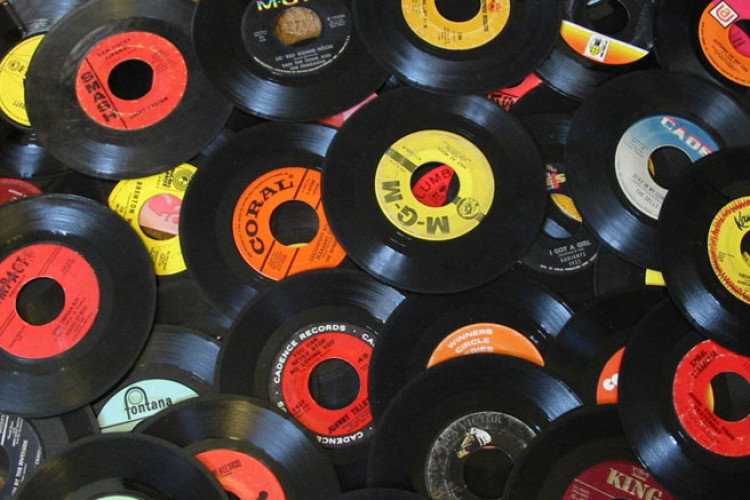
Music collecting is an addictive activity. There's a feeling of euphoria when you unexpectedly find a record whose music enjoy, and digging through dusty crates as well as meeting people in shops, markets, and homes is an experience valuable in itself. Collecting is alive and well in Indonesia, with a large number of people noticeably taking interest in collecting records, cds and tapes. Wahyu "Acum" Nugroho, who you may recognize as the bassist of Bangku Taman, is an avid vinyl record collector who has started a project called Gila Vinyl. The project, which currently takes the form of a website, has Acum sharing his experiences looking for records, as well as tips for other collectors. Most recently Acum wrote a post of his vinyl hunting in Bali - rummaging through a warehouse, shops, and visiting a collector's home. The stories in Gila Vinyl gives you an idea of what its like to look for records in Indonesia. The narrative personal and often humorous, making browsing the site an easy and enjoyable affair. Looking forward to seeing what sort of adventures Mr. Nugroho will experience in his quest for vinyl records.

Available in Uniqlo stores worldwide are these Uniqlo Tees (UT) featuring designs by our favorite children's wear: Cereal Nation! With art directions by Max Suriaganda of Studio 1212, the 3 Cereal Nation designs you see above (click the left or right button to scroll) are available in adult sizes as well as children. If you live in the Jakarta area, you can find the tees and a whole lot more in Lotte Mall as well as Mal Taman Anggrek (which has the first Uniqlos in Indonesia). If you do not have a Uniqlo in your area, visit uniqlo.com to view their graphic tee collection including the Cereal Nation designs.
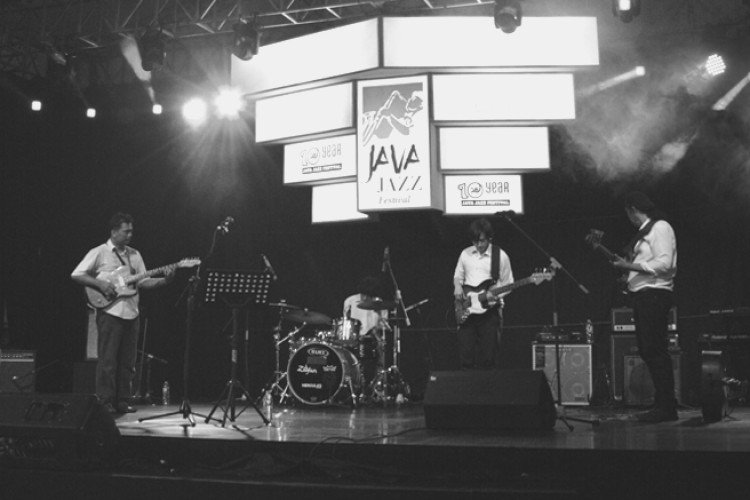
Despite our best efforts, Bergas and I only managed to attend the last day of the 10th annual Java Jazz Festival held at the Jakarta Convention Centre in Kemayoran. And to be quite honest, it was perhaps just as well that we only attended that particular day, as for the most part the selection of artists that performed on the Friday and Saturday were for us as bland as a steamed cucumber resting on a plate of boiled rice. Sure, there were sporadic injections of exciting local talent such as Tomorrow People Ensemble, the Barry Likumahuwa Project, Sandy Winarta, Indra Lesmana and a few other notable gems, but who would want to travel up to North Jakarta, struggle for hours on end to find a decent parking spot, pay over-the-odds for overpriced food and drinks only to be served some Agnez Mo, JKT 48, Dave Koz and Maliq & D’Essentials? Well perhaps more open-minded individuals would, but alas both Bergas and myself are insufferable jazz and music snobs. Moving on and to tone down the cynical rhetoric, we specifically chose the Sunday as it hosted the performances of the legendary Roy Ayers and the much-loved hero of left-field soul-jazz, the Robert Glasper Experiment. Conveniently for us, both performed on the same stage with only 75 minutes separating the two performances. Thus without further ado, the write-up below will dissect those two anticipated performances in greater detail. The name Roy Ayers glowed like a pair of cat’s eyes illuminated by a car’s headlights when I first saw his name on the list of performers. This virtuoso vibraphonist was responsible for pioneering a particular funky strain of jazz that has left its unmistakable mark not only in the world of jazz but also disco, hip-hop, house and beyond. He started his performance at 6pm in front of an eager and highly expectant crowd. No sooner had the announcer read out his name, a great cheer reverberated around the A2 BNI hall and DJ (Total) Eclipse from the X-Ecutioners took to the stage to provide a 15-minute lesson in funky breaks and head-nodding turntablism. And just when you thought he was there simply as an opening act, you realise that there were no drum kits present onstage, signifying that the turntables were also there to stand in as the rhythm section. While I’m an avid fan and champion of DJ-ing and turntablism, I feel that this decision slightly diluted the overall performance of the band as it limited the freedom of movement and improvisation of the drums, piano and bass. When Mr. Ayers finally entered the stage to a ruckus cheer, he was accompanied by a saxophonist (playing both the alto and soprano variants) as well as a backing singer (and part-time percussionist). For the most part the performance was a recital of Roy Ayer’s greatest and funkiest hits, prompting the crowd to join-in a number of enjoyable sing-alongs throughout the gig. One notable highlight of the evening was when Roy’s electric vibraphone malfunctioned to hilarious consequences. Bereft of the star performer who was busy shuffling back-and-forth trying to figure out what on earth went wrong, the soloing responsibility lay on the saxophonist who churned out solo after mesmerizing solo. After 20 vibraphone-less minutes, the electric-vibraphone gods (or perhaps the engineer) managed to set things right and Roy duly delivered head-spinning solos much to the delight of the crowd and served as a fitting end to the memorable 75-minute performance. And then there was Robert Glasper and his band of merry cats. While I’ve already witnessed his band’s mesmerising performance in Amsterdam a couple of years back, this year’s edition was no less impressive with the presence of a near complete line-up with enigmatic drummer Chris Dave the only absent member. Before the Robert Glasper Experiment took to the stage, a certain Allen Stone -a bloke who I’ve never heard of before- was in the middle of completing the last 20 minutes of his performance at the adjacent stage. And for the record, it was quite outstanding. He may look like a Nordic hippie, but there aren’t any doubts as to his fantastic vocals that have seem to be dipped in the proverbial . His set opened with the frankly perplexing award with an obscure title handed out to him by the organisers of the event. Mr. Glasper was almost at a loss of words during his acceptance speech (though most likely due to being genuinely confused as opposed to being overwhelmed by the occasion). As soon as the mini award ceremony was over and done with, the band kicked into gear with their brand of soulful modern jazz that drove the young-ish crowd into a frenzy. Every single band member was on top of their game with vocalist/saxophonist Casey Benjamin leading the line with his vocoder-filtered soulful vocals and absolutely intense sax soloing. True to form, the Robert Glasper Experiment played a mix of their original compositions along with a selection of covers that only vaguely resembled their originals, including Bill Withers’ Lovely Day, Frank Ocean’s Pyramids, Daft Punk’s Get Lucky and Nirvana’s Smells Like Teen Spirit Another notable aspect of the performance was the sheer brilliance of the band members, from Robert Glasper’s piano playing, Casey Benjamin’s sax solos, Derrick Hodges’ funky yet melodic bass playing and the drum-machine like punctuality of the drummer whose name escapes me. When their performance came to and end the crowd were pleading for an encore (or two) yet Mr. Glasper politely declined, citing tight scheduling from the organisers as a reason. All things considered, it was a very enjoyable performance from the two acts we watched with my only gripe being the lack of seats provided for Robert Glasper’s performance (as their brand of music doesn’t particularly evoke dancing, hence being more suited to a sitting crowd). As far as the festival was concerned, it was a shame that there were no slots afforded to the living legends of jazz such as Ornette Coleman, Pharoah Sanders or Sonny Rollins, especially considering that this was the 10 anniversary of the festival. Yet as far as adhering to the tagline of ‘Bringing The World To Indonesia’, I feel that the Jakarta International Java Jazz Festival 2014 just about lived up to its promise. Here’s looking forward to next year’s edition.

The Internet is a blank canvas that invites creativity in content and presentation. For businesses, it is a medium with a potential global market, and for individuals a means to express their unique identity and influence. The web applauds innovation in design, whether it is the visual interface or the programming. Zocko, a website combining social media, e-commerce, and social influence, entered the virtual arena celebrating the malleability of the Internet and the individuals have brought to the medium through its reward system. In brief, individuals can recommend an assortment of products available in Zocko to their audience, whether it’s through the person’s social media or blogs, and when the item is purchased the recommender earns money. The system is an innovative means to encourage an active participation on the Internet. The plethora of items on Zocko ensures that people can customize a specific selection of items according to their tastes. One can now confidently endorse without a second thought, creating an honest and rewarding experience. The products, of course, are only a small part of the equation. The most important element is without a doubt: . We follow personalities because we trust their creative and consistent character. They offer perspectives that are intriguing, helping us appreciate a subject from different vantage points. This individual creativity is what Zocko stresses as the driving force of the colorful word wide web. Offering their personal support, the Zocko team welcomes interested parties to consult with them to find the best way to use the Zocko platform and earn its rewards. Some are already using creative methods in adapting the reward system – using creative writing or picture editing. There are seemingly infinite ways to express oneself on the internet, and Zocko want to make sure you find yours. Maximizing creativity is key, because it is what makes the online experience so rewarding. To contact or find out more about Zocko, follow these links: www.Zocko.com Zocko Twitter Zocko Facebook

Tahun ini Grrrl Gang mendapatkan kesempatan untuk menjadi salah satu line up di We The Fest 2019, dan Vindy diperbolehkan untuk mengikuti aktivitas mereka.