

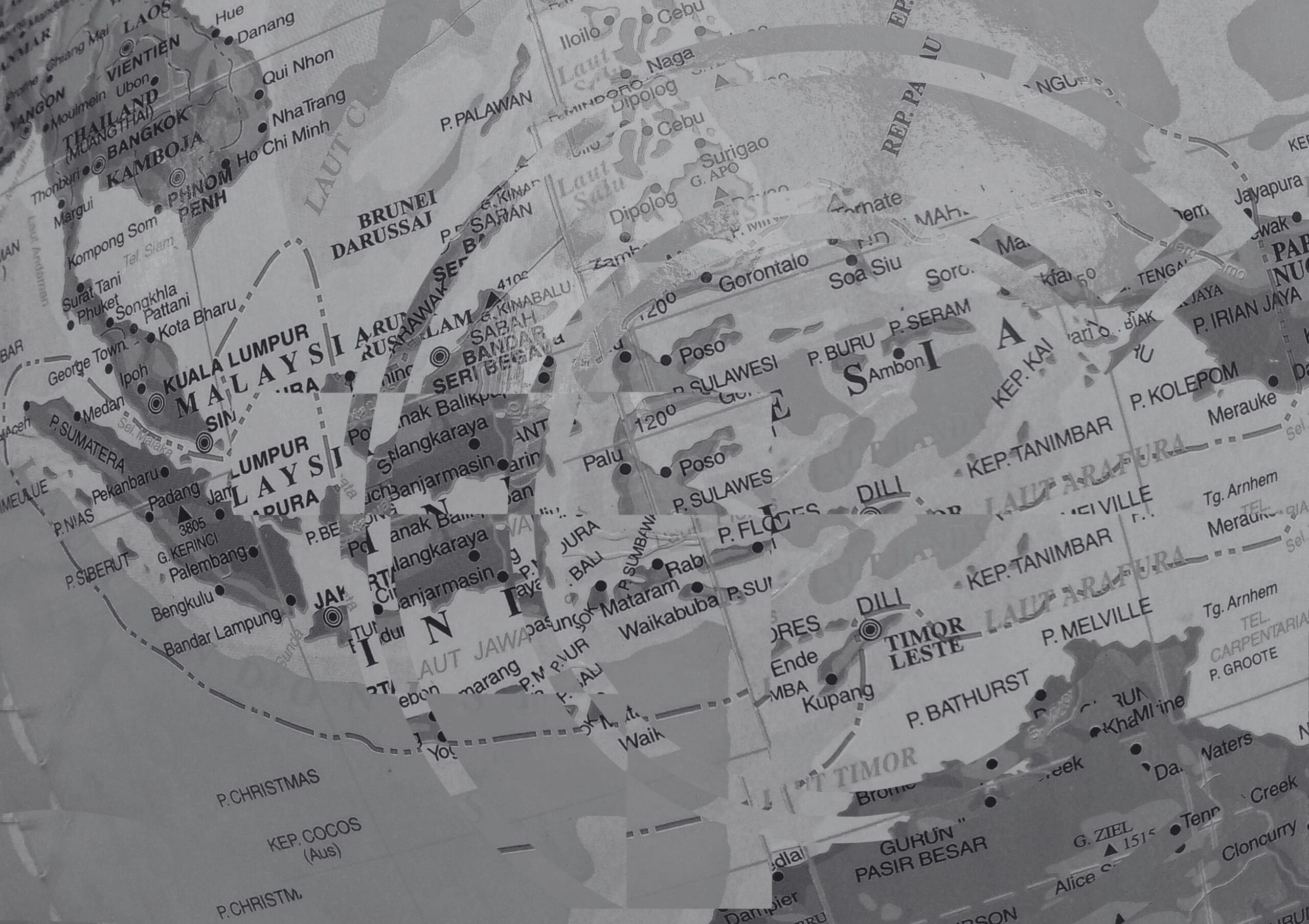


Tuning the Nation to its Native Sound: National Anthem and the Empty Promises of Nationalism
In this Open Column submission, Radit Mahindro contends how a nation’s anthem can try tuning itself to its natural waves, winds, and geographic scales as a way to honour reality – a more honest way to ‘evoke the sensation of being in Indonesia’ and its diverse landscapes.

Words by Whiteboardjournal
If we have ever watched an international athletic competition or a global summit, we have likely noticed a curious pattern when the medals are handed out. As the flags go up, the music begins. But if we close our eyes and focus entirely on the sound, something specific happens. The distinct character of each nation dissolves into a singular musical language. Almost every national anthem on Earth relies on the same sonic template: crisp brass fanfares, swelling string sections, rigid rhythmic tempos, and predictable Western major scales.
Whether the country is located in the high Andes, the tropical river basins of West Africa, or the islands of Southeast Asia, its official song often sounds like it was composed in a 19th-century European conservatory. We have grown so accustomed to this sound that we rarely question it. We accept the European classical march as the natural soundtrack of statehood.
But when we think about it, this is a mind blowing administrative oddity. A country’s food, language, architecture and even coat of arms might be entirely unique, yet its most sacred musical signature is borrowed from a distant continent!
Moving Beyond the March
To understand how we arrived at this uniform acoustic landscape, we have to look back at how the modern state model spread across the globe.
During the 19th and 20th centuries, as old empires shifted and new nations declared their independence from European colonisers, leaders looked for ways to assert their sovereignty on the global stage. At the time, European classical music was considered the standard language of institutional weight. To be taken seriously by global powers, a new state needed the proper “formal attire”. This meant a constitution, a flag, and a song that could be played by a standard Western military brass band when foreign dignitaries arrived.
Because of this historical timing, almost all national anthems inherited a distinct military tone. They were designed to evoke abstract national pride, defence of motherland and borders, victory, and even combat. In today’s interconnected world, however, this focus on conflict and martial discipline can feel a bit intense, and perhaps, unnecessary. When a peaceful international meeting opens with a brass cadence, it can occasionally feel less like a welcoming ceremony and more like John Williams conducting the arrival of Darth Vader on Coruscant or Mustafar. While the Imperial March is undoubtedly a masterpiece of cinematic orchestration, most modern societies are looking to share a narrative of world peace rather than galactic takeover. Modern nations do not need songs that prepare them for battle; they need music that evokes a sense of togetherness.
The traditional concept of nationality itself, built on rigid borders and state pride, is showing its age. A more meaningful approach shifts the focus away from abstract state ownership and toward the physical landscape, regional cultural identity, and surrounding biodiversity. This grounded perspective is already written into the DNA of how humans naturally make music. Across the globe, traditional folk songs rarely spend time singing about abstract regional identity. Instead, both their lyrics and melodies mostly pay tribute to the natural environment and the organic patterns of shared living, celebrating the protective warmth of motherhood, the rhythms of the fields, and the deep connection and gratitude found in sharing a simple meal or a festive moment.
A national anthem can be an invitation to share a space of mutual respect for the earth rather than a display of bureaucratic power. We can find inspiration for this in Central African communal chants, where music is not about marching in lockstep to a single drum, but about layering voices to build collective strength and warmth.
The Freedom of the Vernacular Scale
Honouring native musical traditions does not require a rigid, puritanical approach. It does not mean we must discard global instruments or pretend that history did not happen. The true soul of a musical tradition lives within its internal logic, its melodic patterns, and its scales, rather than the physical object making the sound.
The Hungarian composer Béla Bartók demonstrated this beautifully. He held a deep respect for Balinese music and successfully channeled the essence of Balinese music through a completely Western instrument: the piano. In his famous collection Mikrokosmos (specifically Volume 4, Number 109, titled “From the Island of Bali”), he captured the interlocking rhythms of Bali through piano without using a single piece of Balinese gamelan metal.
We can also look to South America for another brilliant blueprint of this open-minded philosophy. In the late 1960s, Brazil’s Tropicália movement showed the world how to champion regional identity without trapping it in a museum. Instead of retreating into isolation, musical forces like Caetano Veloso, Gilberto Gil, Gal Costa, and the avant-garde rock of Os Mutantes mixed global modernism and electric instrumentation with traditional Brazilian vernacular rhythms and sharp, expressive lyricism. They proved that a nation can absorb outside tools and contemporary frequencies while remaining completely rooted in its own soil.
Icelandic musician Björk explored this deep connection between geology and geography with sound in her own work. She famously crafted her album Homogenic to reflect the volcanic, raw energy of Iceland, while her later album Vespertine was designed to evoke the island’s serene frozen spaces and delicate-tactile snowy landscapes. She did not need a military march to describe her home; she used electronic beats and sonic textures to mimic the very ground she walked on.
This means that an updated national anthem for a country like Indonesia does not have to reject modern instruments.
Theoretically, the anthem could be played on a grand piano, by a classical string quartet, by an acoustic guitar ensemble, or uses pulsing ambient beats while still sounding completely native. The magic lies in the tuning and the framework.
The Archipelagic Symphony
Nowhere is the potential for this musical update clearer than in our country Indonesia. Indonesia stretches across 17,000 islands and three time zones, creating a vast network of human societies, languages, and distinct environments. Yet, the national anthem, Indonesia Raya, follows the classic European trajectory. It is a stirring, dignified march composed using Western notation and standard intervals. It is a song that holds a deep place in history, but it represents only a small window of the nation’s total historical, geographical, and acoustic capacity.
If Indonesia were to look to its regional cultures for inspiration, it would find a massive, polyrhythmic environment where music has always been used to manage the rhythm of daily life, agricultural cycles, and coastal navigation.
Instead of choosing one island’s music over another, an updated national anthem could be designed as a fluid, modular composition that reflects this shared geography.
To build a national song inspired by this landscape means embracing an electrifying way of thinking about sound. In Sumatra, the music leaps forward with the lightning-fast, syncopated conversations between Gondang drums and Talempong kettle gongs. Move toward the dense river systems of Kalimantan, and the sound transforms into the hypnotic, resonant plucking of the Dayak sape, which mimics the wind moving through giant trees.
Furthermore, the lyrics could leave behind old ideas of national pride or rivalry, choosing instead to talk directly about the living world.
In the sun-wrenched landscapes of Nusa Tenggara, the sasando creates intricate, cascading melodies from simple palm leaves and wire, sounding like fresh water running over stones. Further east in Papua, the music connects directly to the soil through the deep, thunderous pulse of the tifa drum, accompanied by raw vocal harmonies that echo across the ancient canopy.
By taking inspiration from these diverse elements (the sound, instrumentation, and beats), the national anthem could represent the country’s dazzling landscapes and colourful-electrifying cultural spectrum. The rhythm could naturally reflect the physical movement of the surrounding sea, weaving the steady percussion of the outer islands with the bright, interlocking bronze melodies of the centre, all framed within open, native scales like pelog or slendro.
Furthermore, the lyrics could leave behind old ideas of national pride or rivalry, choosing instead to talk directly about the living world. The verses could celebrate the volcanic peaks, deep ocean trenches, and thick rainforest canopy that define the archipelago. Such a song would feel deeply familiar to an island society, matching the natural cadence of regional languages and the physical atmosphere of the environment. Ultimately, the national anthem becomes a living piece of storytelling designed to evoke the sensation of being in Indonesia, of moving through its diverse landscapes and being welcomed by the warmth and genuine hospitality of its people.
Sounding Like Ourselves
Stepping away from borrowed European musical frameworks is not a rejection of the wider world. It is simply an act of creative honesty. When we look at the designs, spaces, and stories that move us today, they are almost always the ones that are secure in their own identity. They do not try to look or sound like an imitation of something else; they draw their strength from the specific reality of their home.
Updating national songs to reflect our true musical vernacular is a wonderful way to honour that reality. It allows us to move past the rigid formulas of the past and step into an acoustic future that feels fresh, honest, and filled with a sense of shared belonging. For an archipelago like Indonesia, tuning the national song to the frequency of its own waves, winds, and native scales would be a beautiful reminder of who we are. It ensures that when we sing of our home, the music itself sounds exactly like the place we love.

Radit Mahindro
Currently serves as the Senior Marketing + Commercial Director at Potato Head. In 2020, alongside Balinese art director and gallerist Krisna Sudharma, he co-founded Paras, an online platform dedicated to documenting tourism destinationism in Bali. He launched his 336-page book, Paras: Documenting 100 Years of Hospitality and Hotel Architecture in Bali, in 2025. Radit has previously worked with and consulted for Alila, Aman, Begawan, Regent, Soori, Space Available, and Tandjung Sari, among others. In his spare time, he shares stories through publications such as Travel + Leisure Asia, Manual Jakarta, the Whiteboard Journal, and Eastside Asia, documenting how design and travel reflect the wider culture and society vice-versa. instagram.com/raditmahindro/

yeule Merilis Single “inferno” sebagai Bagian dari Upcoming Album Penuhnya
Part IV: Four Feet

Proyek Duo Lintas Benua, Filastine & Nova Mengumumkan Proyek Baru, Kali Ini Bukan Dalam Bentuk Musik, Tapi Perahu!
