

On Reclaiming Cultural Sovereignty, and Why We Don’t Need Foreign Validation
In today’s Open Column submission that happens to also be on National Culture Day, Radit Mahindro reminds us why we shouldn’t fall into the trap of modern urban taste and be dictated by its ‘deceptive’ standard measure of value and foreign expectations.

Words by Whiteboardjournal
Legendary architect Frank Lloyd Wright once joked that a doctor can bury his mistakes, but an architect can only advise his client to plant vines. He was being sarcastic, but he accidentally stumbled onto a fundamental truth: when top-down plans fail, nature and real human habits take over anyway. Vines grow over rigid walls. Culture is that vine.
When people talk about culture, they are often talking about this exact rhythm. Culture is the way a room is arranged to catch the afternoon breeze, the way a song changes depending on who is singing it, or how a recipe shifts slightly because a certain spice was missing from the pantry. It is an ongoing conversation between people, memory, and the environments they inhabit.
Yet, when people outside a culture begin to observe it, two strong impulses frequently take over. The first impulse is to polish the culture, modernising its edges so it looks smooth, stylish, and easily digestible on a global stage. The second impulse is to freeze the culture, placing it under a protective glass display where nothing is allowed to change, move, or breathe.
Both approaches come from a similar mistake. They treat living practices as static objects to be managed by outside planners rather than experiences owned by the people who live them. Finding a balanced path requires looking at culture differently, not as a product to be sold or an antique to be guarded, but as an active garden cultivated from the ground up.
Elevation and Foreign Interpreters
In contemporary conversations about craft, cuisine, textiles, and architecture across Asia, Africa, and Latin America, one word appears with remarkable frequency: elevate. We hear about the need to “elevate” traditional street food into fine dining, to “elevate” handwoven textiles into international luxury fashion, or to “elevate” village carpentry into high design.
While the intention behind this word is often well-meaning, the vocabulary reveals an underlying complex of cultural inferiority. To say that a traditional practice needs to be elevated implies that it is currently sitting on a lower floor. It suggests that a traditional clay pot, a home-cooked sambal, or a hand-loomed batik is somehow insufficient in its native form, and only gains true value when refined by Western techniques or presented inside a five-star hotel lobby.
Reflecting on the beginning of his career, the late Indonesian interior designer Jaya Ibrahim noted: “I remember in the beginning, I went to a big hotel and noticed all the designers were foreigners. And this is one reason why I decided to get into this. I thought ‘I can do this too’… they’re busy interpreting Asia, which is quite interesting.”
Jaya Ibrahim’s quiet irony points to a recurring pattern. For decades, international hotel chains and luxury brands have hired foreign experts to interpret Asian, African, or South American architecture for global travellers. These outside designers take local motifs, strip away their ceremonial meanings, and repackage them into polite, comfortable decor. The local culture is treated as raw material waiting for a foreign hand to refine it — Jaya was eventually ranked in 2002 by Architectural Digest as one of the top 100 interior designers and architects in the world.
Culture thrives when people feel at ease in their present reality, supported by the memory of where they came from and confident in their right to shape where they are going.
This refusal to beg for outside validation echoes a famous encounter involving jazz trumpet legend Miles Davis. During a formal dinner at the White House, First Lady Nancy Reagan, who did not recognise him, asked why he was invited and what he had done to deserve being there. Straight-faced, Davis, known for talking very economically, calmly replied: “Well, I’ve changed the course of music five or six times. What have you done except fuck the president?” Davis had zero patience for gatekeepers who assumed they held the keys to cultural value.
Moroccan chef Najat Kaanache has expressed similar frustration regarding the culinary world. She points out that non-Western food is routinely categorised as cheap street food until a chef trained in European techniques applies tweezers to a plate. Kaanache argues that ancestral cooking methods, complex spice ferments, and slow-fire techniques developed over centuries are already at the highest level of culinary sophistication. They do not need a foreign stamp of approval to be valid.
Musician and thinker David Byrne observed the same pattern in how global music is categorised by the music industry. He noted: “I hate [the term] ‘World Music’ because it is a way of discounting a band or artist’s originality… It’s a convenient catchall for anything that isn’t white pop music.” The global market tends to accept non-Western music primarily when it fits familiar pop structures or serves as a pleasant background texture. In doing so, the intricate social meanings, ceremonial contexts, and distinct tunings of those songs are quieted down to ensure they do not discomfort the listener. Trying to separate music into neat boxes of global pop versus folk history misses the point entirely.
The assumption remains widespread that modern urban taste is the standard measure of value, and that traditional knowledge must earn its keep by conforming to that standard.
Beautiful Views and Living Museums: Mooi Indie and Baliseering
The impulse to reshape local culture to satisfy foreign expectations is not new. In Indonesia, this phenomenon has deep historical roots in two colonial policies: Mooi Indie in visual art, and Baliseering in cultural administration.
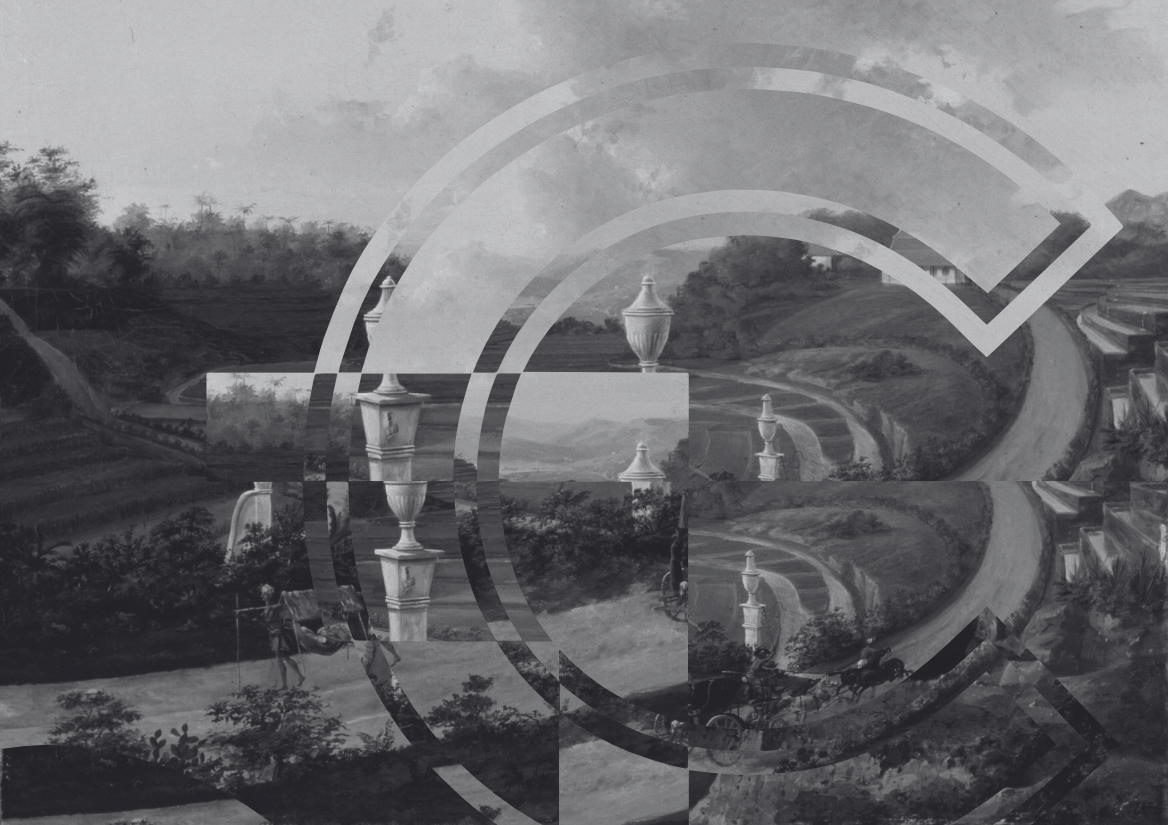
In the early twentieth century, colonial patrons favoured a genre of painting known as Mooi Indie, or the Beautiful Indies. These paintings consistently featured peaceful landscapes with bright blue volcanoes, palm trees, calm rice fields, and smiling villagers in neat traditional attire. The painter S. Sudjojono fiercely rejected this style in the 1930s.
Sudjojono insisted that real art must be jiwa ketok, which translates to the visible soul. He argued that painting should reflect the genuine conditions, hard work, sweat, and inner struggles of the people, rather than offering a pretty postcard image to satisfy foreign tourists and colonial officials. Mooi Indie stripped away human reality to sell a pleasant visual escape.
A parallel policy took place on the island of Bali under the Dutch colonial administration during the 1920s and 1930s, known as Baliseering, or Balinisation. Fearing that modern political ideas, nationalism, or anti-colonial movements might spread to Bali, Dutch officials deliberately enacted policies to freeze Balinese society in a romanticised, pre-modern bubble.
They restricted modern Western education, limited industrial development, and strictly regulated outside religious influences. Bali was presented to the world as an untouched, idyllic paradise of dancers, temples, and artisans, a living museum preserved for European travellers. While presented as a gesture to protect local heritage, Baliseering was an act of political control. It stripped Balinese people of their right to participate in modern political life, turning an entire living society into a static cultural performance.
Today, this colonial legacy has evolved into a sophisticated, high-end travel industry product: the curated village immersion, or what critical sociologists call the poverty tour.
Sociologist John Urry introduced the concept of the tourist gaze, explaining how travellers consume landscapes, environments, and human subjects as visual spectacles constructed by expectations. Building on this, sociologist Dean MacCannell analysed staged authenticity, showing how tourism networks construct artificial, controlled glimpses into “authentic local life” to satisfy wealthy travelers seeking an escape from modern boredom.
In contemporary ultra-luxury travel, this manifests in a deeply grotesque way. Affluent guests pay thousands of dollars a night at secluded retreats, only to be driven in SUVs to a nearby rural village for an organised morning walk. They photograph elderly women weaving baskets on dirt floors or farmers plowing fields with oxen, marveling at the simple, timeless authenticity of it all.
Unconsciously, this voyeuristic gaze imposes a silent, predatory demand onto the villagers: “Please stay primitive, because if you build a concrete house, install air conditioning, buy a tractor, or pick up a smartphone, you ruin our holiday aesthetic and our sense of exotic escape.”
Rural hardship is romanticised as cultural purity. The moment a local community improves its material living standards, the luxury market accuses them of losing their soul or becoming spoiled by modernity. It is the ultimate exercise in hypocrisy: wealthy travelers enjoying every modern comfort while demanding that rural populations remain frozen in picturesque poverty to serve as a living backdrop for their vacations.
Freezing culture in a glass case creates an impossible test of authenticity. Anthropologist Johannes Fabian termed this tendency the denial of coevalness, describing the habit of placing traditional societies into a historical past, denying them presence in the modern world.
Gardening, Not Architecture
Breaking free from both market sanitisation and museum freezing requires a fundamental shift in perspective. A useful way to visualise this shift comes from musician and visual artist Brian Eno, who proposed a distinction between the mindset of an architect and the mindset of a gardener.
Eno noted that traditional architects tend to plan everything from the top down. They draw precise blueprints, specify every material, and expect the final structure to remain exactly as designed indefinitely. A gardener, on the other hand, works from the bottom up. Gardeners prepare the soil, plant seeds, provide water and sunlight, and then step back to allow organic growth to happen. The gardener does not control the precise shape of every leaf; they create the conditions for life to flourish.
When applied to cultural evolution, Eno’s concept reveals why top-down management fails. Both the moderniser and the museumkeeper act like top-down architects. The moderniser tries to redesign culture to fit a commercial blueprint. The museumkeeper tries to construct a rigid glass wall around it.
On the other hand, the gardener approach recognises that culture is a living ecosystem. The primary task is to care for the soil, which consists of ancestral memory, land relations, core values, and community agency. As long as the soil remains healthy, the plants will grow new branches, leaves, and flowers that respond naturally to current weather conditions.
Examples from Around The World
Chef Sean Sherman, an Oglala Lakota cook who has spent years studying native food systems in North America, addresses this issue directly in his culinary work. He refrains from treating native ingredients as historical reenactments. Instead of creating a museum exhibit of old recipes, he uses traditional plant knowledge and ancestral harvesting techniques within a contemporary kitchen setting. He points out that native food systems were never static. Native cooks always adapted to new climates, shared seeds across regions, and invented new techniques. Freezing native cooking in a specific century strips it of its intelligence and reduces a flexible culinary philosophy to a historical costume.
In Sri Lanka, architect Geoffrey Bawa demonstrated an approach often called Tropical Modernism. He did not spend his time writing manifestos about identity. Instead, he walked site locations, studied how rain flows across a hill, looked at local clay roof tiles, and paid attention to how Sri Lankans like to lounge in shaded verandas during hot afternoons.
Bawa’s buildings feature clean concrete lines, open courtyard spaces, unpainted timber columns, and lush indoor gardens. He mixed local materials with modern structural engineering without any trace of self-consciousness. His spaces do not look like historical Sri Lankan palaces, nor do they look like glass towers imported from Europe. They feel completely comfortable in their own skin.
Bawa famously remarked that architecture cannot be made on paper alone. It must be lived, built from the terrain, the sunlight, and the simple way people sit together over tea. His work succeeds because he stopped worrying about whether his buildings looked sufficiently modern or sufficiently traditional. He focused on making good spaces for living, allowing Sri Lankan climate and habits to shape the design naturally.
Indian architect Balkrishna Doshi expressed a similar thought regarding spatial design and traditional forms. Doshi observed: “Tradition is not a static memory of the past, but the continuous stream of life itself. Architecture is a backdrop for living, and if life changes, the backdrop must accommodate those changes without losing its soul.”
Doshi resisted the temptation to copy ancient temple shapes or historical archways just to make a new building look traditional. He understood that true continuity lies in how people move through space, how light enters a room, and how family life unfolds across generations. Attempting to force modern people to live inside historical replicas creates discomfort rather than connection.
The Italian-born Brazilian architect Lina Bo Bardi took a similar stance when designing public spaces in São Paulo. When working on the SESC Pompéia, a converted factory transformed into a centre for recreation and culture, she refused to create a formal museum or a polished performance hall. She remarked that culture should not be treated as a collection of prestigious events to be displayed in expensive showcases. Instead, she viewed culture as the everyday activity of ordinary people, people playing chess, eating lunch, making pottery, or lounging in the sun. For Bo Bardi, stripping away the social life of a space to make it look grand or refined destroys the reason the space was built in the first place.
Bangladeshi architect Marina Tabassum puts this gardening philosophy into direct physical practice. Designing the Bait Ur Rouf Mosque in Dhaka, Tabassum did not copy foreign Ottoman domes or import expensive decorative marble. Instead, she used locally fired red clay bricks, building a porous structure that harnesses natural air currents and sunlight. The building keeps worshippers cool in intense humidity while creating a quiet space for daily gathering.
Tabassum insists that architecture must grow directly out of its immediate climate, land, and local labor realities. Her building does not attempt to impress global critics or state ribbon-cutters. It serves the daily spiritual life of its neighbourhood using the earth beneath its feet.
In China, architect Wang Shu and his partner Lu Wenyu of Amateur Architecture Studio practice a form of spatial gardening. When designing the Ningbo History Museum, Wang Shu collected millions of recycled bricks, roof tiles, and elements from demolished traditional villages across the region. Instead of rebuilding old houses or designing a sleek glass tower, he used those salvaged materials to construct a bold, contemporary building.
The walls of the museum contain centuries of varied masonry traditions, layered together by craftsmen using their own hands and instincts. Wang Shu explains that architecture should be like a tree that grows out of the earth, rooted in what came before while offering shade to the people standing beneath it today. The building is distinctly present-day, yet its skin carries the physical memory of the land.
In 1920s Brazil, visual artist Tarsila do Amaral proposed a parallel strategy for visual art through the Antropofagia, or Anthropophagy, movement. Rather than rejecting foreign ideas or copying them blindly, Amaral advocated for symbolic cannibalism: Brazilian culture should devour foreign artistic influences, digest them through local memory, and transform them into something entirely new. Her painting Abaporu used bold colours and exaggerated figures to forge a visual language rooted in Brazilian light, land, and narrative.
In Mexico, architect Luis Barragán built spaces that achieved a similar quiet depth. Barragán avoided copying historical ornament, choosing instead to focus on light, color, water, and wall textures. He wrote: “Any work of architecture that does not express serenity is a mistake. Tradition is a living inner light, not a costume you put on to look old.”
Barragán’s work proves that a space can feel rooted in its territory without relying on historical tricks. By paying attention to how sunlight falls on a plain plaster wall or how water sounds in a small courtyard, his designs remain deeply connected to Mexican life while speaking a clear, uncomplicated language.
The Indonesian Perspective: Guna, Citra, and Trikon
Indonesian thinkers have long explored how to navigate external influences while maintaining a clear internal centre. Two key frameworks provide practical guidance for achieving this balance: Y.B. Mangunwijaya’s concept of Guna and Citra, and Ki Hajar Dewantara’s principles of Trikon.
Y.B. Mangunwijaya, an architect, writer, and Catholic priest affectionately known as Romo Mangun, spent much of his life working alongside riverbank residents and rural villagers. He cautioned against treating tradition as an ornamental shell. In his writings on design and human dignity, he separated form into two dimensions: guna (utility and function) and citra (image, spirit, and human meaning).
Romo Mangun pointed out that modern technology and global communication naturally push practical tools (guna) toward universal formats. A bicycle, a computer, or a water pump functions similarly anywhere in the world. However, human meaning (citra) springs from local life, personal relationships, and spiritual grounding.
This is precisely why government municipal offices love slapping a traditional roof gable onto a twelve-story concrete office building. It allows bureaucrats to check an official local identity box on a budget without having to care about natural ventilation, local labour, or actual human comfort inside. Slapping a traditional wooden roof onto a steel skyscraper does not preserve tradition; it creates a confused object.; it simply creates a confused object. Real cultural continuity happens when people use available tools to solve current problems while ensuring the final result honours the dignity, warmth, and spirit (citra) of the people using it.
Long before Romo Mangun, Indonesian educational pioneer Ki Hajar Dewantara established the Asas Trikon (The Three-C Principles) to guide how a culture (and education) should interact with the wider world. The three principles are:
1) Kontinuitas (Continuity): A culture must evolve along a continuous line from its own history. Growth should proceed step by step from established roots rather than cutting ties with past knowledge to follow foreign fashions.
2) Konvergensi (Convergence): A culture should open its windows to foreign ideas, universal science, and shared human knowledge. It does not hide in isolation, but meets the rest of the world to exchange gifts.
3) Konsentrisitas (Concentricity): While exchanging ideas with the world, a culture must remain anchored to its own centre. It stands as its own distinct circle alongside other world cultures, rather than becoming a distant moon revolving around someone else’s planet.
The Trikon framework provides a clear test for any new initiative. If they adopt global tools while staying connected to their own roots (Kontinuitas) and maintaining their own centre of decision-making (Konsentrisitas), the result is genuine growth. If they abandon their roots to adopt a global style simply to gain external approval, they lose their centre and slide into assimilation.
Living Sovereignty in Everyday Choices
The middle ground between the market polish and the glass display is not a static point on a line. It is a daily practice centred on cultural sovereignty, which simply means the power of a group of people to decide their own path.
When an indigenous hip-hop group raps in their native language over modern drum loops or heavy metal distortion, they are not corrupting their culture, nor are they performing for foreign curiosity. They are using available tools to tell their current stories. The decisions about what to share, what to adapt, and what to keep private belong entirely to the musicians and their elders.
Similarly, when a neighbourhood cooking collective serves traditional dishes using modern kitchen equipment, they do not need to prove their authenticity to anyone. The food tastes good, the ingredients respect the soil, and the meal brings people together around a shared table. That is more than enough.
Culture thrives when people feel at ease in their present reality, supported by the memory of where they came from and confident in their right to shape where they are going. There is no need to dress up everyday practices to impress an external judge, nor is there any reason to apologise for using a modern tool to make daily life a little easier. Culture will remain like a stubborn weed pushing through concrete: completely indifferent to the government’s and investors’ high-class tourist targets and infinitely smarter than an illiterate doomscrolling crowd that never reads past the headline.
Closing this writing is the song Strange Ritual by David Byrne. Its lyrics reminds me of a travelogue from an outsider or an eccentric anthropologist who mentally pans across the globe, observing disconnected snapshots of human life, juxtaposing corporate loops, forgotten towns, and isolated routines—feels like an ever-evolving hypnotic ritual we are all trapped in without fully understanding why: “Saw people in a remote village proudly wearing their digital watches. Saw a young Indonesian girl possessed by the spirit of Mutant Ninja Turtles…”
Selamat mengobservasi Hari Kebudayaan Nasional!

Radit Mahindro
Currently serves as the Senior Marketing + Commercial Director at Potato Head. In 2020, alongside Balinese art director and gallerist Krisna Sudharma, he co-founded Paras, an online platform dedicated to documenting tourism destinationism in Bali. He launched his 336-page book, Paras: Documenting 100 Years of Hospitality and Hotel Architecture in Bali, in 2025. Radit has previously worked with and consulted for Alila, Aman, Begawan, Regent, Soori, Space Available, and Tandjung Sari, among others. In his spare time, he shares stories through publications such as Travel + Leisure Asia, Manual Jakarta, the Whiteboard Journal, and Eastside Asia, documenting how design and travel reflect the wider culture and society vice-versa. instagram.com/raditmahindro/