




Why Disability Representation Has Become More Relevant Than Ever
In this Open Column submission, Jagardo Gabetorang Damanik jots down the facts that show how disability representation in Indonesia is a lot more urgent now, more so due to political leadership here that continues to be associated with ‘ideals’ that marginalize those who do not conform.

Words by Whiteboardjournal
According to Indonesia’s Coordinating Ministry for Human Development and Cultural Affairs, approximately 8.5% of the population consists of persons with disabilities. While this figure may appear statistically modest, it represents more than 23.6 million individuals, an entire population whose presence remains largely invisible, both socially and politically.
One could argue that the Indonesian government has made significant strides in recognizing the rights of persons with disabilities, particularly through the enactment of UU No. 8 of 2016 on Persons with Disabilities and the ratification of the UN Convention on the Rights of Persons with Disabilities (Adji, 2024; Asrianti, 2011).
However, such developments should not be understood purely as voluntary state initiatives, but also as the result of sustained advocacy and pressure from civil society groups. Despite these formal commitments, persons with disabilities remain largely excluded from political representation. As such, this raises a few critical questions about the substance of democratic inclusion in Indonesia.
Representation must not be understood as mere formal recognition of rights through legal instruments, instead it should be understood as to what extent marginalized groups are meaningfully empowered within political institutions. This argument can be better understood through Hanna Pitkin’s distinction between descriptive and substantive representation. While descriptive representation refers to the presence of representatives who share similar characteristics with those they represent, substantive representation emphasizes the active advocacy of constituents’ interests.
In the Indonesian context, the total absence of legislators with disabilities reflects a structural failure to achieve both forms of representation. Given that more than 23.6 million Indonesians live with disabilities, this absence is not incidental, but indicative of systemic barriers within the country’s political system.
The limited political representation of persons with disabilities can be understood through the institutional requirement that candidates must be nominated by political parties, as regulated under UU No. 7 of 2017 on General Elections. This requirement places political parties in a decisive gatekeeping position, where access to candidacy is filtered through organizational priorities that are often shaped by electoral viability and resource considerations. In practice, parties tend to favor candidates who possess financial capital, strong social networks, and high electability.
This dynamic, on its own, becomes problematic and particularly exclusionary when viewed in relation to the socio-economic conditions faced by many persons with disabilities. Structural barriers in education, employment, and public accessibility have limited their accumulation of economic and social capital; to elaborate further, according to the BPS (2025), only 2.69% of the total workforce consist of persons with disabilities. As a result, they are less likely to meet the informal criteria, such as social and economic capital, that political parties prioritize in candidate selection. This must be understood as a notion that it’s not persons with disabilities that lack political capacity, but rather the very social, economic, and structural conditions that disadvantage them.
Consequently, political parties operate within a framework that provides little incentive to recruit and promote candidates with disabilities. In an electoral environment that prioritizes competitiveness and resource mobilization, inclusion becomes secondary to strategic considerations. The absence of disability representation, therefore, is not merely a reflection of social stigma, but a product of institutional arrangements that align political access with economic capital.
To further understand why persons with disabilities lack political representation, we must also look beyond institutional barriers; the persistence of ableist assumptions within the political culture of Indonesia reinforces said exclusion. Political leadership in Indonesia continues to be associated with ideals of physical capability, productivity, and public presence, all of which implicitly marginalize those who do not conform to these norms. As a result, persons with disabilities are often constructed as subjects of welfare rather than agents of political authority. This framing limits their participation not only in electoral politics, but also in broader processes of agenda-setting and policy deliberation.
The implications of this underrepresentation are most visible in the way legislative functions are carried out. In the absence of meaningful representation, policymaking related to disability often lacks substantive grounding in lived experience. Laws and regulations may formally acknowledge the rights of persons with disabilities, yet fail to address the practical barriers they encounter in everyday life. For instance, Law No. 8 of 2016 on Persons with
Disabilities mandates that public institutions employ at least 2% persons with disabilities and private companies 1% (Lumbanrau, 2019). However, the implementation of this provision has been inconsistent, reflecting weak enforcement mechanisms and limited institutional incentives to ensure compliance (Ansori, 2025).
This weak enforcement cannot be separated from the absence of strong political representation for persons with disabilities. Without actors within legislative institutions who are able and willing to advocate for stricter oversight and sanctioning mechanisms, compliance tends to rely on voluntary adherence rather than binding enforcement. As a result, the lack of representation contributes to a policy environment in which legal obligations exist, but are not systematically enforced, reinforcing the marginal position of persons with disabilities in both the labor market and political sphere.
A similar pattern can be observed in the oversight and budgeting functions of legislative institutions. Without representatives who possess direct knowledge of disability-related issues, the implementation of inclusive policies is rarely subjected to rigorous scrutiny. Programs aimed at accessibility and social inclusion are often treated as secondary concerns or formalities, resulting in limited budgetary prioritization and inconsistent enforcement (Damarjati, 2023).
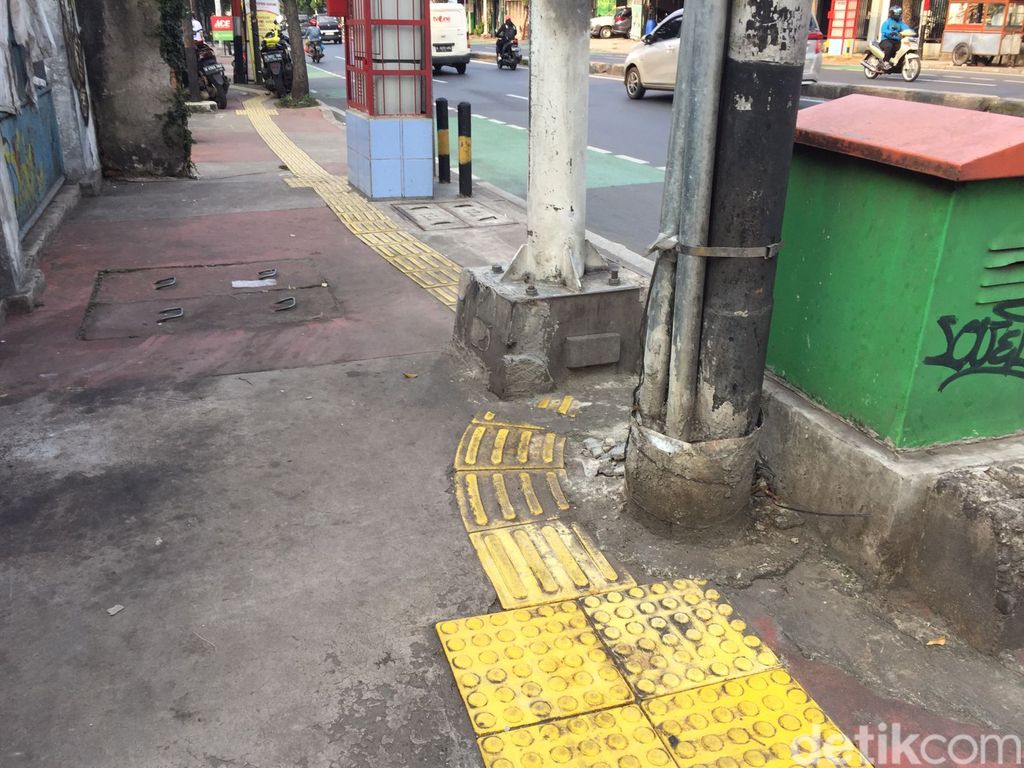
Guiding blocks for people with disabilities not up to standards (Fathia Nabila Qonita/detikcom)
The growing relevance of disability representation must be understood within Indonesia’s post-reform democratic trajectory. While democratization has expanded the authority of legislative institutions, particularly at the regional level, it has not been accompanied by a corresponding increase in inclusivity. Instead, existing patterns of exclusion have been reproduced, indicating that institutional expansion alone does not guarantee representational equality (Istiarsyah, 2026).
At the same time, the increasing prominence of inclusivity as a political discourse has created a paradox. Although inclusion is frequently invoked in policy narratives, its institutional realization remains limited. This deep gap between discourse and practice reveals that recognition is often limited to mere symbolism, rather than meaningful redistribution of political power.
The lack of disability representation in parliament carries concrete consequences. Without representatives who possess lived experience, legislative priorities often fail to reflect the actual needs of persons with disabilities, resulting in policies that are detached from implementation realities.
Moreover, the absence of such representation weakens oversight functions, as there are limited actors within parliament who can consistently advocate for enforcement and accountability in disability-related policies (Wicaksono, 2024). As a result, legal protections risk remaining procedural rather than substantive.
Ultimately, disability representation matters not only as a question of inclusion, but as a determinant of policy quality and democratic legitimacy. As democratic institutions expand and claims of inclusivity become more prominent, the continued exclusion of persons with disabilities becomes increasingly untenable, reinforcing the urgency of their very much needed political representation.

Jagardo Gabetorang Damanik
Jagardo Gabetorang Damanik is a Political Science student at Universitas Padjadjaran who is interested in how social and political structures shape everyday life, and how they often reproduce cycles of inequality.

To Fight, To Flight, or To Freeze?

Who, What, Why: Adhyatmika
Extinction Rebellion: Pembangkangan Sipil Untuk Iklim dan Ekologi
