

What if we lose the memory of the city that we live in?
In this Open Column submission, Fikri Izza unearths how sounds that resonate around and within an urban landscape may actually shape the city more than how we usually visualize it, and soundscapes might also be a method of safekeeping our memories of the city.

Words by Whiteboard Journal
When my grandmother slowly lost her eyesight due to glaucoma, everyone in my family assumed the house would become dangerous for her. We imagined hesitation, missteps, constant assistance. But something unexpected happened. She moved through the house with confidence. She knew who entered without being told. She sensed where people stood. She noticed when someone shifted from one room to another. She no longer saw the house, but she heard it. Through footsteps, through the direction of a voice, through the slight change of echo between the living room and the kitchen, she navigated space with precision. She was living inside its soundscape.
I did not have that word at the time. I only realized it years later, when I began working at the intersection of architecture, music, sound, and preservation. A soundscape is not simply noise; it is the acoustic environment as we experience it. It is the texture of a place made audible, the rhythm and density that shape how we move, gather, and relate. It is how a city breathes. Once I began thinking in terms of soundscape, I realized how much of our understanding of cities is shaped by what we hear rather than what we see.
We tend to describe cities visually. We talk about the skyline, façade, glass towers, density, aesthetics. Even when we speak of “atmosphere,” we usually refer to lighting, material, or urban form. Yet a city’s identity is equally formed by what it sounds like. If we close our eyes and think about Jakarta, what comes to mind is not only traffic in abstraction, but its layered texture: motorbikes accelerating in short bursts, angkot stopping abruptly, the azan overlapping across neighborhoods at maghrib, the metallic roll-up doors of ruko closing at night, the call of street vendors stretching through narrow gang, children playing in front of houses, neighbors speaking across fences. These are not random noises; they are the soundscape of a living city.
Unlike buildings, soundscapes disappear quietly. A kampung can be replaced by a mall within a few years. Residents can be relocated to a rusun where corridors echo differently, where neighbors no longer sit outside their doors, where the acoustic intimacy of gang becomes the hollow verticality of concrete. A pedestrian street can shift toward vehicle dominance, and gradually the human layer of sound recedes beneath engines and horns.
Over time, the collective soundscape thins, replaced by air-conditioning hum, enclosed retail silence, and the synchronized ring of smartphone notifications. Public sound becomes private sound. Shared rhythm becomes individualized frequency.
We rarely ask what is lost in that shift.
In my research abroad, I encountered a street in New York called Tin Pan Alley, once the center of American popular music publishing at the turn of the twentieth century. The street was named not after its architecture, but after its soundscape. Narrow buildings were filled with upright pianos played simultaneously. Publishers competed by repeating catchy choruses endlessly. Songs overlapped. The air vibrated with metallic brightness, so dense that a journalist compared it to the clanging of tin pans. The name stuck because the sound defined the place.
Today, the buildings remain and are protected as heritage. Plaques explain their historical importance. But the overlapping pianos are gone. The soundscape that gave the street its identity has vanished. Visitors can see the façades, yet they cannot grasp how the space once functioned. The architecture survives; the acoustic life that animated it does not.
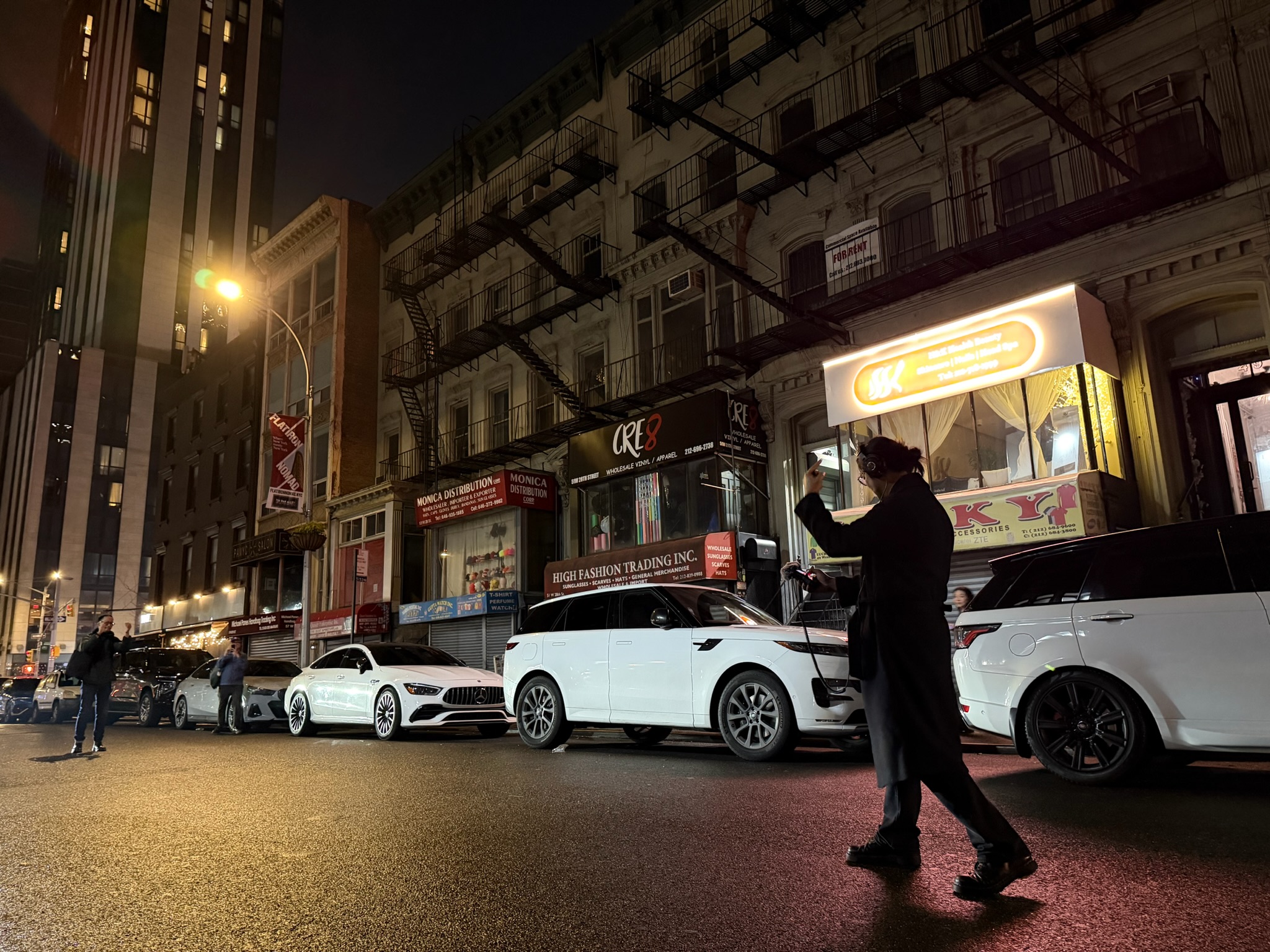
Impulse response recording of Tin Pan Alley. (Image via Fikri Izza)
That absence raises a question that feels relevant far beyond New York. If a place was defined by its soundscape and we preserve only its physical shell, are we preserving the place itself or merely its surface? When the rhythms, calls, and overlapping human presence that structured daily life disappear, something more than background noise disappears. Spatial memory disappears. Social texture disappears. A way of relating disappears.
Jakarta is changing rapidly. Infrastructure expands. Neighborhoods transform. Redevelopment continues. These shifts are often necessary and sometimes beneficial. Cities evolve. Yet evolution always involves selection. Certain sounds are amplified; others are silenced. When pedestrian environments give way to vehicle-oriented streets, the soundscape reorganizes itself. When horizontal neighborhoods are replaced by vertical housing, the acoustic relations among residents change. Sound no longer spills organically into shared space; it becomes contained, regulated, separated.
Silence, in this sense, can be political.
This is not a romantic argument against development, nor a call to freeze the city in time. It is an invitation to listen more carefully. Before the next redevelopment, before the next transformation, it may be worth asking: what kind of soundscape are we producing, and which ones are we allowing to disappear? What soundscape defines Jakarta as Jakarta? Is it the layered azan across districts, the informal street economy calling out to passersby, the density of conversation in public space? Or will the dominant sound of the future be traffic and notification tones?
My grandmother did not need to see the physical shell of her house to understand it. She lived inside its soundscape. Through listening, she sensed presence, distance, and movement. She understood the life within the structure. Preserving only the shell without the life inside it is not preservation; it is a display.
Cities are not only built. They are composed. If we do not listen to the soundscape as carefully as we look at the skyline, we risk preserving façades while losing the worlds they once held. And once a soundscape vanishes, it does not leave ruins. It leaves a new normal, one we slowly accept without noticing what has faded.
Perhaps the first step is simple. To pause, to close our eyes, and to listen attentively. Because in listening, we may begin to recognize what we want Jakarta to sound like—and what we are not ready to let disappear.