

Teenage years are glorified and romanticized, yet for us with invisible disability perceive it differently
In this Open Column submission, Ruth Maria Artauli Purba shared a personal episode of how those storied youth tales cannot be generalized to every young teens – especially considering that one can have invisible disability.

Words by Whiteboardjournal
“Masa muda, masa yang berapi-api / Yang maunya menang sendiri, walau salah tak peduli.”
Rhoma Irama sang those words for the rebellious, unstoppable youth. But when I was 15 years old, that anthem ceased to apply to me. At the peak of my teenage years, a golden transition from middle school to senior high school where nongkrong culture and romance were getting intense. I was diagnosed with epilepsy.
Instead of being berapi-api, people constantly warned me to stay away from actual fire. Instead of spending weekends at the cinema with friends, I sat in a neurologist’s waiting room surrounded by people twice my age. I didn’t get to gossip about my first love, I had to explain my first seizure. While other parents got angry at their daughters for breaking curfew, mine got angry when I forgot to take my phenytoin sodium.
My high school years were completely consumed by fear. It wasn’t the typical teenage anxiety of “What if no one wants to sit with me at lunch?” It was the suffocating dread of “What if I have a seizure in the middle of class?”
My illness didn’t leave me entirely friendless, but it stole the carefree spontaneity of youth. Every time friends invited me out, I had to think about it a hundred times. What if I get an aura? What if I experience an absence seizure and space out mid-conversation? Before the diagnosis, an invitation sparked excitement, “What should I wear? I can’t wait to see them!” Afterwards, it became a mathematical equation of risks.
More often than not, my weekends were spent in hospital beds. Suddenly, my life was dictated by rigid boundaries. I was told not to limit myself, yet the limits were everywhere. A strict 9:00 PM bed time meant an absolute end to sleepovers. No more pillow talk, no more whispering secrets into the late hours of the night, hiding from our parents. In school, I had to watch from the sidelines.
I desperately wanted to join the futsal club. Football had been my favorite sport since I was eight years old. I wasn’t a professional, but I just wanted to play like everyone else. I watched my classmates shed their boring school uniforms at the end of the day to put on the school jersey, running onto the field to score goals and jump together in celebration. Meanwhile, I remained trapped in my uniform, waiting for my dad to pick me up precisely on time on his old motorcycle.
The limitations bled into my future. I had always dreamed of becoming a war zone journalist. I had to let that dream pass, the exhaustion and stress of a conflict zone would trigger a seizure instantly. But eventually, I realized I had my own war zone right here. I had to fight my seizures, my auras, and the heavy cloud of depression that followed.
People rarely mention that having epilepsy multiplies your chances of developing depression fivefold.
The 17-Year-Old Elder
By my second year of high school, the medication and my neurologist had successfully kept the seizures at bay. Yet, the social isolation deepened. I couldn’t drink soda. I couldn’t eat tekwan or Indomie every day at the canteen like my fellas. I tried to look at it positively, treating it like a “cheat day” lifestyle where I only had tekwan once every two weeks. I haven’t touched a sugary packaged drink in almost ten years. At first, I tried to make it look cool, adopting a mindset of: “I’m different from you all. I eat healthy and I can conquer my lust” But inside, resentment was brewing.
During backyard barbecue parties, I felt like the most pathetic person in the room. Everyone else was pouring cups of soda, while I clutched a heavy, one-liter tumbler of plain water that I carried everywhere. At the school canteen, my friends joked that I ate like an opung-opung because I couldn’t put sambal or kecap in my food, and I had to beg the ibu kantin not to use MSG in my soup. I felt like a 17-year-old girl trapped in the body of an fragile elderly person, or worse, treated like a five-year-old child.
The unfairness of it irritated me to my core. Why did I have to swallow pills just to survive the day while they didn’t? Why could they abuse their bodies and remain perfectly fine? Swallowing my medication in front of my friends made me feel like a pathetic loser. I hated my life.
The Rebellion of Denial
So, I made a stupid decision, one that I regret to this day. I staged a massive internal coup. I decided that the way to fight epilepsy and depression was simply to pretend they didn’t exist. I adopted Rhoma Irama’s next line, “Darah muda, darahnya para remaja / Yang selalu merasa gagah dan tidak mau menyerah.” I threw my medication into the dustbin. Terrifyingly, for a whole year, nothing happened. I thought I had won. But the brain doesn’t forget who they are.
A few months later, the seizures returned with a vengeance. I experienced blackouts and convulsions almost every single day. Because the COVID-19 pandemic had hit and we were locked indoors, my friends never saw me collapse. My parents only found out when they caught me convulsed on the living room sofa while a Netflix show played in the background.
Even then, my stubbornness won. I refused to see my neurologist or therapist. I begged my parents to take me to pengobatan alternatif (lit. alternative medication) instead, completely denying modern science. Things only grew worse. Because of my unmanaged health, I watched my friends merantau across the country to attend their dream universities, while I stayed locked in my bedroom. My sickness hadn’t just cost me my dream of war journalism, it felt like it had cost me the right to a higher education entirely.
Turning a Sad Song Better
One afternoon, while I was numbly watching Ted Lasso in my room, my dad knocked on the door. In his characteristically soft tone, he gently suggested that I try taking the university entrance exam. He brought up Universitas Padjadjaran for German Literature, remembering how I used to take private German lessons before the epilepsy ruined my plans. As I sat there after he left, the TV continued playing. a scene came on where the characters sing The Beatles’ “Hey Jude” on the bus.
“Hey Jude, don’t make it bad / Take a sad song and make it better”
Those words hit me with the force of a physical blow. I realized I didn’t want to make my life worse anymore. My chronic illness was a devastatingly sad song, but I was the one choosing how to sing it.I made the bravest decision of my youth. I surrendered. I admitted to myself that I have epilepsy and depression, and that it is okay. I started taking my medication again. I showed up to my neurologist and therapist appointments once a month. And I passed the exam. I went to Unpad.
College life as an epileptic is, of course, far more complex. Now that I am in my final semesters, the anxieties have shifted. Will any company hire an officer with epilepsy? My romantic life is fragile, it is painful to watch myself hurt the love of my life because I am struggling to control the emotional side effects of my medication and the left lobe cortical dysfunction of my brain.
I still have to retake classes sometimes. I even had to take a one-semester academic leave when the pressure became too heavy. I still get auras and debilitating migraines. But it has been three years since my last generalized tonic-clonic seizure.
Two years ago, when I was having seizures every single day, I genuinely believed I would die tomorrow. Today, despite the heavy tumbler of water, the morning pills, and the modified diet, I look in the mirror and know that I can still become someone. I took the sad song, and I am finally making it better.
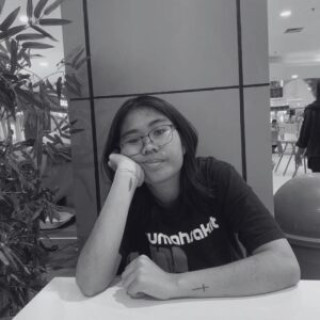
Ruth Maria Artauli Purba
Mahasiswi Sastra Unpad. Sebelumnya, tulisan saya mengenai isu disabilitas tak tampak juga pernah dipublikasikan di Whiteboard Journal.

Tripped

Serve Humanism Now! Against Western Media’s Double Standard

Creativity, Not Computation