



How Nusantara Beat Reminds Us Again the Novelty of Indonesian Life That We See as Mundane
In this Open Column submission, Teuku Reza Fadeli writes about witnessing Nusantara Beat, the Amsterdam-based six-piece psychedelic rock and vintage Indo-pop outfit, playing live in Utrecht, which prompted him to write home about the stories and diaspora memories brought to life by the band.

Words by Whiteboard Journal
I almost missed Nusantara Beat.
A friend of mine, Vivien, posted an Instagram story from their show in The Hague. Leiden, the city where I live, is close, and I still let it slip. So I did what you do after that kind of regret: I went looking. I clicked around, followed venue pages, skimmed listings, and found a date that felt like a second chance. December 7th, TivoliVredenburg, Utrecht. One train ride later, I was in a room full of people who had made the same decision. This band was worth getting on the move for.
If you have not run into Nusantara Beat yet, the simplest description is the one floating around their debut campaign: an Amsterdam-based six-piece that draws on Indonesian folk traditions, then runs them through psychedelic rock and vintage Indo-pop. On paper, it reads like promo language. Live, you hear what it means in practice. Percussion, guitar, bass, keys, and vocals move as one unit, and the groove keeps tightening until the whole room starts leaning forward with it. By the end of the night, I started to feel that this is music about movement and belonging: songs for people who live between cities, languages, and histories.
Their story sits between diaspora experience and local scene life. The group formed in Amsterdam, and the idea clicked when several members met in 2021 and realised they were after the same thing: an Indonesian-rooted band that treats inherited sounds as working material. Something you can stretch, rephrase, argue with, dance to, carry into a new city and still call your own. The line-up is usually listed as Megan de Klerk (vocals), Jordy Sanger (guitar), Rouzy Portier (guitar/keys), Sonny Groeneveld (drums), Gino Groeneveld (percussion), and Michael Joshua (bass). Joshua was born in West Java and moved to the Netherlands as a teenager, a small biographical detail that matches what you hear on stage. The music that has migrated, settled, and then decided to move again.
Their self-titled debut arrived in November 2025. Around that release, they set off on a run of shows across the Netherlands, and Utrecht was part of that circuit. In that context, the concert felt like more than a random gig squeezed between studio sessions. You could sense a band stepping beyond the “great singles” stage. The tracklist, from “Tamat” through to “Kota Bandung,” reads like a chain of scenes rather than a neat genre exercise. Each song opens a small door, then closes it before you can get too comfortable.
And then there is “Djanger”, which, probably for many listeners, is the track that travels fastest. It is the one people tend to mention first, the one that sticks in the head, the one that feels like a live set’s gravitational centre. Part of its pull, at least to my ears, is how it plays with the idea of “tradition” without slipping into museum mode. “Djanger” is a title with a long cultural afterlife, and hearing it in Utrecht, in a room that felt like a mix of Dutch listeners, and maybe people with some kind of Indonesian connection, I kept wondering what exactly is being invoked here.
Is “Djanger” working as a cultural memory cue? Or is it closer to a kind of Kawi-style revival, in the loose sense of staging something that feels ancient even when it is written in the present? I am not sure, and I do not want to force a neat reading. What I can say is that the song makes people feel they recognise something, then refuses to explain what they recognise. It leaves you with questions instead of liner notes, and perhaps my reading is already more elaborate than the band ever intended.
The tour itself felt deliberate and steadily building. It came across less as a themed “Indonesian night” and more as a normal sequence of club dates that happened to be carried by a diaspora band. It read as a proper run of shows in The Hague, Eindhoven, Groningen, Nijmegen, Rotterdam, Utrecht, and finally a bigger date in Paradiso, Amsterdam toward the end of the year. Utrecht was billed as one of the major stops, and it played like one. The crowd listened as if it already knew the record, then reacted as if the record was only a sketch of what the band can do once the groove has room to stretch.
Before Nusantara Beat came on, there was an opening act: Naga Kirana. The best way to describe that set is as another doorway into a similar atmosphere. Indonesian (and Sundanese)-inflected melodies floated over analogue synth lines; singer Inda Duran held the centre while electronics and guitar thickened the sound around her. Rouzy Portier joined on stage as well, so the night felt less like a strict hierarchy between support and headliner and more like a small network of players who keep crossing each other’s paths. The set made space. It slowed the room’s breathing. It built a mood you could step into.
I would say, Naga Kirana deserves a separate essay. That is not a formulaic compliment. The act has its own internal story and its own way of organising sound, and folding it entirely into someone else’s narrative would not do it justice.
When Nusantara Beat finally started, what caught my attention first was not an abstract idea of “Indonesian-ness”, but how Indonesian actually sounded in that Dutch ‘space’. The vowels, the accents, the slips between Indonesian, local slang, and regional terms carried a particular charge. It felt like the language of home being tested in a different climate. Watching people sing along to lines in Bahasa Indonesia and Sundanese in a venue that usually hosts ‘international’ indie and pop acts, I kept thinking about how migrant communities make themselves heard through everyday phrases that suddenly echo in public.
Under that layer of language, there was what I earlier called the discipline of the groove. They lock into a rhythm and stick with it. Drums and percussion hold the pulse, while guitar and keys jump in, throw in a line, then pull back. Things change on top, the tempo stays put. As a listener, you stop noticing the effort and simply let yourself be carried.
This sense of control felt familiar to me from older Indonesian band music I grew up overhearing on the radio and in car tapes. Nusantara Beat’s sound leans on psych, but you can also hear an affection for the kind of patient phrasing where choruses arrive slowly, hooks sit low in the mix, and repetition invites people to hum along before they even realise it. I am not claiming Nusantara Beat are directly copying anyone. It feels closer to a method that earlier musicians already tested: let a song repeat until it becomes communal rather than merely repetitive. In Utrecht, that “older” logic read as confidence, not nostalgia.
This social quality is what made “Mang Becak” stand out for me, and here my own research probably colours the listening. I have been working on the history of bicycles and cycling in Indonesia, so I walked into the venue already sensitive to any mention of wheels. “Mang Becak” quickly became my favourite, partly because of that bias, and partly because the song earned it on stage.
For readers who might not be familiar with the terms: a becak is a cycle rickshaw, a three-wheeled vehicle powered by pedals, once common in Indonesian cities and still present in various forms. Mang is a Sundanese way of addressing an older man, roughly like saying “uncle”, and Eneng is a casual way of referring to a young woman in Sundanese and Betawi urban speech. Even before you translate the lines, those words fix the song’s social world: this is West Java, or at least a West Javanese register, with its own rhythm of teasing and complaint.
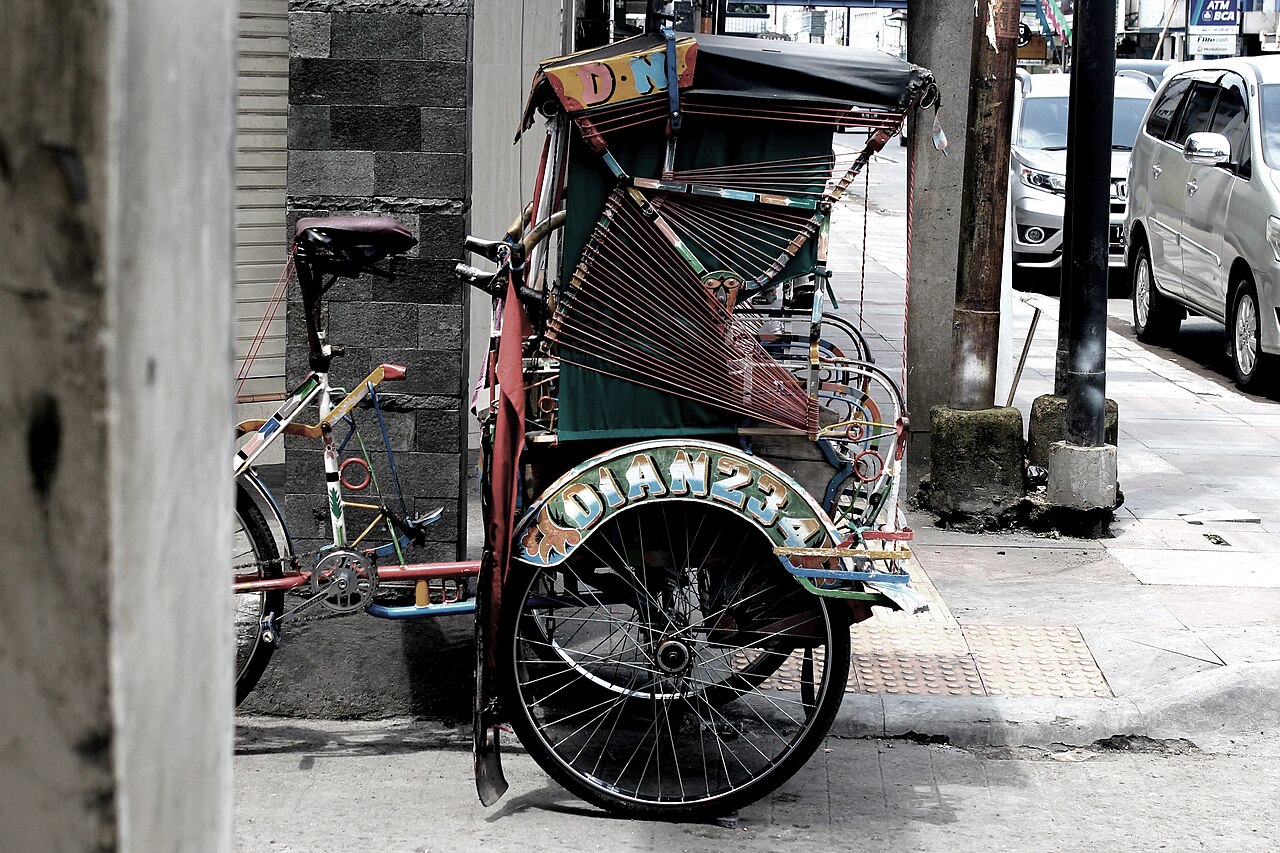
Becak. (Image via Abdulrohmatt/Wikimedia Commons)
The humour of “Mang Becak” lives in that street-level back-and-forth. The lyric loops through lines like “Mang becak, mang becak… becak sieun ka kota” and “becak, becak, kade jalan bebas becak”, a mix of repetition and warning that sounds like a passenger half-joking, half-terrified on the way into town. Mang is a Sundanese form of address for an older man; Eneng a casual way to call a young woman. Those two words alone already sketch a small social world: West Java, an everyday ride, a relationship built on banter and need. Anyone who has sat in a becak, on the back of a motorbike, or in a Jakarta angkot at rush hour will recognise the rhythm of it. You worry, you complain, you trust the driver anyway, you keep moving. The song leaves that whole scene inside a joke you can dance to, while the band keeps the groove steady underneath.
Only later did my mind drift to another song that circles everyday behaviour from a different angle, “Sifat Manusia”, written by Ali Usman and later sung by artists such as Zul and Asmidar Darwis. The lyrics of “Sifat Manusia” describe the many sides of human life. Joy and sadness, wisdom and inconsistency, beauty and oddness, framed as a basic script that runs from “Adam dan Hawa” (Adam and Eve) to the present. People laugh, sulk, celebrate, and suffer, and none of it lasts. The song lists these moods almost like a catalogue of types, while the melody keeps things light enough to sing along to. If “Sifat Manusia” pulls back to show the pattern, “Mang Becak” zooms in on one small ride and lets us feel that pattern from the passenger seat.
That tone of everyday comic realism will feel familiar to anyone who grew up with Indonesian pop from the 1980s and 1990s, where stage persona and humour stayed tied to daily life. Singers like Farid Hardja, with his mix of pop and playful delivery, and Doel Sumbang, whose Sundanese-inflected satire took social quirks as its subject, show how humour in Indonesian pop often comes from recognised behaviour and cultural detail. In Utrecht, nobody roared with laughter at “Mang Becak.” What I saw were shoulders loosening, hips starting to move, people mouthing words they only half caught. The humour travelled through bodies rather than punchlines. Either way, the band keeps everyone dancing. If “Mang Becak” feels like a short story, “Ular Ular” feels like a mood that keeps slipping away as soon as you think you have pinned it down a quality that recalls the way Indonesian rock from decades past could conjure atmosphere without literal narrative, much like Dara Puspita’s late-’60s performances, where raw energy and repetition were everything.
For Indonesian audiences, there is another layer to all of this. Nusantara Beat are not selling “Indonesia in Europe” as a postcard. They are making a contemporary band sound in Amsterdam and treating Indonesian source material as something that can still generate new work. Language, phrasing, older pop sensibilities, fragments of folk melody all of that appears in their songs, and it circulates. You can hear similar energy in other Indonesian groups like Ali, a Jakarta funk/disco trio that blends 1970s grooves with Middle Eastern-influenced rhythms and has carried that hybrid sound onto international stages.
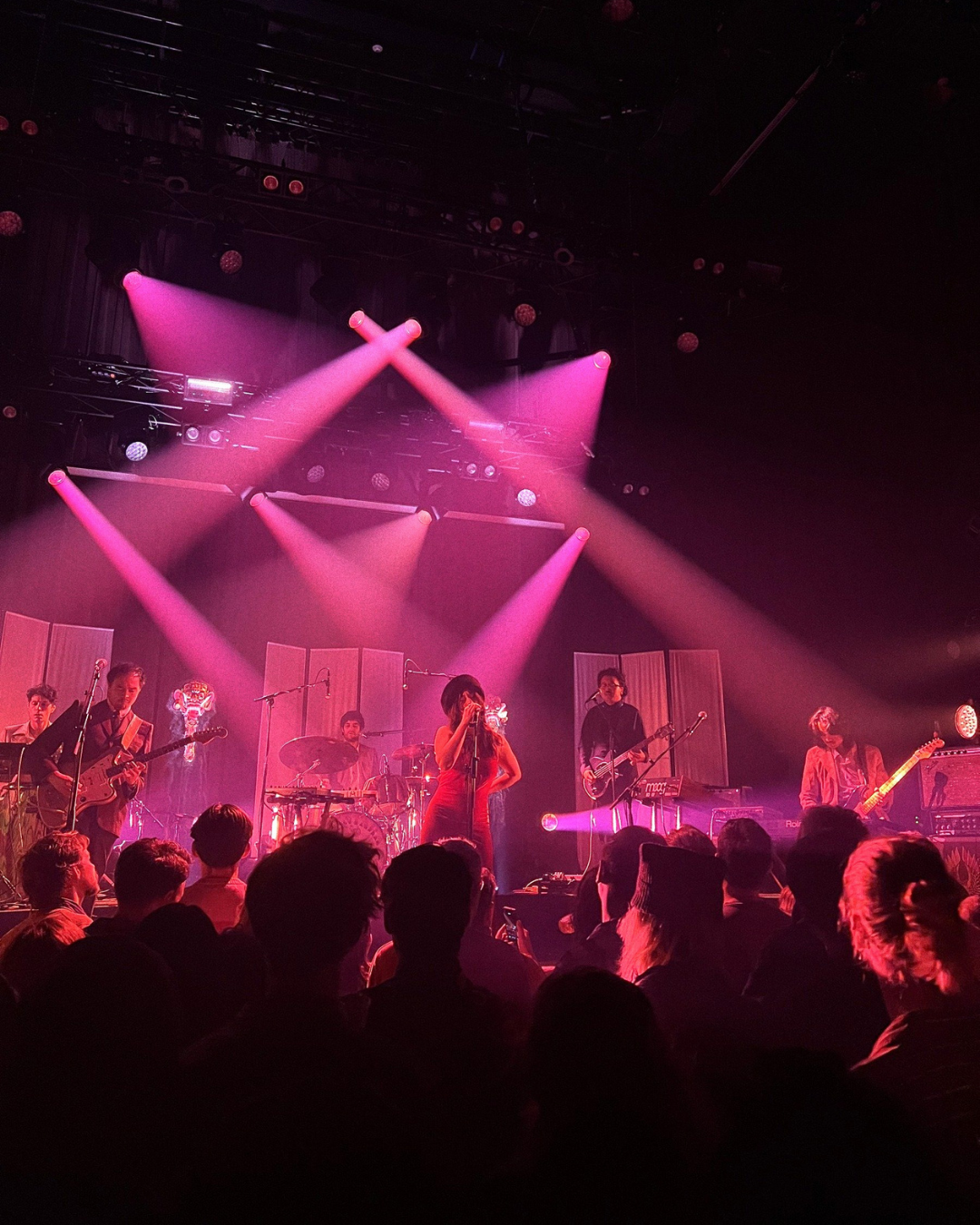
Nusantara Beat at TivoliVredenburg, Utrecht. (Image via Teuku Reza Fadeli)
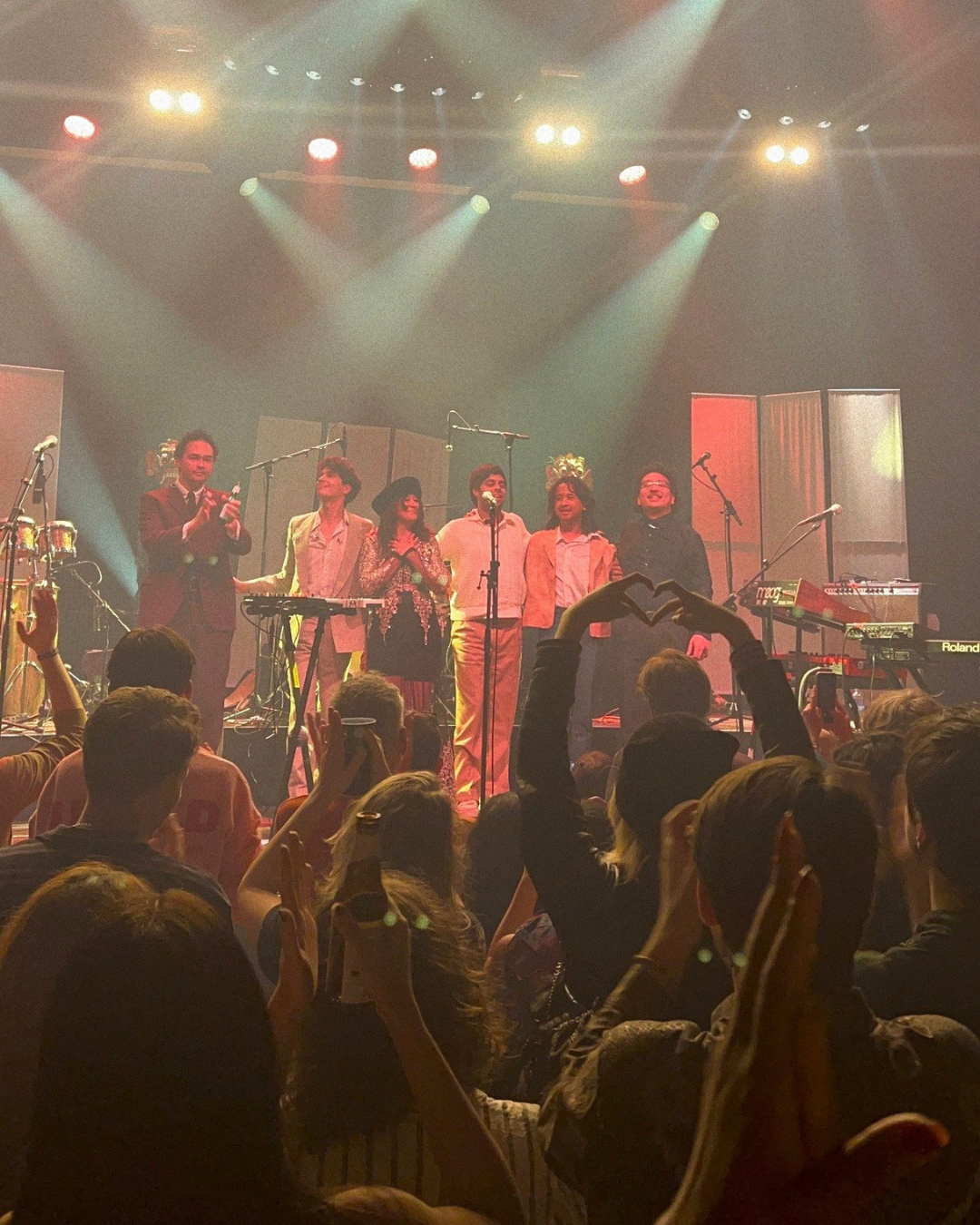
Nusantara Beat at TivoliVredenburg, Utrecht. (Image via Teuku Reza Fadeli)
Live, you realise why this matters. A record can map out influences on paper; a concert tests how those influences hold up in real time with real people. In Utrecht, the groove stayed steady, the melodies travelled, and the audience responded less like a group assembled to consume “world music” and more like people who had found something they could move with.
I went because I missed a story. I left feeling like I had finally caught up with something that has been forming for a while: a band turning diaspora memory into dance music, without apologising for the mix. They have already brought that sound to Yogyakarta, at Universitas Gadjah Mada, and to Jakarta, at Erasmus Huis, in 2024; with any luck, it will keep circling back to Indonesia and meet listeners who bring their own archives of “Djanger”, their own street memories of becak rides, their own sense of what counts as old, new, or “ours”, perhaps? With that in mind, we wait and see what the next chapter sounds like.

Teuku Reza Fadeli
A historian and Visiting Fellow at KITLV Leiden. His research focuses on colonial and post-colonial Southeast Asia, with a particular interest in consumer culture, mobility, and the social histories of everyday life.

Adakah Kesempatan Kedua untuk Sosok Cancelled? Billboard Music Awards 2022 adalah Jawabannya

Kolektif Musik, Parlemen Pop, Menanggapi COVID-19 Melalui Single Terbaru Bertajuk “AWAS!”

Beabadoobee Berkolaborasi dengan Matt Healy dan George Daniel dari The 1975 Untuk Single “Last Day On Earth”
