

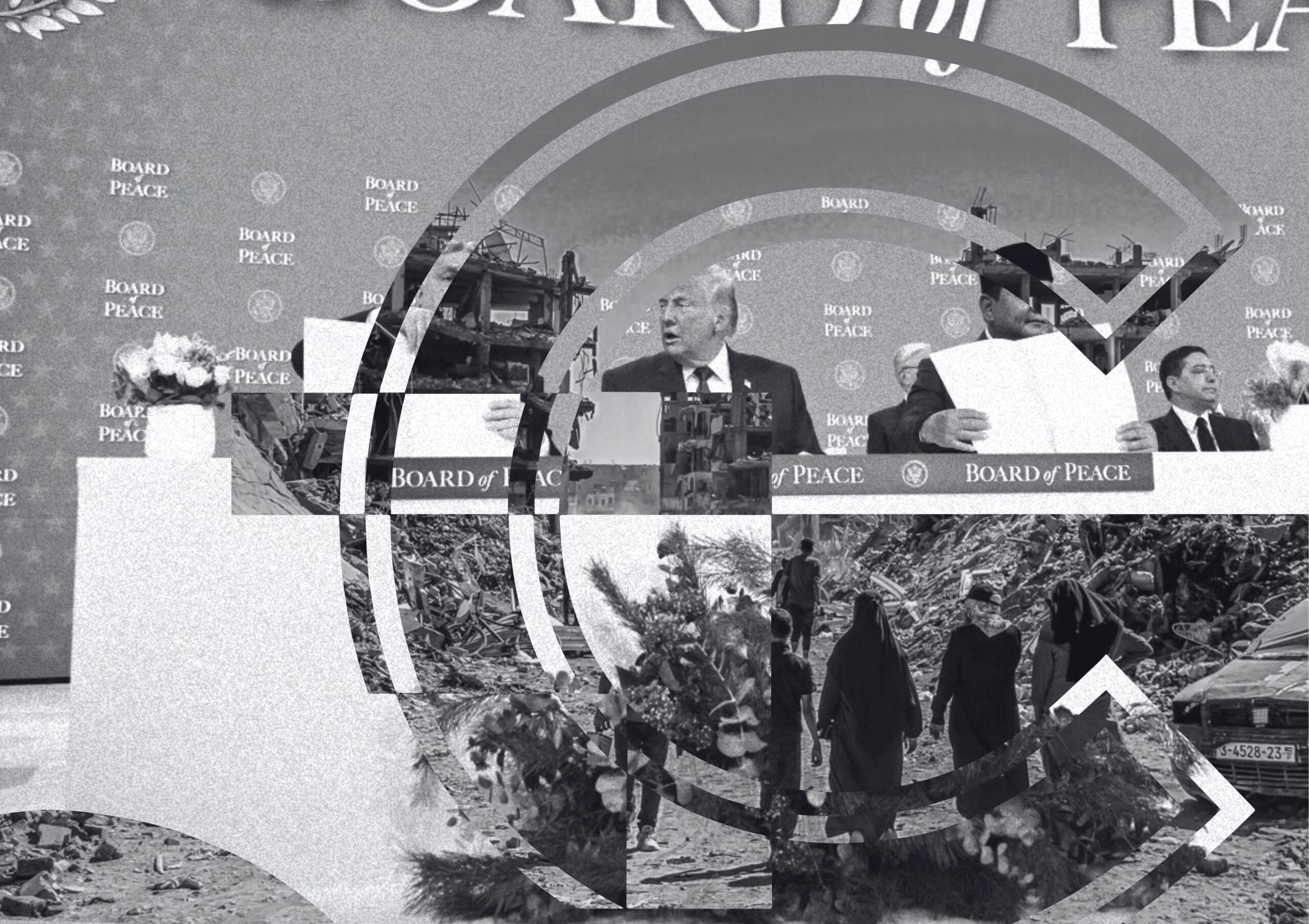


Instead of Freedom, The Board of Peace Decisions Made Indonesia Complicit in The Genocide
In this Open Column submission, Nadine Sherani clears up the ever-murky proposed solutions of ‘peace’ of those complicit in the complete opposite of said phrase adorned by the Board of Peace, and how Indonesia may be even further from aiding the liberation of Palestine.

Words by Whiteboard Journal
Indonesia’s decision to join the United States-initiated Board of Peace (BoP) marks a critical moment for its foreign policy where one risks undermining decades of principled diplomacy on Palestine and human rights.
While the current Indonesian President, Prabowo Subianto, proudly presents the move as a strategic opportunity – as endorsed by the Ministry of Foreign Affairs to The People’s Consultative Assembly – to contribute to peace in Gaza, the structure, leadership, and political orientation of the organization raise concerning questions whether Indonesia is advancing towards Palestine’s freedom and peace, or instead falling to a “business as usual.”
The BoP was officially launched by the U.S President on 22 January 2026 in Switzerland. Marketed in fancy blueprints as a new global forum to resolve conflict, the board is, in reality, a striking departure from post-World War II Multilateralism.
Unlike the United Nations, whose very foundation rests on preventing genocide and crimes against humanity, BoP’s charter makes no reference whatsoever to international human rights standards nor basic principles of humanitarianism. The omission is not accidental. It aligns neatly with the Trump administration’s broader hostility toward what it labels “woke” values that include gender equality, climate justice, and universal human rights norms.
As a collective reminder, Trump’s leadership has systematically undermined the UN by defunding life-saving programs, withdrawing from the World Health Organization (WHO) and climate bodies, sanctioning International Criminal Court (ICC) Officials, to “blacklisting” accountability mechanisms for grave international crimes. The BoP should therefore be understood not as a complement to the UN, but as an alternative designed to sideline it.
Worse, the board is explicitly structured to concentrate power as Trump appoints himself lifetime chairman, holding supreme authority to adopt resolutions at will. Permanent membership reportedly requires contributions reaching billions of dollars, reinforcing the impression that the board operates less as a collective peace mechanism and more as a “pay-to-play” political club.
Originally conceived to oversee post-war Gaza, the board’s involvement in Palestine has been accompanied by disturbing signals. A subsidiary body, the so-called Gaza Executive Board, includes figures such as Jared Kushner, Tony Blair, and Senior Officials from Turkey and Qatar, but no Palestinian representatives.Thus, this initiative lacks sensibility and is deemed as a “Peace Business” orchestrated by the strongman.
The figure’s vision of a “New Gaza” which has blueprint of luxury as its middle name, gives a borderline against the reality of mass displacement, destroyed schools and hospitals, as well as more than 70,000 Palestinian deaths, in which the U.S has been a complicit for many years.
Palestine Peace Plans without Palestinians is equal to humanitarian catastrophe, rooted in illegal occupation and systemic violence. As humanitarian scholars and peacebuilders repeatedly warned, peace imposed from the outside, especially by actors with clear geopolitical interests, rarely delivers justice, let alone sustainability.
For many years, Indonesia has positioned itself as one of the strongest supporters of the Palestinian self-determination and consistently condemned Israel’s illegal occupation. This stance has not merely been rhetorical, it has been inside Indonesia’s moral leadership in the Global South and the Muslim world. More so, recently in 2024 that the Indonesian Vice Minister of Foreign Affairs prohibits members of the Organization of Islamic Cooperation to exercise trades with Israel as a form of solidarity of Palestine – although it is still found that Indonesia kept its trillions of Rupiah surplus with Israel.
Yet, by joining the U.S dominated organization that excludes Palestinian voices and include leaders accused of war crimes, including Israeli Prime Minister Benjamin Netanyahu, Indonesia risks appearing complicit in redefining “peace” as stability without justice.
The government has argued that joining the board allows Indonesia to influence decisions from within. The Indonesian Foreign Minister even suggested that Indonesia’s participation could facilitate humanitarian access through Rafah. While humanitarian corridors are urgently needed, short-term access cannot justify long-term legitimization of a fundamentally unjust framework.
As international relations scholar Agung Nurwijoyo noted, the BoP is not a UN-mandated body. It lacks clear mechanisms, checks and balances, and equal representation. In such a structure as well as Trump’s dominating power, Indonesia’s ability to meaningfully influence outcomes is highly questionable and has puzzled many experts. Supporters – meaning the ministerial bodies and other government institutions – of Indonesia’s decision point to pragmatic considerations. The Trump administration is known for using economic-political pressure, including tariffs, as diplomatic tools. Joining the board may assist Indonesia avoid friction with the U.S and preserve bilateral relations. This presumes strongly that Indonesia does not necessarily have anything to do for the Gaza conflict.
However, pragmatism becomes problematic when it erodes principles. Indonesia’s “bebas aktif” (free and active) doctrine of foreign policy was never meant to imply passivity or accommodation toward great power politics. On the contrary, it was designed to allow Indonesia to act independently, promote justice, and resist domination by any single power bloc and always sided with weak and discriminated countries.
By aligning with Trump’s centric initiative, Indonesia is potentially drifting from the free and active principle, to dependent and reactive foreign policy. Worse, Indonesia may only serve itself as a dusty doll on the shelf rather than a genuine agenda-setter. Hence, if the U.S takes the wheel over the board’s decision, Indonesia’s presence is futile.There is also a domestic cost of symbolic diplomacy. Indonesia’s contribution up to Rp 17 Trillion (USD 1 Billion) comes from the state budget. This raises alarming ethical debates at a time when large segments of Indonesia’s population continue to face acute hardship.
In parts of Sumatra for example, communities affected by the great flood, landslides, and other natural disaster occurrences still lack reliable access to electricity, clean water, adequate food, and proper housing after 2 months. Public services remain strained and social protection gaps continue to persist.
Thus, allocating public funds to an opaque international body with questionable legitimacy appears deeply inconsiderate. Solidarity with Palestine should never come at an expense of neglecting Indonesia’s own citizens, especially when the effectiveness of that solidarity is far from guaranteed.
The million dollar question remains: Can the Board of Peace actually contribute to Palestine’s liberation?
If history is any guide, peace initiatives dominated by the U.S while sidelining the international law have consistently failed Palestinians. From the Odo Accords to Abraham Accords, the pattern is similar with the normalization without representative participation, economic promises without sovereignty, and peace without freedom.
If the U.S. were genuinely committed to the Palestinian independence, it should already accommodate immense leverage to stop Israeli aggression, illegal occupation, to the epitome of genocide itself. The creation of a new body that bypasses existing international organizations such as the UN, suggests not commitment, but avoidance.
By this, Indonesia must ask itself for necessary reflections. Is the decision joining BoP advancing Palestinian rights or is it then merely participating in a political performance designed to absolve powerful actors of responsibility and turn the peace mission in Gaza into a mere business purpose?
Nadine Sherani
Nadine Sherani is the international advocacy officer of the Commission for the Disappeared and Victims of Violence (KontraS). Her daily tasks involve monitoring the implementation of international human rights standards as well as mobilizing national, regional, international solidarity to cross-cutting human rights such as the Myanmar and Palestine humanitarian crisis.

Part VI: Muka Bumi

Membakar Buku: Melukai Ingatan dan Membunuh Identitas
Negative Lovers – .38 Loves Me/Flooded Eye
