When it comes to showing work online, the artist has several venues to choose from. Generally, it is good practice for many artists to publish work on several platforms to optimize their online presence. The process itself can be quite daunting. In this article, Kriztille Junio details her recommendations on which sites to use when creating a portfolio based on her own personal use.
The digital landscape has changed the way an artist makes art and where it is made. The methods that we learn have been vastly reinterpreted to allow for learning materials to exist in a variety of forms from your typical university classroom setting to a digital one with all the advantages of a physical space and more. In this column, Kriztille discusses how online art and design courses function in a digital art space.
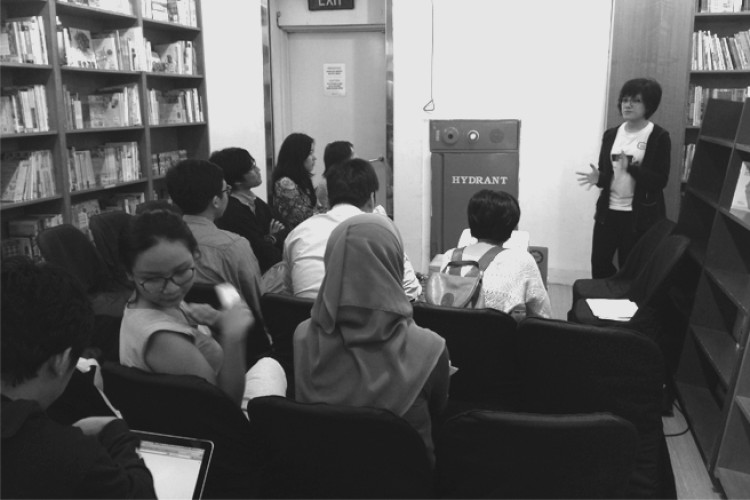
- Technical elements are not the only things that make a film appealing – the unseen ingredients are equally important (the personal touch and “the soul” of the director)
- Music can be the nostalgic element of a film. In other words, it is one of the strongest elements that remind viewers of a movie they had already seen.
- Music can change the perception that viewers have towards a particular movie.
- However, it is not only music that matters. In fact, a participant argued that it is the absence or presence of certain that make or break the ambience of a film.
- There are many different “standards” that determine the quality of films. What is important is not the standard, but the coherence of a movie – that is, the ability of the director to with the
- The number of teasers, trailers available prior to the release of a film exists to give viewers visual expectations (as opposed to text, which allows viewers to draw their own “visual” expectations).
- On adaptations: The best way to go about them is to perceive and accept books and movies as completely different formats.
- While the “mood” of a film can be at the core of a film, one of the participants emphasized on the crucial role of a certain form of structure that can accommodate that mood (so that viewers will not be lost).
- The strength of a director’s concept is important. Ideally, she or he ought to have a strong connection with her or his work. This connection can be cultural or emotional.
- The editing process of a film – deciding on which scenes to extend, shorten, include or discard – can determine the final outcome, which would then determine the reaction of the audience.
- Towards the end of the discussion, participants briefly exchange thoughts on the state of film censorship, including the recent ban of has caused quite a stir among Indonesia movie-enthusiasts.
Your feedback would be greatly appreciated, so please feel free to tweet us @wjournal or send us an e-mail to with the subject title “We Discuss #9.”
Here is a list of recommended reads for next week’s Fantastic Film Feast discussion:
Southeast Asian Films with Apichatpong Weerasethakul
“For me, story is secondary to feelings, and when you try to explain so much you are losing the beauty and locality. When you travel abroad there will be many things you cannot understand. I don’t need to explain that, it is the beauty of differences, accept it for what it is. Film is not a textbook; it is a different form of expression.
If you really want to reach a wide international audience, then what kind audience? Because there are so many. Do you want to be a textbook and make everything clear? It depends. For me, I prefer to make the film as much as I want to understand.”
Film Craftmanship with Mouly Surya
“In my opinion, even though it won’t apply to everyone, I am not talking about feeding the students with bulky theoretical thoughts but there are conventions in filmmaking that people should understand before they start filmmaking. A degree of knowledge has to be learnt to understand a film within the first five minutes of its inception. Think of it as a language. I see film as a language to communicate. Filmmakers need to understand this visual language.
I don’t believe in an instinctive filmmaker, moreover I don’t believe in talent. There is basic knowledge about filmmaking that people need to acquire if they are truly interested in their craft.”
The Persisting Vision: Reading the Language of Cinema by Martin Scorcese
“Now we take reading and writing for granted but the same kinds of questions are coming up around moving images: Are they harming us? Are they causing us to abandon written language?
We’re face to face with images all the time in a way that we never have been before. And that’s why I believe we need to stress visual literacy in our schools. Young people need to understand that not all images are there to be consumed like fast food and then forgotten – we need to educate them to understand the difference between moving images that engage their humanity and their intelligence, and moving images that are just selling them something.”
Film as Film by Malcolm Thorndike Nicholson
“I do not mean to suggest that the critics above are not thoughtful or knowledgeable enough about film as an art. Yet the aspects of filmmaking these critics are ignoring are hardly peripheral. They are as crucial to the effect of a movie as brushstrokes and pigment are to a painting. And remembering the question we began with – in the digital age what is left for a critic to supply? – it makes their absence all the more relevant.
It doesn’t follow that critics should suddenly ignore narrative and character development and spend 500 words analyzing camera technique; that would be fatally boring, as well as alienating. But reviewing films as if they are stories that merely happen to be told using a camera can often miss the point. Most importantly, the sort of writing we currently lack can, and has, been done successfully before.”
Towards a New Film Criticism by Willie Osterweil
“Entertainment reinforces the narcissistic myth of the consumer as master of his own experience: In the movies, a protagonist always wins by making the right choices or loses by making the wrong ones. The important thing isn’t success or failure, tragedy or comedy, it’s the protagonist’s individual responsibility: If he’s crushed, it’s because he picked a fight with an enemy too powerful to overcome. If he finds love, success, and happiness, it’s because he did the right things starting from a level playing field where anyone can succeed. But the individual’s actions provide cover for the systematic processes of alienation and exploitation.
By focusing on the film-historical context—the aesthetic idiosyncrasies of an individual film or its connections to other films by genre, crew, or cast—film criticism fails to see the intentions and desires of the film industry, the only active subject in major cinema. In doing so, film criticism colludes with the entertainment industry’s massive project of commodifying experience. By treating entertainment products as a mirror of social experience, film criticism legitimates capitalist alienation while cheapening the possibilities of art. The point is not, however, to become silent. A new film criticism must emerge: By evaluating a film’s methods of production, its place in the film current, and its similarities to concurrently released films on top of its individual contents, film criticism can understand the multiplex’s true ideological effects and reveal new avenues of cinematic pleasure.”
Tuesday, March 25, 2014
7–9 pm
Kinokuniya Plaza Senayan
(near the language section)
Jl. Asia Afrika 8 Sogo
Plaza Senayan Lt. 5
Jakarta 10270
Please look out for more #WeDiscuss updates on our Facebook page and Twitter account! If you’d like to share your opinions, or if you have friends who’d like to share theirs, sign up via e-mail with the subject title “We Discuss” at ! If you have comments or questions, tweet us @wjournal.
Despite the pervasiveness of music in our daily lives, last night's discussion proved that there music is made up of multiple layers. In order to understand music, knowing what or who we enjoy listening to is not enough. Below are some of the points that were brought up during last night's discussion:
- Because music is so difficult to describe, the most important thing is often our reactions. Those reactions are the most crucial part of music.
- The musical experience – that is, our listening habits – are mood-based. It is usually the case that we look for songs that would intensify our emotions at the time. Music, in a way, amplifies and perhaps even justifies our feelings.
- Instrumental music vs. songs: both songs evoke different feelings and reactions. The former often conjures impressions whereas the latter produce a clear image/narration.
- On the social significance of music: we typically listen to music that we can relate to. Music does not only affect a person on an individual level, but also at a more collective and cultural level. , for instance, usually includes lyrics that tell the story of a person’s life in a given socio-economic context.
- Stereotypes affect how we listen to music, and whose music we listen to.
- Our appreciation towards music is often related to time. This is perhaps why the idea of a “generation” is very strong in the context of music. People who have gone through similar social experiences are more likely to relate to the music produced during a particular era.
- DJing is both active and passive since the DJ plays as s/he listens to the music.
- On sampling and originality: sampling is not a second-rate pursuit in music as it involves the active selection of existing material to create something new.
- It is difficult to separate music and the creators (though sometimes it depends on the genre).
- Music is first and foremost a form of entertainment; the message can come later (once the listener has familiarized his/herself with the music).
- Music is intrusive. It is not like text, a medium that allows people to choose their involvement with it.
- In live performances, musicians can get direct feedback from the audience. It is possible to have an interaction.
- In addition to the romance associated with the physicality of vinyl records, they are useful for documentary purposes whereas digital files that are distributed through the Internet increase the accessibility of music (by an audience that will most likely consists of diverse cultural and socio-economic backgrounds). In short, each medium or “vessel” has its own purpose. One can’t simply say that one medium is more superior to the other.
- Technological advancement opens doors to new ways of understanding and appreciating music (e.g. smartphone apps that help users experience a song in an innovative way). And the more our old and current mindsets adjust to the development of technology, the more ways we’ll create to make and share music.
Your feedback would be greatly appreciated, so please feel free to tweet us @wjournal or send us an e-mail to with the subject title “We Discuss #8.”
We would like to thank those who came and contributed to the discussion. We hope to see you again at next month’s session! Look out for announcements and related updates on next discussion. Check our website, Facebook page, as well as our Twitter and Instagram accounts!