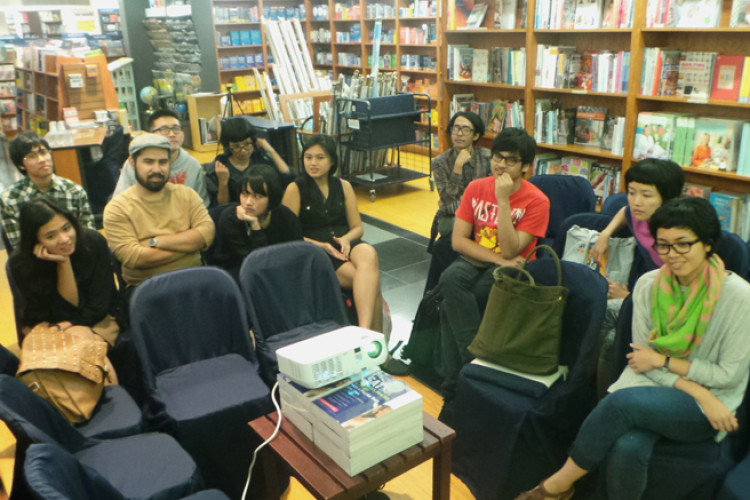
Last night, Whiteboard Journal hosted our 7 We Discuss session. This month, we talked about many different aspects of what we have come to know as the “Do-It-Yourself” (DIY) culture. Lots of intriguing ideas were exchanged throughout the discussion, which have been summarized in the following points:
- When you can’t find things that suit your preference and/or needs, you begin to consider making them on your own.
- Economical motivations are also common (i.e. the need to save money).
- “Yourself” is the heart of the widely used acronym, DIY, as it emphasizes the creator’s independence.
- However, the most important part is a person’s involvement in the process, further adding a personal touch to the product.
- But is it possible to purely “independent” in the sense of not relying on other like-minded individuals? There were participants who thought that establishing a network among DIY-ers could threaten the very idea of DIY.
- However, there were also participants who were in favor of a community that would act as a support group to sustain the movement. In this case, independence is achievable on individual and collective levels.
- A question was raised regarding the standards of DIY products. Are standards even necessary? Or does the appeal of the DIY culture lie in its absence of standards?
- A sense of accomplishment is one of the plus points of engaging in DIY activities.
- When speaking of the DIY culture, one must learn how to distinguish between a “DIY product” and an “invention.” DIY products have less to do with the originality of the idea behind them, and more to do with the creator’s initiative to be involved in the process.
- Another point worth highlighting is the necessity of sustaining the availability of resources (i.e. the materials needed to make various products). Without the materials, it would not be possible to make more things.
- With regards to technology, an interesting argument was made about the irrelevance of the “analog vs. digital” argument in discussions on the DIY movement because technology is always evolving. What’s important is how those changing technologies are utilized. It’s about using what is at your disposal at the present moment.
- This is then linked to the time-based nature of DIY goods. There is something is immediate about them.
- From a musician’s perspective, DIY is about being control (e. g. recording one’s own music in one’s own room.) However, although the process itself could be controlled, the consequences of releasing the end product – if it were to be released – cannot be controlled.
- Increased effort = increased support for the cause. In other words, when a lot of effort into a certain product – be it a thing, event, or movement – it is highly possible that others would want to sustain it.
- It is dangerous to stress the “handmade” element of a DIY product because it does not necessarily guarantee the quality of the product.
- DIY products are very subjective. Their value cannot be measured according to monetary standards. They are often segmented, and not designed for the masses.
- A point was raised regarding net labels – independent online distributors of music – that break the barriers of copyright.
- The DIY movement is both a subculture and a counterculture – depending on the motivation of the creators. It depends on whether one simply make something for one’s own purposes, or is there a vision to influence others to do the same.
- Ideally, the DIY movement shouldn’t be tied to commercial interests (especially in terms of profit), as it would defy the purpose of establishing something that is “for the people.” However, in cases where “the profit” is used to finance the needs of the people (be it for the continuity of the makers movement or charity), exceptions are made.
Your feedback would be greatly appreciated, so please feel free to tweet us @wjournal or send us an e-mail to with the subject title “We Discuss #7.”
We would like to thank those who came and contributed to the first We Discuss of 2014. We hope to see you again at future discussions! Look out for announcements and related updates on next discussion. Check our website, Facebook page, as well as our Twitter and Instagram accounts!
2014 is only two weeks away, but that doesn’t mean there’s no time for a We Discuss session! On December 17, Whiteboard Journal, along with enthusiastic participants, talked about food. And some of the ideas that were exchanged during the discussion were indeed food for thought.
- Despite the invention of liquids that can give the human body the nutrients it needs, we still crave for food that we can bite and chew. It seems that texture, in addition to taste and nutritional value, is important.
- Processed vs. natural food
- We associate what we eat with certain shapes and smells.
- “Organic” and other keywords that are related to health are marketing tools that directly or indirectly affect the way we consume food.
- Although advertisements and the media in general can affect the public in negative ways (increased junk food consumption, etc.), they can also raise public awareness about healthy food.
- When scanning the ingredient labels of foods available at supermarkets, it’s crucial to know what one does not want in one’s food. In other words, educating one’s self about basic ingredients that ought to be avoided is each individual’s responsibility.
- Healthy foodstuff is normally more expensive than the standard, and most likely less healthy, option – meaning that it is only affordable to a limited group of people. Is it possible to produce food that contains nutritious elements at a lower price?
- Different cultures have different tolerance towards “expiry dates” – which can also be seen as a marketing tool.
- Cooking, like eating, is a social activity.
- The utensils we use to eat reflect our connection to food. For instance, using one’s hands to eat represents the intimacy that one has with one’s meal while using chopsticks or spoons sets a distance between the diner and the food.
- The foodie phenomenon on Instagram and other social media enhances the aesthetic appreciation that we have towards food.
- The sort of “food appreciation” that was mentioned in the previous point and “food criticism” normally take place at higher social classes – that is, people whose relationship with food already go beyond reasons for survival.
- Culturally speaking, different societies have different ways of appreciation food (e.g. the Japanese habit of slurping noodles)
Your feedback would be greatly appreciated, so please feel free to tweet us @wjournal or send us an e-mail to with the subject title “We Discuss #6.”
We would like to thank those who came and contributed to last We Discuss meeting of 2013. We hope to see you again next year! Look out for announcements and other updates regarding the next discussion on our website’s blog and events section. Or check out our Facebook page, as well as our Twitter and Instagram accounts!
It is easy to think of a photograph as a mere image that contains a certain amount of information, but as Ridzki Noviansyah points out, the photograph is also a work of art and ought to be valued as such. While his previous essays focused on the camera and the photographer, this piece is about the tangible product itself.
Nicoline Patricia Malina is a name one should be familiar with when talking about fashion photography. The Jakarta-based photographer dynamic body of work has earned her spreads displayed in magazines such as Elle, Harper's Bazaar, & Esquire. Speaking to her, we learned that she has dabbled in multiple art disciplines prior to photography, and she constantly motivates herself to learn more. This constant search for knowledge is present in her photographs, which becomes more and more dynamic as she goes along.
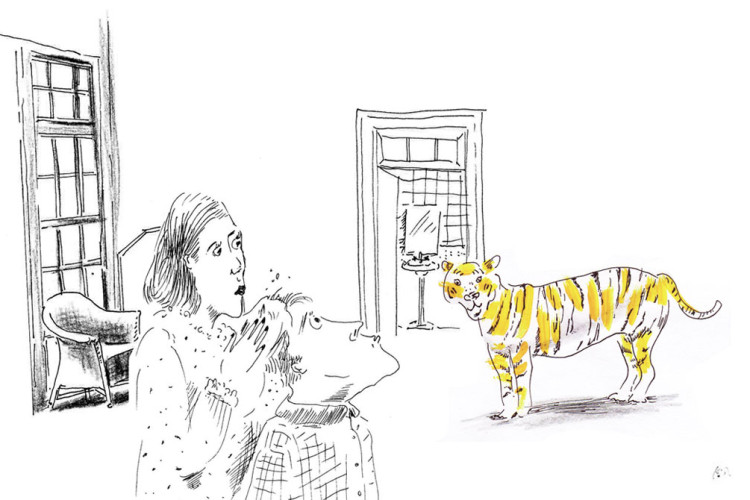
We — especially those of us who live in man-made cities — often forget that human beings share the world with other creatures. When a tiger named Monsoon wanders into the life of a young couple, a human—animal bond begins. This is the first installation of Rain Chudori's short fiction series, Monsoon Tiger.
Picture yourself enjoying a meal or cup of tea under the comforting shade of a large trees. There are not many cafes in Jakarta that make people want to sit outside instead of in an air-conditioned room. Kedai Lentera, a cafe in Pasar Minggu that was originally established to finance LenteraTimur.com, offers a relaxing setting for those who want to eat and have discussions.