There are only seven days until the last We Discuss meeting of 2013. This month, we are going to relax and talk about something everyone loves: food.
But where, how, and the people with whom we share (or don’t share) our meals also define us. Because food is essential to our survival, we rarely take the time to think about eating as an activity that is loaded with cultural codes and traditions. Let’s use this opportunity to take a step back and look into our eating patterns.
- What is your favourite food? Do you think that the combination of flavours, smells, and memories determine what you would consider to be your favourite food? How so?
- Instant food vs. fresh produce. Are we willing to sacrifice convenience at the expense of our health?
- With regards to “organic food,” are we really becoming more health conscious or are we just participating in a fleeting culinary trend?
- How do we decide what is food or what it isn’t? Why do we think that some dishes are “bizarre” while others aren’t?
- We associate certain foods with specific cultural or religious celebrations and vice versa. To what extent do the two depend on each other?
- The plates and cutlery that we use for our food are also an integral part of our eating habits. Some use chopsticks, while others use spoons or even their bare hands. Do you think the survival of a culture depends on the continued practice of using specific tools?
- There is a growing appreciation towards “food” as opposed to food. This increased interest in food is not only limited to cooking shows on television. But there are magazines such as Kinfolk and Cereal – just to name a few – that portray food and the process of making it, as an art form. The question that arises from this: is this sort of “food appreciation” applicable to all cultures? What does it say about social classes?
- What are the major differences between eating at home and eating out?
- The popular philosopher, Alain de Botton, once tweeted: “Cooks: make the food others too busy to prepare.” But sometimes we eat for reasons other than the food itself. We also consider the ambience of restaurants and cafes. How big or small is the place? How far is one table placed from the other? How is the lighting?
- Do the concepts of “take away” food or food carts reflect the pace of our society?
Tuesday, December 17, 2013
7—9 pm
Kinokuniya Plaza Senayan
(near the language section)
Jl. Asia Afrika 8
Sogo Plaza Senayan Lt. 5
Jakarta 10270
Please look out for more #WeDiscuss updates on our Facebook page and Twitter account! If you’d like to share your opinions, or if you have friends who’d like to share theirs, sign up via e-mail with the subject title “We Discuss” at ! If you have comments or questions, tweet us .
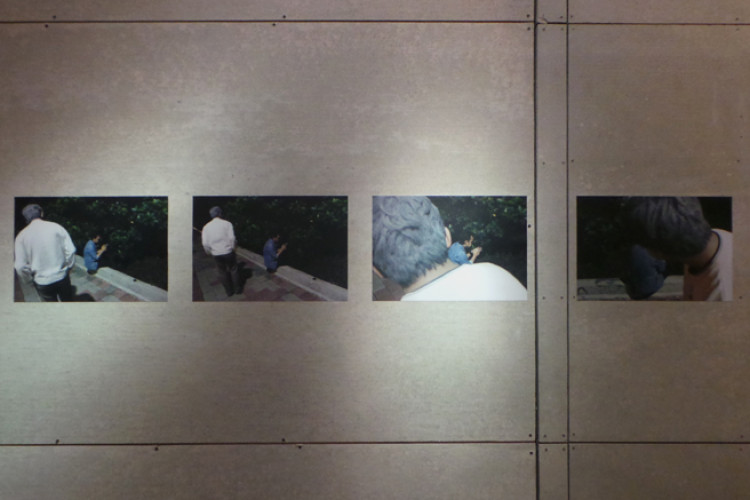
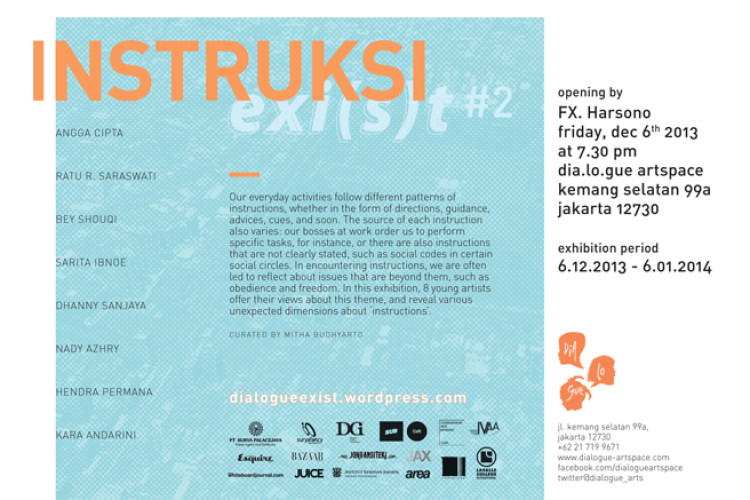
officially started on December 6, 2013 at Dia.Lo.Gue Artspace Kemang. The exhibition kicked off with opening statements by Mitha Budhyarto and FX Harsono, as well as a brief introduction of the eight participating artists.
“Our lives are filled with instructions that act as directions, orders, and cues as to how we must behave,” goes a line in Mitha’s introductory text in the guidebook. It is difficult to take a step back and analyze the very instructions that have shaped our behaviour and perspectives. Instructions – both written and unwritten – interlock with the way we lead our lives.
This year’s EXI(s)T focuses on the attempt to reevaluate and reinterpret society’s many instructions through artistic means. While some think that instructions are a form of repression, others see them as rules that can be manipulated. The 2013 batch explored the theme using different mediums – from drawings, videos to performances. From the diversity of the methods alone, one can see that despite the seemingly absolute nature of instructions, they are actually quite relative.
Below is the list of displayed artworks and their respective creators:
by Dhanny Sanjaya
by Hendra Permana
by Ratu R. Saraswati
, , and by Nady Azhry
by Sarita Ibnoe
by Angga Cipta
by Kara Andarini
by Bey Shouqi
The field of art is expanding in ways that may have not been possible centuries, or even a few decades earlier. Art’s boundaries are becoming more fluid; therefore offering endless opportunities for aspiring and professional artists to experiment.
FX Harsono emphasized that as an educational program, EXI(s)T has no templates. It does not aim to produce artists who is like this person or that person, or whose works are like painting or that sculpture. Both FX Harsono and Mitha Budhyarto, as two experienced individuals in Indonesia’s art scene and the official mentors of he program, encourage new types of artists and new types of creations.
EXI(s)T #2: Instruksi will be open to public until , so do stop by before it ends!
For more information, please visit EXI(s)T’s blog.
In today's world of photography, there seems to be a tendency to immediately associate editing with Photoshop and similar softwares. But as we will find out in this essay, there is more to editing than simply tweaking a photograph on a computer. In his fourth piece, Ridzki Noviansyah shares his thoughts on how the current generation of photographers ought to approach the editing process.
It is not easy to make as an artist in Jakarta, especially for young artists who are at the beginning of their career. However, despite the hurdles, there are communities as well as institutions that are very supportive towards various artistic endeavours.
Dia.Lo.Gue Artspace’s annual exhibition, EXI(s)T, is one concrete example of a platform that welcomes the fresh ideas of budding artists based in Jakarta. But the most appealing feature of this exhibition lies in the process that precedes it. The goal is to let the participating artists explore their ideas with the guidance of established artists and curators.
This year, EXI(s)T will exhibit the works of the following artists from December 6, 2013 until January 6, 2014:
- Angga Cipta
- Bey Shouqi
- Dhanny Sanjaya
- Hendra Permata
- Kara Andarini
- Ratu Saraswati
- Nady Azhry
- Sarita Ibnoe
For more information, please visit EXI(s)T’s .
Reading your favourite stories becomes much more convenient when they are compiled in one neat edition. This month, we recommend ten collections of stories by authors ranging from Haruki Murakami to the recent winner of the Man Booker International Prize, Lydia Davis. All titles can be purchased at Kinokuniya Bookstores in Jakarta.
Joseph Brodsky said that poetry is "the most concise, the most condensed way of conveying the human experience." While there is nothing to doubt in his statement, it is equally important to note a poem's immortality. While all works of literature are never truly finished, it is most visible in poetry. In Dwiputri Pertiwi's final part of her series on literary forms, she talks about the nature of a poem.