With over 20 years of experience, Marco Kusumawijaya has dedicated transitions from his experience as an architect and urban planner to currently being a activist and thinker in the field of researching about urban management and governance. As the founder and director of RUJAK.org (Ruang Jakarta) he intends to invite people from all walks of life to understand the various environmental and social aspect about their city. We had a chance to visit him at his office to discuss further about his thoughts of the city.
While some might say that the increasing popularity of short films has something to do with our decreasing attention spans, it would be wrong to say that the form itself does not have its own value. Like short stories, short films can be interpreted in many different ways precisely because of their limited length. With so little information, viewers can let their imagination run wild, while those who make them can have more room to experiment.
Short films come in various types and cover a wide range of topics, and they are also easily accessible on sites such as Youtube and Vimeo. But it turns out the even before short films became as admired as popular as they are today; there have been numerous attempts to bring them to the next level. 21 years ago in Sydney, John Polson founded , a short film festival that has now become “the world’s largest short film festival.”
The festival has reached New York and Abu Dhabi, and this year, it has finally made its way to Southeast Asia. Over 180 entries from all Southeast Asian countries except Laos were received during the submission period that began on May 6 and ended on October 28. All films must include the Tropfest Signature Item (TSI) to show that they are specifically made for the festival. For the first SEA festival, the TSI is: rice. The concept seems simple enough, but the fact that a pre-selection judging panel consisting of 10 of notable individuals in the industry indicates the seriousness of the selection process.
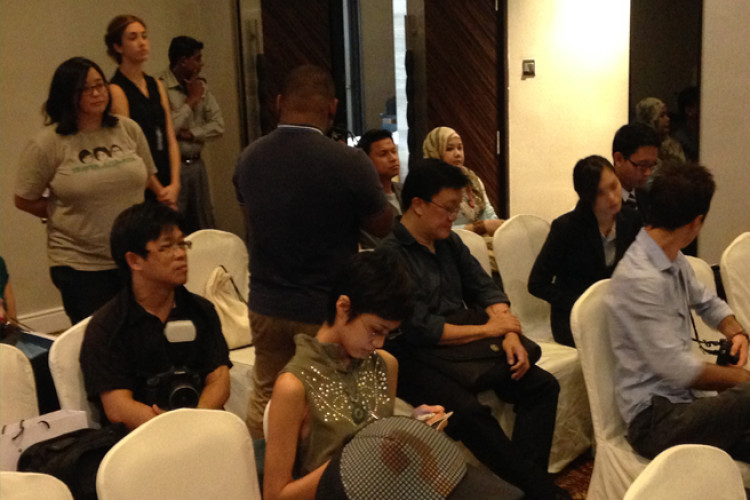
On Friday, November 22, 2013, Tropfest SEA held a press conference at the Majestic Hotel in Kuala Lumpur to introduce the festival. The first managing director of Tropfest SEA, Joe Sidek, gave his introductory remarks before he introduced one of the festival’s regional ambassadors, Thai independent film director, .
Mr. Weerasethakul is the director of (2010), (2004), and (2002) – just to name a few of his long list of accomplishments. Known for his unconventional style and surreal plots, there are indeed high expectations for Mr. Weerasethakul’s contribution in the festival’s live judging session that will take place in Penang in January 2014.
When asked about the process of making films, the soft-spoken director said that it is spontaneous, and that “the more you make them, the more you know what you are feeling, and what you can or can’t do.” He also highlighted how making films has helped him to shift perspectives, and film is essentially about “making oneself immerse in the memory of others.”
With such a big festival involving respected individuals such as Mr. Weerasethakul coming our way, it is hard to contain the excitement. We are only a few months away from seeing some of the region’s emerging talents. Let the countdown begin!
-
For more information, please visit Tropfest SEA’s official website.
Nowadays, many of us use our phones to check the time instead of relying on good old-fashioned watches. But a phone cannot reflect the character of its owner in the same way a watch can. Watches are more than just tools to tell time — they are also tools of self-expression. Here is a selection of products available at The Watch Co.
Abebe Tinari is back to challenge common conceptions about video games, and give readers some food for thought that goes beyond the commonly-heard topics about games. In his previous piece, Abebe examined the role of violence in games, not as a sick indulgence of maladjusted creators, but as a tool for symbolic expedience. This month, he addresses another long-standing fascination of the game industry: realism.
On November 19, Whiteboard Journal hosted our fifth meeting at Kinokuniya Plaza Senayan. This month, we focus on the concepts of “place” and “space” in everyday life. How do we perceive our workspaces? To what extent do we feel attached to our “homes”? By sharing our personal experiences or reflections, we tried to answer such questions.
- The word “home” means different things to different people. Some participants think of a physical building that will always be waiting for them, while others think of it – to borrow Avianti Armand’s analogy – as a “place of transit.”
- While the home is often considered as a private space, it actually consists of the multiple privacies of its inhabitants. The sum of these privacies gives “life” to the building itself.
- A place becomes a place once it can be associated with something – a memory or a feeling – otherwise it is just a space that can be easily replaced.
- The typical living arrangement in Jakarta is still very family-oriented. Many working individuals still choose to live with their families even when there are no financial constraints. This might be explained by Indonesia’s collective culture.
- However, those who do choose to live independently do so for two possible reasons: Due to practical reasons (to be closer to their workplace/university) or because they want to break away from the standard arrangement (to create an alternative way of living).
- Some offices have cubicles/partitions while others do not. There are downsides and benefits found in each one, but the effectiveness highly depends on the nature of the job.
- What is a major difference between public and private places? Rules. While the former typically has clear rules that allow or prohibit certain actions, the latter operates according to unwritten rules that are based on mutual expectations of the involved parties.
- While the number of cafes in Jakarta has been increasing at an impressive rate, the “cafe culture” as we know it today is actually nothing new. It is merely one that reflects the current society’s buying power. The tendency for Indonesians to “nongkrong” (hang out) has always been around.
- Social media has changed the way people perceive boundaries. We are rarely aware of the distance that separates our online friends and us.
- Laptops, smartphones and tablets are portals that take us away from the physical places we are in. Can our technological habits change our need for space? Will people of the future be content with smaller living places?
--
We would like to thank those who came and contributed to the fifth We Discuss meeting. We hope to see you again in future discussions. Look out for announcements about next month’s discussion on our website’s blog and events section. Or check out our Facebook page, as well as our Twitter and Instagram accounts!
Working at home might sound like a good deal, but it is not as easy as it sounds. Coffee shops can be a good alternative, but it would be hard to concentrate with the endless chattering in the background. The most ideal option, however, might be Comma Indonesia. This co-working space located in South Jakarta could be the solution to all freelancers' problems.