We’ve already talked about education and national identity in the first two meetings. What are we going to discuss about this month?
Has the Internet era given birth to a global taste? In the case of fashion, Yvan Rodick, a popular blogger known as Facehunter, claims that the opposite is true. “People think being an individual is cool so they try to use elements that already exist from somewhere else but they would do their own mix, and in the end I think there is more diversity,” he noted in an interview with Whiteboard Journal. Are our standards of aesthetics in fashion shaped by the Internet’s diverse sources?
- If what Rodick said about individuality was right, does this mean that the Internet has given individuals the confidence to explore and develop their own tastes instead of solely relying on certain iconic figures?
- Have fashion blogs such as and become main references?
- Are print fashion magazines still relevant? Or has the Internet managed to turn the locality of magazines accessible to an international audience, hence creating the same impact as fashion blogs?
- Aesthetics vs. Function
- According to Auguste Soeasastro, more and more attention is paid to the aesthetics of fashion rather than its practicality. Can this emphasis on the aesthetic aspect of fashion affect the way people respond to beauty?
- What will happen if fashion turns into an object of art devoid of function regardless of the creative energy that went into it?
’s Sally Singer once noted that it is important to pay attention to cultural contexts in order to truly understand fashion. But since obtaining references from sources outside one’s own comfort zone, how should one know where one culture ends and another begins?
Does culture affect what is considered to be “good fashion”?
Tuesday, September 24, 2013
7—9 pm
Kinokuniya Plaza Senayan
(near the language section)
Jl. Asia Afrika 8
Sogo Plaza Senayan Lt. 5
Jakarta 10270
For further information, please look out for updates on our Facebook page and Twitter account! If you’d like to share your opinions, or if you have friends who’d like to share theirs, sign up via e-mail with the subject title “We Discuss” at ! If you have comments or questions, tweet us .
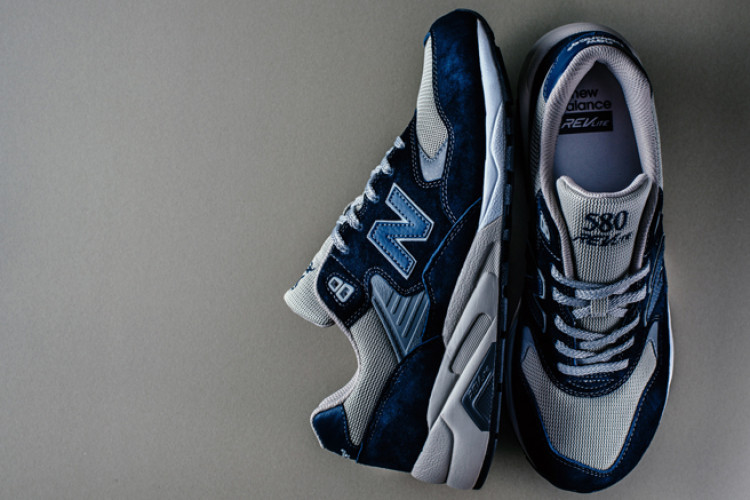
The Boston based brand, New Balance, introduces its latest MT580 inspired sneakers. Available in two colorways – the classic New Balance grey and navy blue – the collection still retains the suede/mesh upper of the original MT580, but it also includes a sole unit with Revlite cushioning. Revlite’s technology is popular for maximizing the comfort of the wearer, and also because of its lightweight feel.
But that’s not all New Balance has to offer this season. The winter 2013 collection also consists of three models that are available in grey-blue, indigo and red. Unlike the Tier 1 models, these ones feature Nubuck leather/mesh uppers.
The come in sizes 5-11 and 12 (width D).
For further information, click here.
More often than not, fashion is associated with runways, exclusive brands, and a highly competitive industry. But step out of that superficial mindset, and you will discover many ways to understand it. The clothes we wear as well as the accessories we choose say so much more than we think. This month, Whiteboard Journal offers a selection of 10 books related to fashion, with the courtesy of Kinokuniya Indonesia.
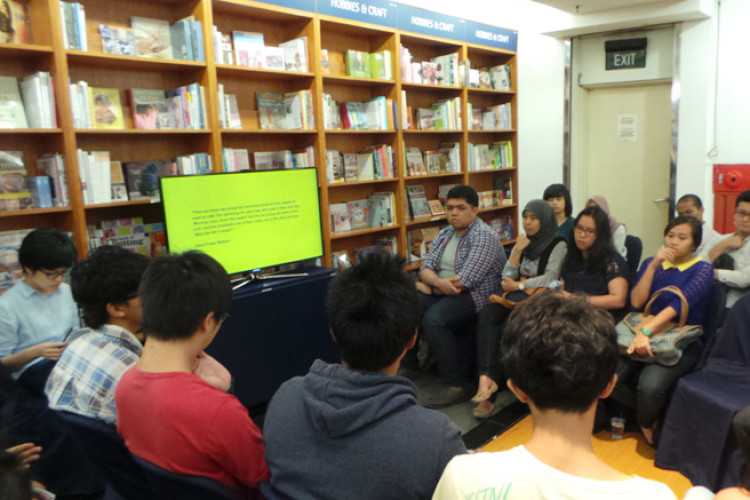
On August 27, 2013, we had our second event at Kinokuniya Plaza Senayan. This month’s theme is national identity, which is a big part of who we are and aren’t (or believe to be or not be), whether we realize it or not. A majority of the participants who voiced their opinions have experienced living outside their home countries, and can therefore compare and contrast different ways of life.
Despite the nomadic tendencies of the current generation, and how migration – both in the physical sense and that achieved through the Internet – has made national identity more fluid, the values of one particular city, region or country still prove to be more dominant than others in a person’s life. While travelling and relocating can indeed expand one’s point of view, there is still one main reference point that is used as the basis of processing new information and experiences.
- It is almost impossible to come to the conclusion that there is only one single sense of national identity. As one participant noted, everyone has multiple layers of identity – citizenship, ethnicity, and worldview. All aspects need to be analyzed if one seeks to have a deeper understanding of one’s own national identity.
- Another participant highlighted the difference between the state and the nation, and how one typically has a strong relationship with only one of the two.
- There were also repetitive comments on the flaws of Indonesia, as well as how they can or cannot be fixed. Here, the big question was whether we should look at more advanced nations as an example to simply emulate or use as references that we adapt to our own context.
- Following the previous point, it also becomes apparent that comparing ourselves to our past selves as opposed to the current state of others will be more useful if we aspire to improve and develop.
- In the international setting, Indonesia is still regarded as a “third world nation” despite signs of modernity across the country (particularly in the big cities). Participants argued on how to cope with that label. Have we come to accept that label by simply ignoring it, or does it serve as an incentive to show what we are capable of? Is it even necessary to prove others wrong? Would it benefit us?
- History, and the relationship that we have with the history of our nation, was also one of the popular topics in last night’s discussion. Do we need to understand the past in order to strengthen our sense of belonging?
Since the discussion’s participants were mostly Indonesian citizens, most of the topics were heavily focused on Indonesia. However, it is clear that with the Internet, those who had never lived abroad are also exposed to foreign culture, politics, ideas, public figures, etc. – even if the depth of their involvement may vary.
The combination of physical and cyber migration has brought us to the idea of “world citizenship.” Perhaps this generation is more connected with the world compared to those of previous eras, but what if the connection remains at a philosophical level? Would a legitimate document enforcing that sense of connectedness with the world change the way we make sense of our existence? Would it make us want to become members of smaller groups, even if it is not based on nations (e.g. interests and ideologies)?
When the Greek philosopher, Diogenes announced, “I am a citizen of the world,” was he just being philosophical or did he have something more practical in mind?
If you would like to share your thoughts on any of the above points or respond to the questions, please feel free to tweet us @wjournal #WeDiscuss. Or send us an e-mail to with the subject title “We Discuss #2.”
The Whiteboard Journal team would like to thank those who joined the second We Discuss meeting. We hope to see you again in future discussions. Next month’s theme is: . Stay tuned for the specific topics!
Just as a building needs a strong foundation to stand tall, a nation would crumble into smithereens without its cultural roots. The traditional dances of Indonesia provide us with the opportunity to build a stronger nation identity while preserving the country’s diverse cultures at the same time.
We Discuss #2 is coming up! Last week, we posted this month’s theme and topics. Below is a short list of materials that will hopefully be useful in the discussion.
Crossing Borders with Dave Lumenta
“With a country as an identity, people tend to categorize what you can do and what you are like. Sometimes it is a stigma. A nation’s identity can facilitate many things as racism and segregation.”
If the saying goes “Don’t miss the forest for the trees,” perhaps there is also something that needs to be said for the opposite. Focusing on the bigger picture – the forest, or in this case, the country – will make us forget about the individual dots and lines – the people. And yet the so-called passport country is still a big part of a person’s identity, making it difficult to get rid of stereotypes and discrimination.
“There are these two young fish swimming along and they happen to meet an older fish swimming the other way, who nods at them and says ‘Morning, boys. How's the water?’ And the two young fish swim on for a bit, and then eventually one of them looks over at the other and goes ‘What the hell is water?’”
To summarize his little story, Foster Wallace then said, “The point of the fish story is merely that the most obvious, important realities are often the ones that are hardest to see and talk about.” Are we, like the young fish, unaware of the environment – whether cultural, political or otherwise – that shapes us?
The transcript of the original speech is available here.
by Colum McCann
"It struck me that distant cities are designed precisely so you can know where you came from."
Do we need to leave “home” to understand it better? How does migration, or even travelling, affect our sense of self with regards to our country of origin?
by Michael J. Sandel
“With belonging comes responsibility. You can't really take pride in your country and its past if you're unwilling to acknowledge any responsibility for carrying its story into the present, and discharging the moral burdens that may come with it.”
How relevant is national loyalty in a highly interconnected world such as the one we live in today?
(For those who are interested on the topic of justice, check out Michael J. Sandel’s series of lectures here.)
by Richard Bellamy
“Just as citizenship seems to be becoming the universal panacea for every problem, it seems that the really distinctive aspect of citizenship – that’s participation in voting and elections, and in collectively solving problems through forming a government – seems to be in decline. Everywhere that you have elections, you’re now seeing fewer and fewer people involved.”
He speaks about lower levels of political participation, and how citizenship is transforming into something that is more private than public. Are nations a thing of the past? Are we now turning to clustered communities that pursue their own interests? Can this model actually bring about positive changes?
Richard Bellamy briefly explains the contents of his book in this video.
Tuesday, August 27, 2013
7–9 pm
Kinokuniya Plaza Senayan
(near the language section)
Jl. Asia Afrika 8
Sogo Plaza Senayan Lt. 5
Jakarta 10270
Please stay tuned to our Facebook page and Twitter account for more details! For those of you who would like to join our event, there is still time to sign up via e-mail with the subject title “We Discuss” at ! If you have questions, don’t hesitate to tweet us @wjournal.