




The Jesus and Mary Chain Gets Real and Honest About Themselves with Jimi Multhazam, Sunlotus, Nearcrush, and Peter Walandouw
Ahead of their set in Jakarta and Bali, we had longtime fans of The Jesus and Mary Chain converse with Jim Reid and William Reid, bringing everyone closer to the honest sides of everyone’s formative band.

Words by Whiteboardjournal
Sometimes revered as your favorite musician’s, favorite musician’s, favorite musician, The Jesus and Mary Chain has had their fair share of being involved in a range of mediums that most would call as ‘formative.’ With such weight in their name, one can only wonder – what does the sole of their shoes feel like? Do they get misunderstood by the press? Have people ever grab their pitchforks to their songs? How personal can they get in the making of their hit?
Your friends who are fans of the band may have questions along those lines, and so do these local heavy-hitters: From the Bandung-based shoegaze outfit, the guy behind notable shoegaze/indie rock bands that decorated one’s formative years, to Jimi Multhazam, these fans of The Jesus and Mary Chain prepared a set of questions that wishes to scratch that itch.
Catch their conversation in today’s Artist on Artist interview. Also catch their upcoming set in Bali and Jakarta, 26–27 November 2026, brought to you by Noisewhore, Junks, and Black Sand Brewery. Check out www.whoisjamc.com for more info on the tickets.

Image via Nearcrush
Nearcrush
For me, the use of “Just Like Honey” as the ending act for Lost in Translation (2003) is really epic and bittersweet. Do you guys like how the song was situated and timed in Sofia Coppola’s film? How did the process go for Sofia Coppola to contact you guys to use said single? And also, what did you guys think of the film?
Jim: It was a very good use of the song. It was very well placed in the film. I don’t really remember how it came about. Someone at our publishing company just asked if we’d be into it and of course we were. Yes, it’s a very good film indeed.
If you were to make Psychocandy today, will it still sound the same or even an entirely different thing altogether – sound and arrangement-wise?
Jim: If we made Psychocandy today it would sound completely different. A record is a snapshot of what you’re all about at that time. More than 40 years later our headspace couldn’t possibly be what it was like in 1985.
If The Jesus and Mary Chain were starting as a completely new band in today’s music landscape—where algorithms and social media shape discovery—do you think you’d still make the same uncompromising music, or would your approach be different?
Jim: Both I think. Compromise doesn’t have much to do with the way the music business is structured. There were things about the music business that we detested back then and I wouldn’t use the word compromise, but we had to work our way around certain obstacles. It would be the same today, it’s just that the obstacles are different. But ultimately whether it’s 1985 or 2026 you should just be making the best record you could possibly make. If you start considering things such as radio plays or digital streams then you’re putting the cart before the horse – it should always be music first.
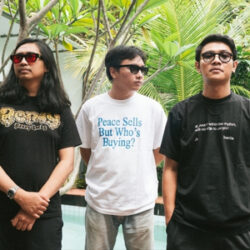
Image via Agung Hartamurti/Whiteboard Journal
Sunlotus
Has there ever been a big life-changing decision that does not have anything to do with music, but instead changes the trajectory of your songwriting?
William: No.
After being a public figure for decades, are there any sides of you guys that are almost always misunderstood by the fans or the media?
Jim: It’s a strange life to lead and you kind of have to create a 2 dimensional version of yourself that will make sense to people. Although people think they know who and what we are, they actually don’t. We’re very private people and the truth is actually kind of boring! But to say we’re misunderstood wouldn’t really be accurate either. Things are more filtered on a “need to know” basis.
William: I think people think that we are very dark characters, when the truth is that we are sweet and kind and vulnerable people who are just trying to make sense of this nightmare/dream that we call existence.
“Reverence” has the lyrics: “I want to die like Jesus Christ / I want to die like JFK.” What inspired said lyrics? And how do you react to the controversies that came about because of the lyrics?
William: The lyrics are inspired by life and death. I think most people are terrified by death while simultaneously looking forward to it in a weird way. I didn’t know that there was much controversy about the lyrics. It’s just a song for fuck’s sake.

Image via Hafitz Maulana
Jimi Multhazam
“The Hardest Walk.” A song about a broken heart that made me dance, it was also made in two versions and damn do I like all of them. What was the consideration to remix these songs to be more noise-friendly, and why must a song this beautiful be played less often as of late? P.S. Will you be playing it here in Indonesia?
Jim: I don’t remember remixing “The Hardest Walk” but we did rerecord it for a film soundtrack. I think it was called Some Kind of Wonderful (1987), and there was a guy producing the soundtrack of the album (I can’t remember his name). For us it was a kind of try out to see if we could work with a producer. In the end, we thought the original version was 100 times better than that version.
William: The remix of “The Hardest Walk” was done by Stephen Hague who was compiling songs for a John Hughes movie. I guess he was trying to make it more radio-friendly for the 1980s sensibilities. I prefer the Psychocandy original.
For William, can you tell us what it was like to record “Birthday” from the album Munki (1998)? The song sounded really personal, but it still managed to be as catchy as ever – still singable, and is a hit (at least for me personally).
William: “Birthday” was very personal. I wrote it at a time when I was struggling to make sense of the world and my place in it. I guess nothing ever really changes. Still struggling and still trying to set my thoughts to catchy music.
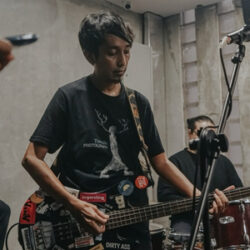
Image via Peter Walandouw
Peter Walandouw of Anoa Records
It’s been 4 decades for The Jesus and Mary Chain to still be together and making music. What is it that kept you guys enthusiastic in music in today’s age – where it’s a really different time from your early career?
Jim: We just really like music but don’t really like enough of what we hear other people doing. So if nobody else is doing it then why not us?
William: I think it’s difficult to keep enthusiasm going for decades. Sometimes I get very dispirited and discouraged by the music scene because I can’t connect to most of it. Thank god we came up at a time when rock and roll was still a potent force—it’s almost dead now.
There’s a million young people who chose to play in a band like The Jesus and Mary Chain, or at least to pose in front of a mirror and sing your songs – have this kind of scenario ever crossed your minds when you first made The Jesus and Mary Chain?
Jim: When the Mary Chain started the idea was to make music not just for the time it was recorded but for the future. We felt sure that people would still be listening to our music in decades to come. We would have seen the band as a failure had that not been the case.
William: Of course, I don’t think you would be a normal person if you didn’t fantasize or pose in front of a mirror when you are a teenager. I used to use a tennis racket as a guitar and play Bowie singing “Rock and Roll Suicide” and pretend that I was him. And that was only last week.
In terms of The Jesus and Mary Chain as a band, the fans, and the music industry – what’s something that’s so different in the 80s/90s and today? Is it all fun, or the other way around?
Jim: In the beginning it seemed more intense but kind of less enjoyable because there was always a feeling of “maybe this will end soon”. But it’s more than 40 years down the line and we’re still doing it so we have a more relaxed attitude because there are still people out there that enjoy what we do.
William: I don’t envy bands starting out today. Music was so much more important to young people in the 80s – it was a huge thing to see one of your favorite bands on television, for instance, and the rarity of that made the experience so much more meaningful and intense. I don’t think there is the same level of attention to music today because there are so many more distractions. It’s still fun, but it’s less focused.

Brockhampton Sajikan Kejutan Berupa Dua Single Terbaru, “N.S.T” dan “Things Can’t Stay The Same”

Men I Trust Siap Menggemparkan Panggung GBK Di Tahun 2023

Melawan Kepenatan Social Distancing, Yosugi Merilis EP Bertajuk “UNBOTHERED. UNMASTERED.”
