

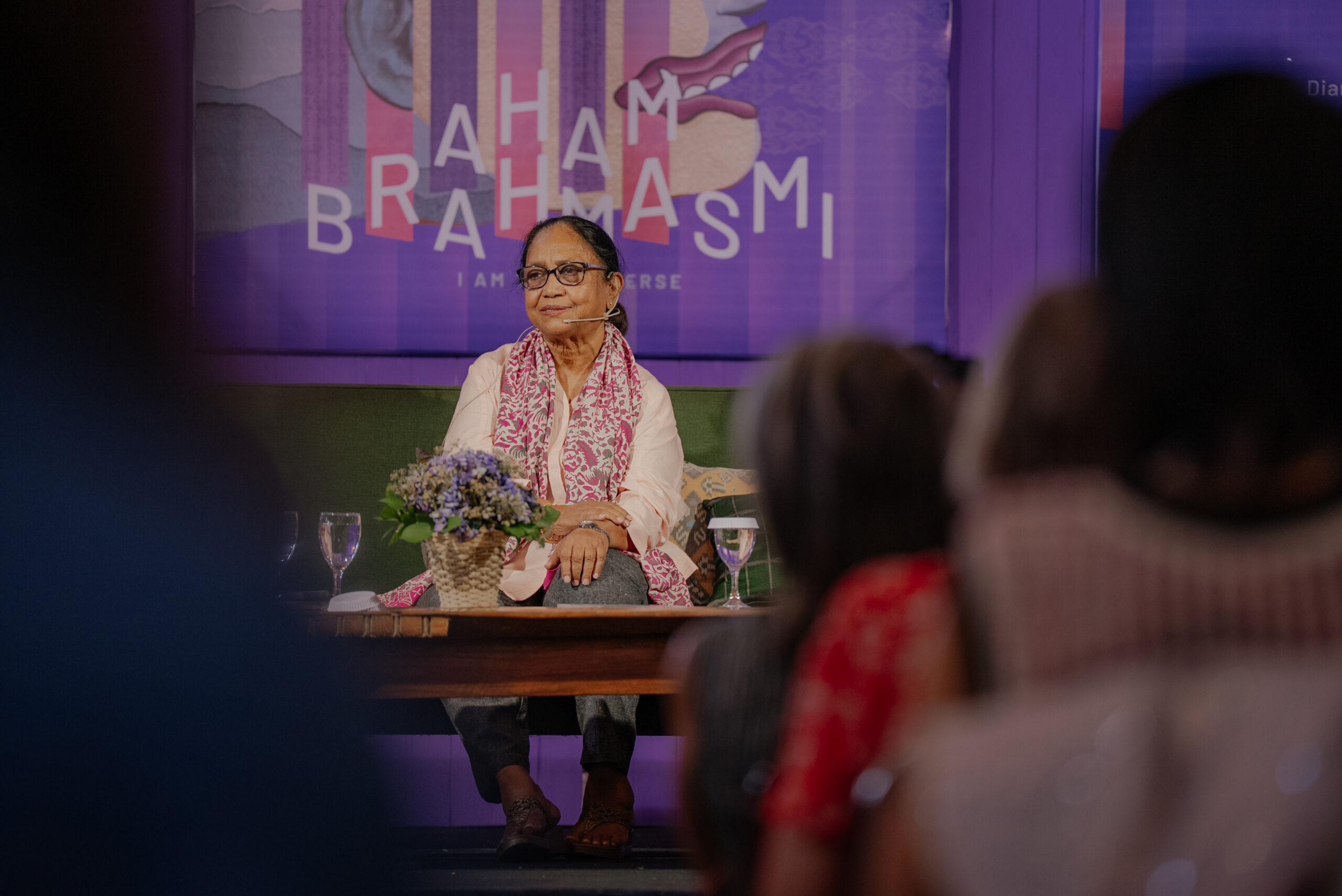


Banu Mushtaq: “In Indonesia and India, it’s only solidarity that can carry us further.”
We sat down with Banu Mushtaq during Ubud Writers & Readers Festival 2025, exploring her award winning book, Heart Lamp: Short Stories, and how solidarity can be one of the hopeful movement in tackling patriarchy.

Words by Whiteboard Journal
Words: Jemima Panjaitan
Photo: Prema Ananda/Ubud Writers & Readers Festival
When The International Booker Prize announces Heart Lamp: Selected Stories as the winner in 2025, Banu Mushtaq’s life changes.
As a kid, she grew up studying the Quran in a Muslim neighborhood in Karnataka, and has been exposed to the Urdu language. The official language of the Karnataka state, called Kannada, was an alien concept to her.
Decades later, Heart Lamp: Short Stories becomes the first ever Kannada book, recognized by The International Booker Prize as a winner. Translated by Deepha Bhasthi, who is also the first translator from India who won the prize. This is also the first time a collection of short stories won the prize.
Consisting of stories spanning from over 30 years, the book is an emblem of language and identity for the Muslim women of Southern India where societal norm, religion, and womanhood entwine. In an interview with The Hindu, Mushtaq believes that faith can become a source of comfort, but when weaponized, it turns into an oppressive tool.
Her years of being a journalist, activist, and lawyer has guided her of making a movement of cultural resistance. Her works have been published in radical Kannada journals, such as Lankesh Patrike and Sahitya Sangama, exposing the dominance of Hindutva and Islamic oppression, in which everything represses women and their autonomy.
Deepa Bhasthi, the translator of the book, also gives a phenomenal Translator’s Note. Titled Against Italics, Bhasthi emphasizes the importance of deliberately not using italics, for it exoticises a language, making it visible to a reader that it is imported from another language. This approach also helps readers to familiarize themselves with the Kannada language, since many of the words remain untranslated and brings a lot of cultural knowledge and context.
Through Heart Lamp: Selected Stories, Mushtaq guides us into the struggles of living in a place where religious conservatism molds the norm, where caste discrimination is the dividing line in Southern India, where women are discarded from entering the mosque.
The stories you found in Heart Lamp, transcend the prison of faith and cultural traditions in India, for these stories can be found throughout generations of women in every culture, countries, and ethnicities, where everything developed into a survival guide for living in a world shaped by men. Remaining grounded in her community, Mushtaq’s stories candidly capture and translate how patriarchy operates and is engrained in our system.
Your debut appearance in English, Heart Lamp: Selected Stories, has won the 2025 International Booker Prize. How has that changed the way you view writing? Is there any strategic change you want to make in the way you write and curate the stories?
It’s quite natural to change as a writer, because we write about exploring our experiences. After I won The International Booker Prize, I changed so much. I am exposed to a different world, and there’s a lot of different experiences I have encountered.
Naturally my writing style and my thought process will be changed. Because writing is sprouted out of the thought process, experiences, and then the synthesis of it comes out. Naturally, it is going to be different now.
With winning the prize, you have gained a lot more of an audience—especially with it being translated from Kannada to English. Has this made any impact on other Kannada writers and the literature scene?
Well, in Karnataka, India, not many people knew about the impact and the importance of The International Booker Prize. But then, they announced that the winners are me and Deepa Bhasthi (author and translator of Heart Lamp) and we are both from Karnataka. It was big news and had a lot of coverage. Due to these things, almost all the Kannadigas came to know about the book, the power of translation and it reaches a wider audience. After that, a lot of Kannada writers, readers, everybody who is interested in literature, they want to gain a wider audience and I also think it changes our thought process.

Image via Prema Ananda/UWRF

Image via Prema Ananda/UWRF

Image via Prema Ananda/UWRF

Image via Prema Ananda/UWRF
You wrote Heart Lamp in the span of over 30 years, it explores a lot about the society in Southern India under the fault lines of caste, religion, and class. Has the condition of the society improved as you finish writing it? What has changed over the years, and if they haven’t what struggles that still happen daily?
For every 10 years, normally there will be drastic changes in the way the people are living, their conditions, their thinking process, their resources, everything. It will be changed a long way.
In the 30–40 years of my writing, the people, alongside with the resources, the income, socially, everything has changed. But because of the existence of computers and technology, the state of Karnataka has become a computer hub. It’s like the Silicon Valley of India, so a lot of people from all over the world come to Bangalore, to Karnataka, and naturally it changes people’s education and income a lot. But when it comes to social norms, people have become more stringent.
How about the patriarchy? Is it still as bad as 30 years ago?
It is even worse. Patriarchy has taken its worst possible position now.
What happened in the stories in Heart Lamp, I do believe that similar conditions are also happening to women in Indonesia, especially with the religious conservatism we have to battle everyday. How can us women tackle the challenges of living in the middle of such society?
The way my characters have tackled it is without breaking their fabric of marriage, and in their own way, they have rebelled against the system, against the patriarchy, against the household violence they are getting, all those things. And there are various women’s organizations at home who are striving for the betterment of the life of women. In Indonesia and India, it’s only solidarity that can carry us further.
View this post on Instagram
Your book has been translated to many languages, and you are a translator as well. What are the important things to ensure cultural sensitivity still exists in the translated version of the book?
In my stories there is universality, there are women’s issues and patriarchy, and the challenges of systematic oppression. All these things cross borders, that’s also what the chairman of the International Booker Prize thinks. Universality means it is not only confined to one place, it spreads. And I think this plays a part in keeping the cultural sensitivity in the stories. When universality is applied, it also becomes everyone’s stories, they will contemplate on those stories. And at that juncture, whoever the translator is, I’m sure they will be highly careful towards the culture displayed in those stories.
Between all the 12 short stories featured in Heart Lamp, which story do you think is the most meaningful or heartwarming to you? And why?
I cannot discriminate and choose one of my stories because all of them are my works. They are born out of my mind and heart. I am like a mother to those stories and a mother doesn’t discriminate against her children. The stories are all dear to me. It is the readers who have to say which appeals to them more, they can say one is dearer to them compared to another one. It is the reader’s words to say, not myself. I cannot discriminate. Which one was your favorite?
I love that one where the mother-in-law, wife, and husband are all fighting, I think it’s called A Decision of the Heart.
Can you recommend any Southern Indian or Kannada female writers to read?
There are a lot of them. I cannot even recommend them because I myself take up whichever good book the other writers have written. There are hundreds and thousands of writers, the best writers. Kannada has got a very beautiful literary tradition. The Kannada language is about 2000 years old and it is rich in literature, the tradition, art, culture and literature. They [Kannada writers] need to be exposed, They will be known by people when their works get translated to a proper format.

Artist on Artist: Petra Sihombing Interviewed by Hindia, Nadin Amizah, to Aya Anjani

Barakatak Bercerita Tentang Promosi Musik Melalui Pembajakan Hingga Stigma Kelas Bawah untuk Funkot

Bam Mastro Berbagi Cerita Di Balik Proses Berkarya
