

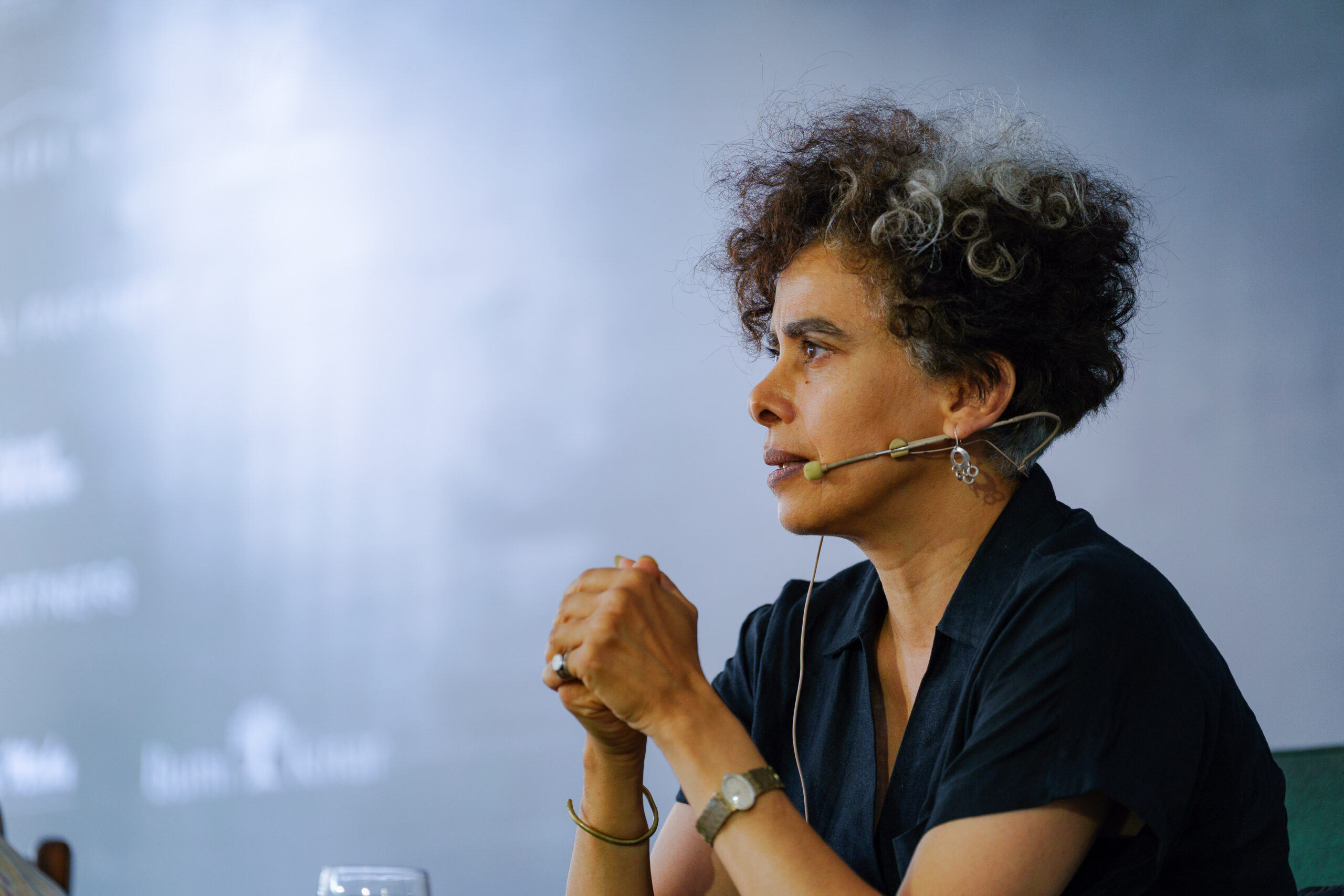


Adania Shibli: I’m not afraid of censorship, my fear is when we don’t have a language at all, when we have all the freedom but we’re still unable to find the words to narrate it.
During Ubud Writers and Readers Festival 2026, we had the chance we had the chance to sit down and have conversations with Adania Shibli, where we talked about Minor Detail, Palestine, literary force, resistance, language, and culture.

Words by Whiteboardjournal
Teks: Jemima Panjaitan
Foto: Yuda Wijaya
When the whole world is chanting “Free Palestine!” every now and then, it was not the case for someone in the Upper Galilee during the seventies. Gasps of shock are more of a natural reaction, more fitting during the era when Palestinians were more accustomed to saying “the land of sweet oranges…” when people ask them where they come from. Nonetheless, young Adania Shibli wondered, she ought to know, why are the oranges sad?
In her early career as a translator for news outlets, she found herself looking upon wrecked houses which were caught in a fire. One of the victims then complained to her and asked her to tell the journalist about their lost identifications. Shibli argues in her mind, how would the journalist see the importance of a Palestinian identification card? What would be the narrative that comes from it? Would it be necessary information for them?
In this rumination, Minor Detail by Adania Shibli was released in 2017, later it was translated into English in 2020. This book explores the undermined voices of Palestine, about stories that won’t make it into news headlines. The story began in the summer of 1949, just one year after what Palestinians know as the Nakba, the displacement and expulsion of more than 700,000 people.
A young Palestinian girl was captured by a group of israeli soldiers, raped, and buried in the sand. Decades later, a woman from Ramallah becomes curious with this minor detail in history, that coincidentally occurred on her birthdate. She then tries to investigate the case independently, only to be met by checkpoints, logistics problems, and bureaucratic obstacles.
Back at Ubud Writers and Readers Festival this year, we had the chance to have conversations with Adania Shibli, where we talked about Palestine, literary force, resistance, and language.
Your book, Minor Detail, is built on small, precise facts. When did you realise that the smallest detail could carry the weight of the whole story?
I would say… it is because the literary sensibility that I grew up with, or the linguistic sensibility, and the realizations, due to the erasure of Palestinian life, what happened in 1948, erasure of life, erasure of villages, and even erasure of generation, because we have no access to what has happened there.
The only things that we still could see are traces of this destruction, and that’s the moment when you realize that in fact, your story, your narrative, your language, and even your presence is in the remnants of destruction. If we are talking about the major story, if you’re at the center, the center is what gets destroyed, and it already has been.
So the minor, the things on the side, the things no one notices, are what managed to escape erasure, destruction, and annihilation. You see the remnants of a wall, or of a house that is the only thing left of a village that once had so many houses and so many lives. That house becomes the small detail that holds a story that has otherwise been completely erased.
The novel is separated into two parts, and the second half feels very different in rhythm and perspective. How did you decide on that structure, and what did you want the reader to feel in the gap between them?
Writing this novel was similar to taking a path in the darkness, in the vagueness. I was moved by things that I didn’t know of and they are so much like any literary force.
It moves you in ways beyond clarity and this force was perhaps a culmination of realizing that the narrative is so much destroyed that it doesn’t exist. And whose narrative exists? The Palestinian narrative is the narrative that is being attacked, the narrative that is being doubted, the narrative that is saying, “no, this didn’t happen.” It’s always a subject of doubt.
Whereas the israeli narrative, by contrast, is the narrative that is supported by power and force. It’s a narrative that is supported by archives, because they hold the power over the archives. That is why it is considered to be the reliable one.
How many times do we question the israeli narrative? And how many times do we question the Palestinian narrative? And I grew up with this, and the Palestinian narrative is the one that is always doubted, the one that is not believed, the one that is not trusted, and therefore it is abandoned.
So I was wondering what this form of narration in literature means. What kind of literature comes from this form of narration? These were the forces that moved me to the moment of writing.
In fact I wanted only to write one part, which is the point of view of the israeli officer, because I wanted to examine this violent narrative, the narrative that convinces everybody, even in literary means, that it has a clear character, a voice that you can trust, a voice that you don’t doubt. This kind of protagonist, he’s very clear in his movements and in his perception.
He could be the trustworthy protagonist, whereas the Palestinian girl in the second part is the untrustworthy one. But when I finished the first part, the unreliable narrator of the second part insisted: “I also want to tell a story that nobody thinks is important.”
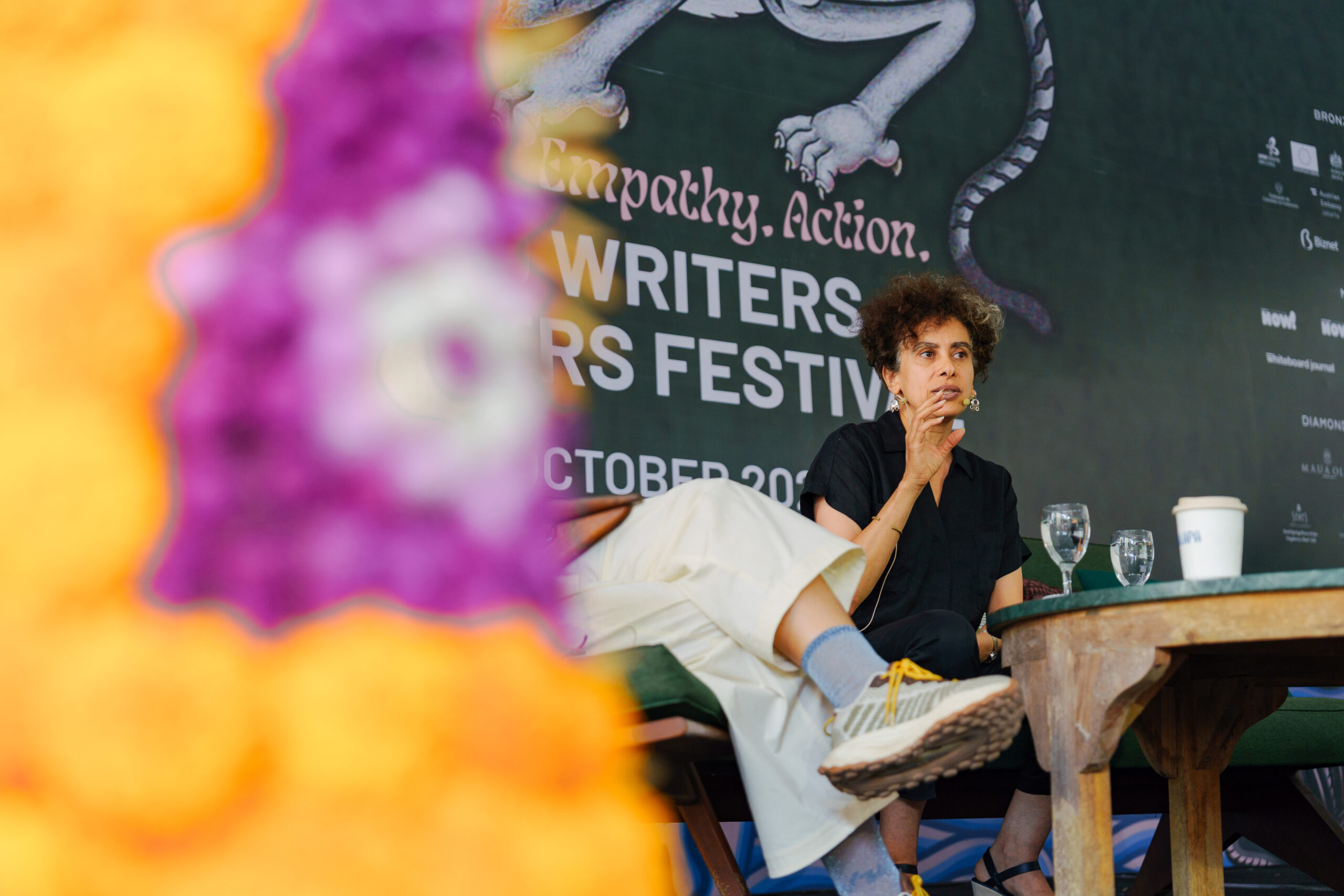
Image via Yuda Wijaya
This year’s theme for Ubud Writers Fest is awareness. As an author, do you think awareness is something the author gives the reader, or something the reader has to earn through the work?
I’m less interested in awareness itself than in the process that leads us to it: a process of openness that allows something new to enter. Writing and reading are the same process, though each begins from a different entry point. So it isn’t that the writer gives something to the reader, or the reader to the writer. It’s something both of them find in the book.
In the second half of Minor Detail, much of the tension comes from ordinary logistics, such as renting a car, reading a map and approaching checkpoints. Why did you choose to filter the enormous, historic weight of the occupation through these mundane, everyday anxieties rather than through grand political statements?
I don’t see writing only as a tool to express something. It’s really connected to questions that really follow me through time in writing. This goes back to the second novel which is titled in English We Are All Equally Far From Love. After finishing it, I noticed that the characters don’t move. I was struck. In fact, I didn’t realize that they don’t move. A friend of mine told me, your characters don’t move, they are very static because you write from a condition that your movement is being attacked. And this is the whole idea of checkpoints, of wars, of this division. You cannot move. The occupation also occupies your own movement.
So I said, just as a joke, “Oh, my next novel, I’m going to have my character go everywhere.”
This somehow brings what it means to have your character move everywhere in a place where movement is being attacked. This movement was important because the second part of Minor Detail is about going and moving and investigating. Going to a crime scene. How can you investigate if you don’t have the tools of investigation? And what prevents them? This is somehow also a reflection between a desire to move, the impossibility, and the difficulty to move. How our desire is being limited by reality in terms of literature, and by literary means. How the desire is crushed by conditions and reality.
You spent years working on a story that took place in 1949. What did you discover along the way, and did any of it change what you thought the novel needed to say?
I don’t like to connect Minor Detail with real events, because we will never have access to the real story. We will never have access to the voice of the victim or to what the victim felt. So I don’t think I have the authority, or the position, to know what the victim felt. The same applies to the present.
There is no way we can have access to their experiences. Access to the murdered, to the massacred, to those who are being annihilated. So, the book is a lot about an investigation of this impossibility. It’s about not being able to access something in reality and the only thing that allows you to question your ability of not accessing reality is in fact fiction.
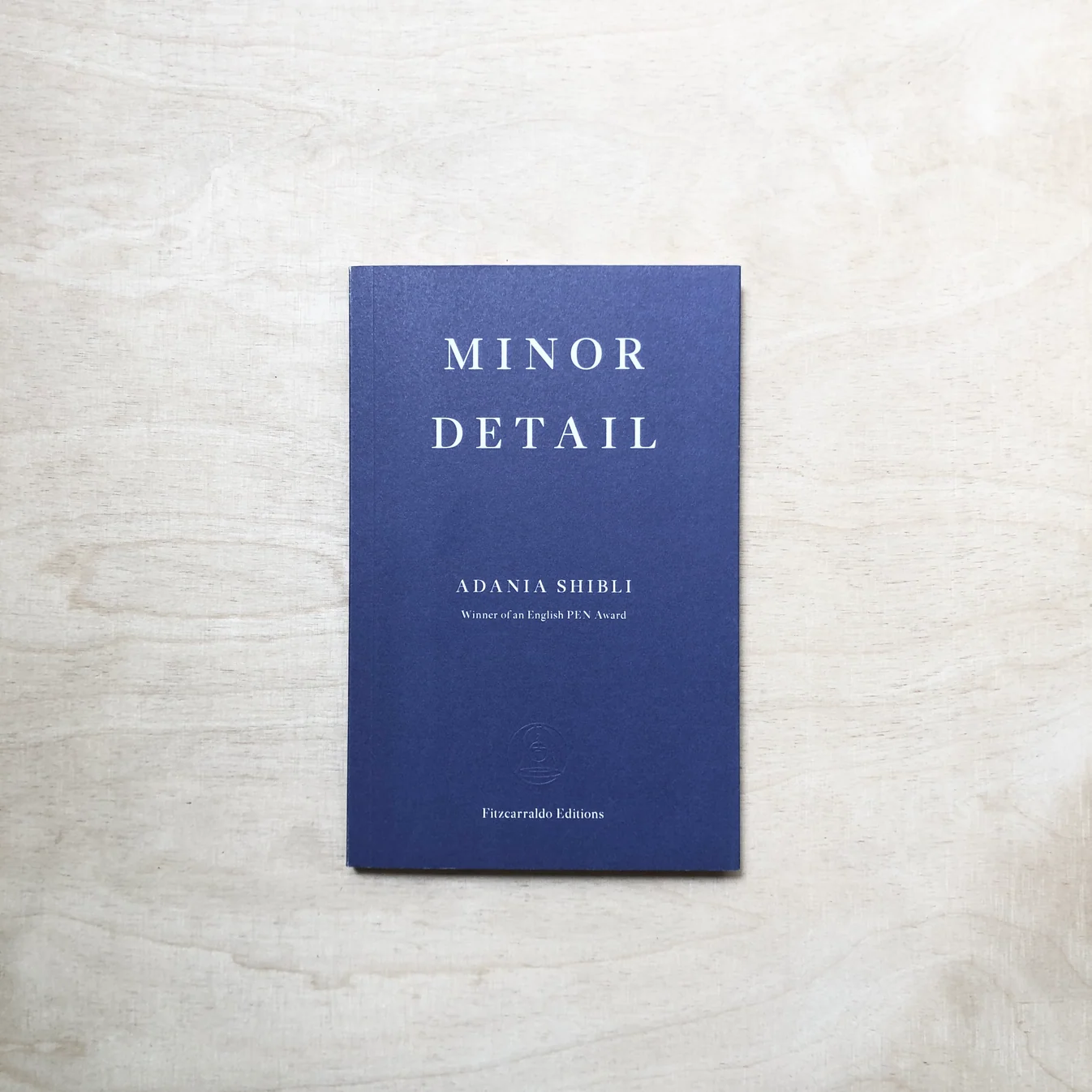
Image via Zabriskie Buchladen für Kultur und Natur
My book is a way to address the limits of reality and how fiction can open you to a different way of approaching something that you cannot have access to.
Your new book, Tamwih (translated into Delusion in English) comes eight years after Minor Detail. How has your writing changed, and what drew you to this new subject? And over that time, did your understanding of the world change?
So I finished Minor Detail in 2016 and I worked on Tamwih which was published in 2025. So we’re talking about nine years. In these nine years… with every book I’m writing, I’m being pushed with certain questions and certain investigations and the end of this investigation is not realization, but even more investigation.
When I came to write Minor Detail, the question was a lot about the narrative structure: what kind of trustworthy characters can you write when you’re not able to narrate? So once I finished this question, it became what it means to have characters at all. If the characters you witness in your life are always being sidelined, and never be the main characters, then even the language itself participates in making them secondary. This is exactly the new form of investigation. I describe my writing process as digging: each time you don’t find answers, you find clues to lead you somewhere else.
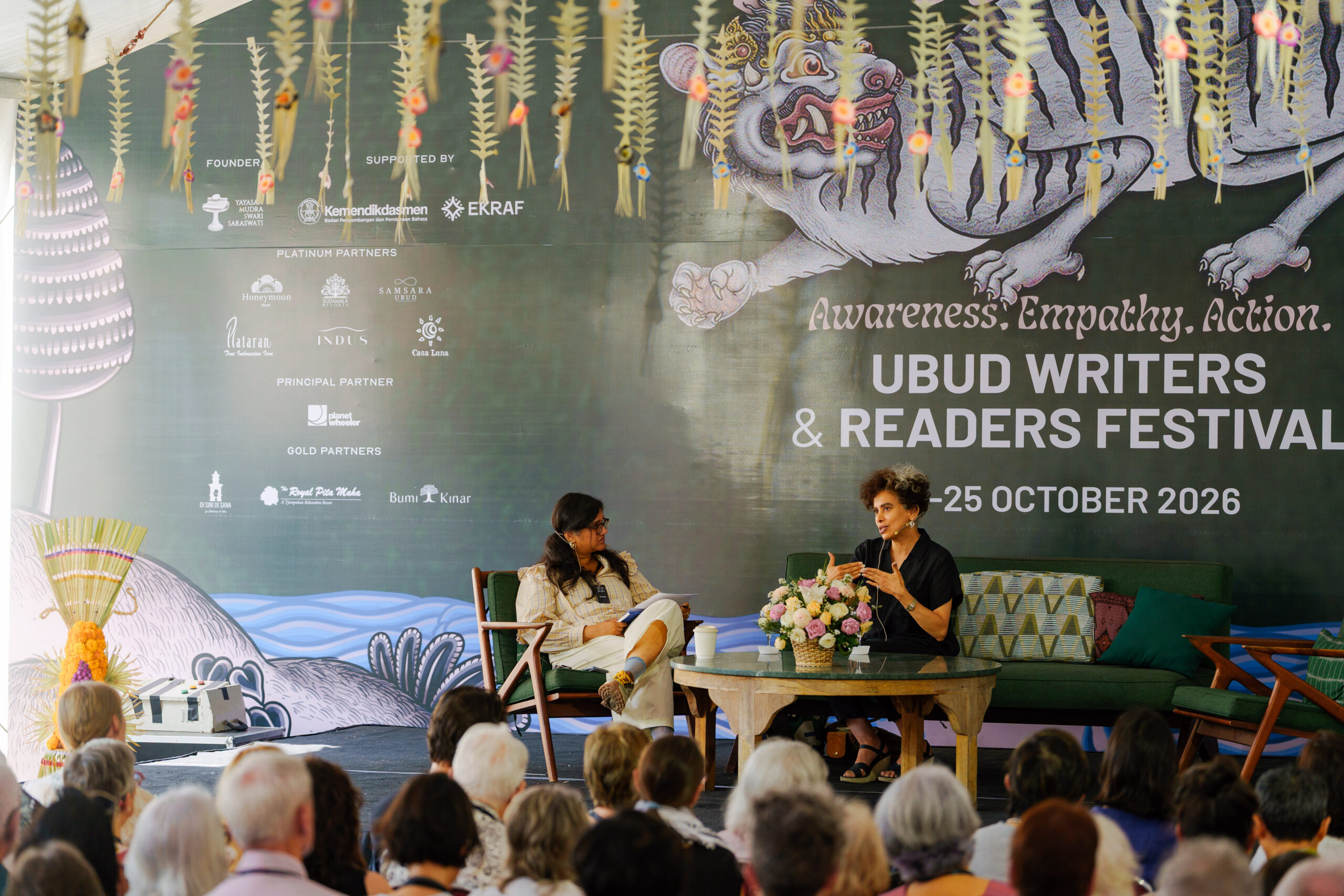
Image via Yuda Wijaya
Your book has travelled further than many Palestinians are allowed to. Minor Detail now has been translated into English, Dutch, and even Indonesian. What does it mean to you that translation lets it cross those borders?
I think by now it has been translated for more than 40 or 45 languages. I don’t keep the count. I love language, I love Arabic language, but I love all other languages. As a kid, I dreamed that if I put a dictionary under my pillow in the morning, I would wake up and I would know that language. I tried it and it didn’t work, sadly. But now I see these translations, a fulfillment of a certain dream, the dream of polyphony, of languages, of a book. Maybe I can’t speak all these languages, but the book can speak it.
In the same way that so many other books speak Arabic when they are translated into Arabic. This is very important. In a way, it’s like being guests in different worlds. It only gives you strength and trust in those presences.
I would love to see so many books translated into so many languages. And to allow this ‘hosting’ of different ideas. When we go as guests in a home, this is not a home like ours, but it opens to us. So we can have different experiences.
I actually want to point out one thing that you mentioned in the discussion earlier. You said that in journalism, sometimes the story is limited. Young writers and journalists often feel they can’t speak plainly about oppression without being silenced. Can writing about small, everyday details, the way Minor Detail does, be a way around that, or is it only effective in certain situations?
There is not one answer to this. I think it is very important that we keep investigating and keep asking. I’m not afraid of censorship because censorship means you know what you want to say is being forbidden. The one who suppresses the information is the problem, not you. It’s a matter of how you share it with others.
My fear is when we don’t have a language at all, when we have all the freedom but we’re still unable to find the words to narrate it. When it’s taking words away from you, this is linguistic helplessness. You become helpless in language.
For me Minor Detail was an investigation of why words are taken away. The violence involved in taking it away. And I think what we should do is to not give up and never to surrender. We have to maintain the possibility of having the language. If we don’t find the words, we borrow another until we find the right words.
Your panel asks what risks writers take when they challenge prevailing narratives. Do you think that taking risks is always necessary, or can writers challenge the narratives in their comfort zone?
In regard to this, I would like to talk about something else. It’s about fear. I’m very interested in that emotion because it means it’s just a step from being aware that you need to do something. But you’re unable to take it because you’re afraid. This is a moment when you are suppressing yourself and the others also keep suppressing you.
So, what does it mean to cross fear? This is a very important act, it’s not the same as taking risks, you have to cross this emotion of fear. To go through it. Because whatever they’re hiding in fear is in fact an imaginary obstacle.
Even if risk is part of that fear, it’s something imposed on us. I think we need to walk through our fears without thinking about risk or comfort zones, because even our comfort zones are full of fears. We just need to walk through them.
Is there any side of Palestine that people need to know of? Maybe about their art or books? Any recommendations of authors?
Gaza was a main center in the last 20 years with amazing art and writing initiatives. In fact, the main literary magazine was created in Gaza. So there are so many writers and artists from there.
Sometimes when I think about Palestine, about the level of destruction that it has been subjected to. The only thing that continues to hold us together is culture—the literature and the art. It allowed us to continue to be together.
I would recommend you Rana Batrawi, Shareef Serhan, a visual artist, Basel El-Maqousi. There are also writers like Mohamed Al-Zaqzooq and Bissan Nateel.
I would also really recommend writers from the early 20th century until now. I would suggest Samira Azzam. I read her as a teenager, and she influenced me so much. She was writing in the 30s and 40s and experienced the Nakba. Ghassan Kanafani is a well-known writer. He was assassinated by israelis. Fadwa Tuqan is a poet from Nablus. But today we also have so many amazing writers, I would recommend Nasser Abu Srour. He wrote a book called The Tale of a Wall, and he wrote it from prison. It was published in the U.S. by Other Press. In that book, you see how those who are in prison offer us the language of how to proceed in life outside the prison.


