When an artist picks the tools of his or her trade, it is often a matter of preference. However, it is important to remember that there is also a purpose that is parallel to the age in which the artist lives in. In the first essay of her series, Kriztille Junio offers a personal insight into the artistic medium and how it evolves with technology.
While books certainly have more than enough power to unleash the powers of our imagination, there are times when we surrender our favorite stories to those who can make them come alive for us. This month, with the courtesy of Kinokuniya, we recommend 10 novels that have been interpreted to accommodate the big screen.
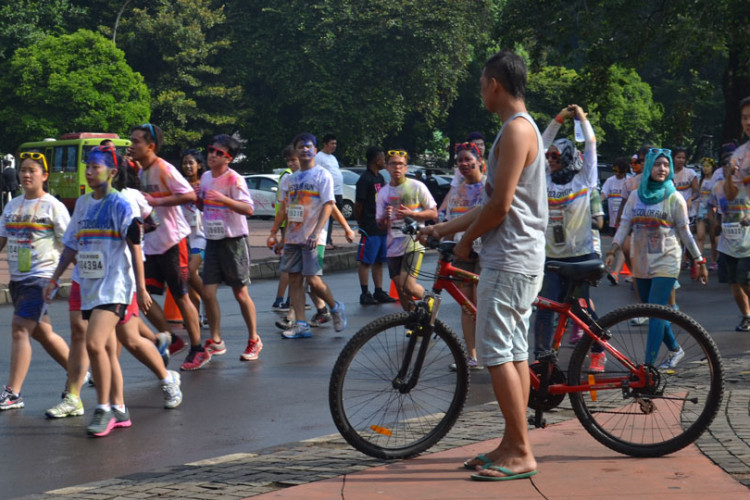
“Walking is, in addition to being a healthy endeavor, also an effective means of travel,” writes Tama Salim. He is convinced that, if given the chance, Jakarta can be a pedestrian-friendly city. In the second part of his essay series on walking, Tama sets out to debunk the myth that the residents of Jakarta are reluctant walkers.
Despite the pervasiveness of music in our daily lives, last night's discussion proved that there music is made up of multiple layers. In order to understand music, knowing what or who we enjoy listening to is not enough. Below are some of the points that were brought up during last night's discussion:
- Because music is so difficult to describe, the most important thing is often our reactions. Those reactions are the most crucial part of music.
- The musical experience – that is, our listening habits – are mood-based. It is usually the case that we look for songs that would intensify our emotions at the time. Music, in a way, amplifies and perhaps even justifies our feelings.
- Instrumental music vs. songs: both songs evoke different feelings and reactions. The former often conjures impressions whereas the latter produce a clear image/narration.
- On the social significance of music: we typically listen to music that we can relate to. Music does not only affect a person on an individual level, but also at a more collective and cultural level. , for instance, usually includes lyrics that tell the story of a person’s life in a given socio-economic context.
- Stereotypes affect how we listen to music, and whose music we listen to.
- Our appreciation towards music is often related to time. This is perhaps why the idea of a “generation” is very strong in the context of music. People who have gone through similar social experiences are more likely to relate to the music produced during a particular era.
- DJing is both active and passive since the DJ plays as s/he listens to the music.
- On sampling and originality: sampling is not a second-rate pursuit in music as it involves the active selection of existing material to create something new.
- It is difficult to separate music and the creators (though sometimes it depends on the genre).
- Music is first and foremost a form of entertainment; the message can come later (once the listener has familiarized his/herself with the music).
- Music is intrusive. It is not like text, a medium that allows people to choose their involvement with it.
- In live performances, musicians can get direct feedback from the audience. It is possible to have an interaction.
- In addition to the romance associated with the physicality of vinyl records, they are useful for documentary purposes whereas digital files that are distributed through the Internet increase the accessibility of music (by an audience that will most likely consists of diverse cultural and socio-economic backgrounds). In short, each medium or “vessel” has its own purpose. One can’t simply say that one medium is more superior to the other.
- Technological advancement opens doors to new ways of understanding and appreciating music (e.g. smartphone apps that help users experience a song in an innovative way). And the more our old and current mindsets adjust to the development of technology, the more ways we’ll create to make and share music.
Your feedback would be greatly appreciated, so please feel free to tweet us @wjournal or send us an e-mail to with the subject title “We Discuss #8.”
We would like to thank those who came and contributed to the discussion. We hope to see you again at next month’s session! Look out for announcements and related updates on next discussion. Check our website, Facebook page, as well as our Twitter and Instagram accounts!
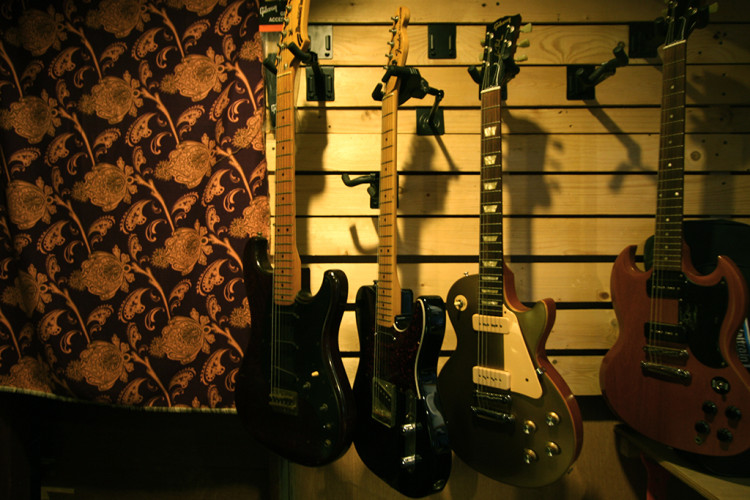
Kemang might be an ideal neighborhood in many ways, but as far as music shops are concerned, it still has a few improvements to make. Nestled among the lively restaurants and bars is Tokove, the sole go-to place for professional musicians and hobbyists alike. Not only does it offer a specialized selection of instruments equipment, but it also beams with a friendly atmosphere.
Here's our list of recommended reading material for next week's "Speaking of Tunes" We Discuss session.
Listening and Collecting with Fadli Aat
“For me, vinyl records are very primitive – it’s very analog. It’s like those pianos in cowboy saloons or music boxes, the player read this physical groove on the record. Also, the sound vinyl records produce… compared to CDs they sounds much better and much more honest, in my opinion.
They are both mixed and mastered, but I don’t know, it just is much more honest. The physicality of the groove has a lot to do with it. CDs are digital, so CD players read them without that physicality. The artwork on records has a lot to do with it as well.
There are so many things you get when you buy that one record. The music and the musical quality, then you have the large and beautiful artwork as well.”
Rhythm of the Archipelago with David Tarigan
“It’s difficult to put into words. I grew up in an era before music can be ripped digitally. I started buying CD, cassettes and vinyl back when I was in primary school. The physical format of music has always played a big part for me. I love old music, and I wanted to experience it the way it was first released. It is an artifact, a piece of history. That’s why until this day I have never purchased a single re-issue. No matter how bad the quality of the record is, it is a part of the experience.
You don’t just listen to a song. When you get you hands on the album, you open the sleeve, read it, touch and even smell it. It is sort of a ritual, a way of worshipping your favorite band. Sometimes people buy an album based on its cover, and if the music is as good as the cover, the experience will be even more rewarding.
In the end it really depends on the individual. I always tend to leave some room for the imagination when it comes to my interaction with music. I like to interpret songs and create personal images of the music. The physicality of the record and the ritual of listening is the foundation that allows me to create my personal opinion of the music.”
The Lint of Material by Sven Birkerts
“The shift from vinyl recordings to CDs was significant, psychologically as well as technologically. While the shiny silver disc physically echoed its predecessor in a few obvious ways – was still a flat circular disc with a hole in the center – the differences were many. They were also symbolic. Where the album had two sides, needing to be ‘flipped’ for full hearing, thereby underscoring its temporality and the fact that its contents were arranged, the silver disc compressed its material on a single side. Tracks were no longer demarcated for the eye, so that all one saw was an elegant shimmering surface. And to make it operational – to play it – the listener had to slide it into the player. It disappeared, and the process whereby the information coded onto the disc became sound was (to me) conjectural: something to do with a laser scanning digits. To change cuts – assuming one was listening to standard fare – no longer required moving the tonearm to the wanted place. A quick touch of the button sufficed. If my explanation of how a needle extracted sound from vinyl was rudimentary and approximate, at least it took into account the basic elements and the everyday physics involved. I can’t tell you how a laser translates digital information; indeed, I cannot tell you how information is rendered into digital form, beyond invoking something about binary code – sequences of ones and zeros that are ‘read.’”
Beethoven and the Quality of Courage by Daniel Barenboim
“Music means different things to different people and sometimes even different things to the same person at different moments of his life. It might be poetic, philosophical, sensual, or mathematical, but in any case it must, in my view, have something to do with the soul of the human being. Hence it is metaphysical; but the means of expression is purely and exclusively physical: sound. I believe it is precisely this permanent coexistence of metaphysical message through physical means that is the strength of music. It is also the reason why when we try to describe music with words, all we can do is articulate our reactions to it, and not grasp music itself.”
“The Grain of the Voice” in by Roland Barthes
“The (if the transposition be allowed) covers all the phenomena, all the features which belong to the structure of the language being sung, the rules of the genre, the coded form of the melisma, the composer’s idiolect, the style of the interpretation: in short, everything in the performance which is in the service of communication, representation, expression, everything which it is customary to talk about, which forms the tissue of cultural values (the matter of acknowledged tastes, of fashions, of critical commentaries), which takes its bearing directly on the ideological alibis of a period (‘subjectivity,’ ‘expressivity,’ ‘dramaticism,’ ‘personality’ of the artist). The is the volume of the singing and speaking voice, the space where significations germinate ‘from within language and in its very materiality’; it forms a signifying play having nothing to do with communication, representation (of feelings), expression; it is that apex (or that depth) of production where the melody really works at the language – not at what it says, but the voluptuousness of its sound-signifiers, of its letters – where melody explores how the language works and identifies with that work. It is, in a very simple word but which must be taken seriously, the of the language.”
Tuesday, February 25, 2014
7—9 pm
Kinokuniya Plaza Senayan
(near the language section)
Jl. Asia Afrika 8
Sogo Plaza Senayan Lt. 5
Jakarta 10270
Look out for updates on our Facebook page and Twitter account! If you’d like to share your opinions, or if you have friends who’d like to share theirs, please sign up via e-mail with the subject title “We Discuss” at ! If you have comments or questions, tweet us .