

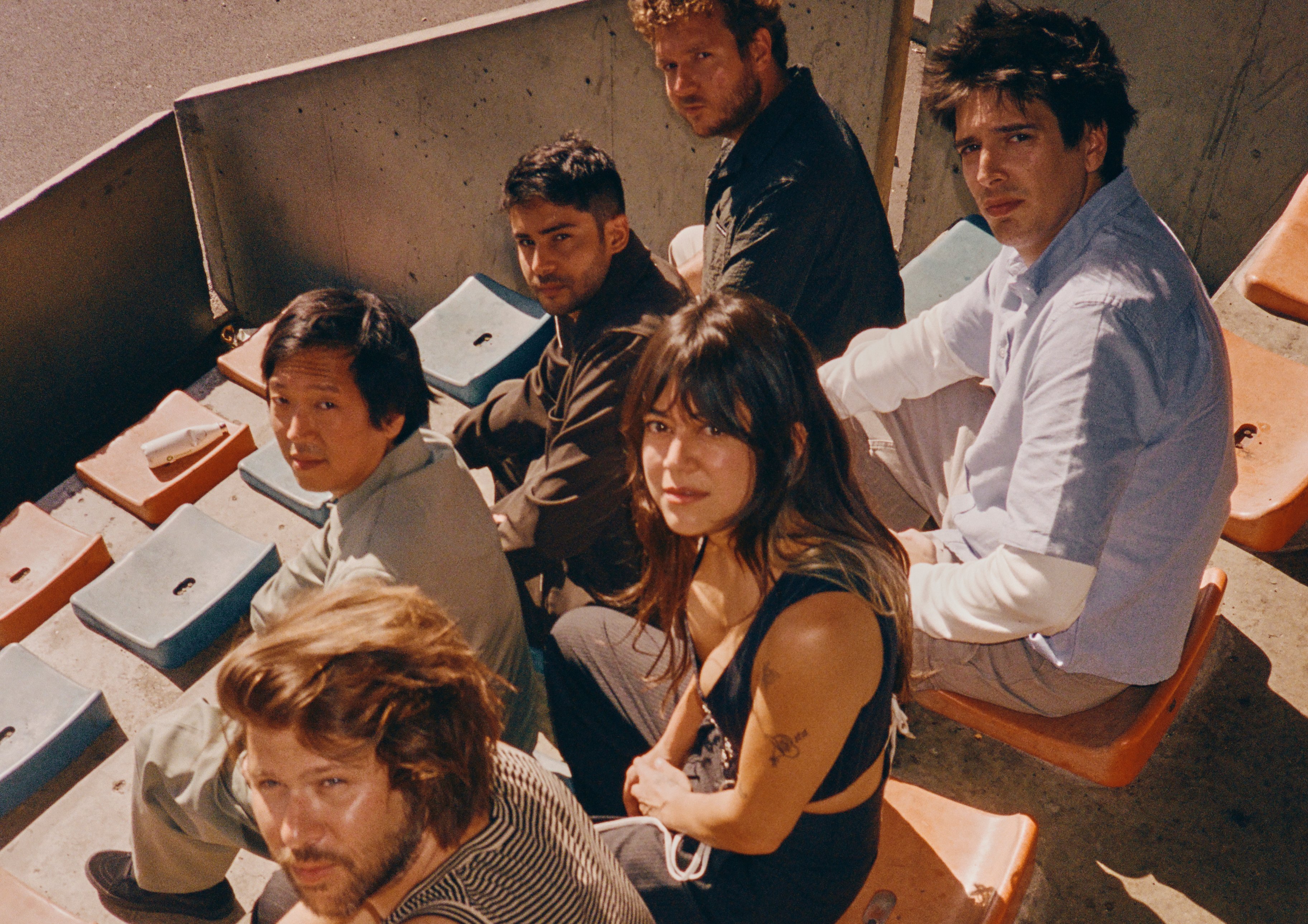


Artist on Artist: L’Impératrice Interviewed by Indonesian Disco Connoisseurs, Featuring Precious Bloom, Diskoria, and Thee Marloes
We have Precious Bloom, Diskoria, and Thee Marloes to chat with L’Impératice, talking about how films have been their DNA, their connection with the French language, and music inspirations with questions we gathered from three Indonesian disco and soul units.

Words by Whiteboard Journal
Words: Jemima Panjaitan
Image: Manu Fauque
If you time travel to 2012, and listen to L’Impératrice, you’ll find out that in the past decade, the French nu-disco unit has gone through growth and self-discovery along the road in the current timeline.
Starting from Charles de Boisseguin’s passion in funky music, he grew to realize that L’Impératrice would be the answer to a music that’s too groovy to be in a record, and since then, a newfound collaboration was born. A six-piece consists of Hagni Gwon on keys and strings, de Boisseguin on keys, drummer Tom Daveau, bassist David Gaugué, guitarist Achille Trocellier, and vocalist Maud “Louve” Ferron.
As a unit, their creative process has always been staying true to the essence of being themselves. From purely just instrumentals in 2012—2015, trying to make records in English, having their feeling and expressions infused in their album—L’Impératice proves just how much they can do from critically-acclaimed debut album Matahari, taking stages at Coachella, Lollapalooza, to being produced by American producer, Neal Pogue. Everyone wants a taste of Eurodisco.
As we approach the first Joyland Sessions in Jakarta this November, we got the chance to have a conversation with Charles, Tom, and Achille of L’Impératice where they talk about how films have been their DNA, their connection with the French language, and music inspirations with questions we gathered from three Indonesian disco and soul units.
Image via Leandro Quintero/Precious Bloom
Precious Bloom
If L’Impératrice were to design a public space like a train station, park, or bar that sounded like your music, what would people hear and feel walking through it?
Achille: Wow, that’s a nice question.
Charles: Yeah, that’s the first time we’ve been asked this kind of question. So public places. Oh, wow. I would say maybe the Grand Palais.
Tom & Achille: Ah, yes.
Charles: It fits well. So there is this place in Paris called the Grand Palais, the Great Palace, which is like a really, really beautiful place. We used to record a video here, a live session during COVID, I guess. Was it COVID? Yeah, just right after COVID.
Can you describe maybe like a feeling that people would feel?
Charles: Space and peace? I mean, this place is really, really super high. So when you walk inside, you just feel like, I don’t know, peaceful? Because you always feel peaceful when you walk in like a super huge, empty space with huge walls. And you know, I mean, there are windows everywhere because it’s made of glass. So the feeling is super lightful and yeah. I mean, people will feel alive. I mean, I think our music is made to be super vivid.
French music in the late ’70s and ’80s had this unique cross pollination from disco and library music to synth pop and even North African or Caribbean influences. Are there any obscure French records or composers from that time who shaped your sonic DNA in unexpected ways?
Charles: There are a lot. I mean, to be perfectly honest, when I started L’Imperatrice, I started because of composers, French composers, some of them, I guess.
And there’s this man, he’s dead now, but he’s called François de Roubaix. And yeah, it was kind of obscure. I mean, only the initiated know him, but it’s still kind of niche, I guess.
François de Roubaix made super good music. He was sampled by Lil Bow Wow back in time, you know? Snoop Dogg’s nephew. He did a song called ‘Beware of Dog’. The instrumental is a sample from François de Roubaix’s music for a movie called Dernier Domicile Connu (1970). I think Robbie Williams sampled him too. Which is funny.
Also, Vladimir Cosma. He is a French composer, super, super mythic, super known in France. He made a few scores like La Boum.
Achille: Yeah, that’s a good one. He did a lot of old French, even funny movies. A comedy with a very famous actor called Louis de Funès.
And yeah, I’m thinking about, he’s actually famous in France, but you know Michel Polnareff? He actually did a score from one movie, La Folle des Grandeurs (1971). That is really, really amazing.

Image via Plainsong Live©
Diskoria
French pop historically carries a mix of detachment and seduction. How do you see yourselves in that lineage, more in the Gainsbourg tradition, or trying to escape it?
Charles: Yeah, I love the detachment thing in music because that’s one way to describe pop. And when music is just there for entertainment and not necessarily commitment, political commitment or something.
And I think the main purpose of our music is just to make people escape from their lives and just to have fun and to feel emotions that they don’t necessarily feel every day. So we often try to blend, to mix two kinds of emotions in our songs, which are joy and melancholy. And so, yeah, I mean, I think we can agree with this kind of Gainsbourg stuff, even if Gainsbourg was a bit, I mean, criticized sometimes because of his behavior. He crossed the limits. But he still made beautiful songs. And he has this image of the French singer who smokes cigarettes and is super cool, and wearing repetos and 501 blue jeans. But I love this analogy.
Your lyrics are often elliptical, almost dreamlike. How important is it for you that non-French listeners understand the words versus just feel the texture of the language?
Achille: I would say it’s… well maybe, to me, the idea of L’Imperatrice is that the words and the music are one big thing. So everything is connected together. We try to use the words and the voice as an instrument.
What you said about the texture, not even in understanding the words, but getting the texture of it, I think that’s something I personally use in music in general. It’s something that… If any language blends with the music, I would listen to it as a texture, actually.
It depends on how you want to listen to music, if the words are super important to you, or whether you listen only to the music, I would say, for L’Imperatrice, it’s a mixture of dreamy words. Because actually the lyrics consist of ‘dreamy’ words, and we always try to blend them with the music. So I would say they make a whole element.
Charles: Yeah, I agree. And, you know, I mean, regarding the choice of the language, I think the instrumental decides it, you know? We don’t decide to write in French or in English or something, it really depends on the vibe, sometimes you just create an instrumental demo, you’re working on it, and it just feels like English can be used, or French can be used, or Spanish sometimes. Or Italian… That’s exactly what happened with the song ‘Danza Marilu.’
When Achille and Tom were working on it at the studio, they were like, okay, this song should sound Italian, you know? This song is made to have Italian lyrics and an Italian vibe. And we were like, yeah, sure. And that’s interesting. So, for example, we have this song ‘Chrysalis,’ and I think the meaning is super important, especially for Louve, because it’s about success, the way to succeed, are you legitimate or not to succeed in music, you know? Or in life, in general. And that, to me, it’s a super good statement, especially for women in the music industry nowadays and we fully support that.
View this post on Instagram
But in another way, sometimes we just want to write about lighter things, maybe cooler, smoother things, and so the meaning can be a lot more about the vibe and the texture.
If L’Impératrice were to make a record that completely breaks your own rules, what would it sound like?
Achille: Wow. Interesting as well. So, yeah, there would be no synths, no guitar, no nothing. Yeah.
Tom: Only feathers.
Charles: I think there are so many records, weird records, from, like, Brian Eno, or, you know, that were super… breaking-any-rules, you know? All the rules. And to me, it might be… I love this pianist called Brad Mehldau, and he made an album back in 2019 called Finding Gabriel. I think it was Finding Gabriel, and the concept is super amazing. He’s a super good jazz pianist, and one day he was just basically reading the Bible, so, he discovered about the angel Gabriel, and he decided to make, to create, a whole album about Gabriel. And this album breaks all the rules because it’s super rare to have a good jazz pianist, making music about, holy stuff? And the way he made this album is really crazy because he mixed religious things with jazz and pop music. And, I mean, there is this song, this particular song called ‘Born to Trouble,’ and you have to listen to it, and to me, it would be this.
Image via Thee Marloes
I feel that your approach to music videos and songs is very harmonious. How much influence do visuals have on L’Impératrice’s music? Did you imagine any scenes when creating those songs?
Achille: Everybody in the band loves movies and films. So, when we create a song, we all imagine recipes of colour, image, language, and a lot of things like this. It’s our DNA.
Charles: It’s our DNA. We are really, really big movie fans and movie lovers. And, yeah, I think we really discovered [how to create songs]. At the very beginning, we were only an instrumental band playing instrumental music during live shows because in pop music, people only relate to the singer, you know? And that could be a problem sometimes because people forget about what’s a bass, what’s a guitar, what’s a drum, what’s an arrangement, what’s a good instrumental because they only focus on the vocals, people mostly want to sing.
And so, the statement was, in the movies, you barely know a hit song, mostly just the atmospheres and we really wanted to recreate this, but in a dance-y and pop way. So, yeah, that’s the basics of L’Impératrice.
So, obviously, we were super influenced with our original soundtracks and all.
You guys said that you guys are big fans of movies. Do you have any specific movies that you like?
Tom: For me, I would choose Jackie Brown (1997). Because I love the way he puts original music and music from bands. And it’s a perfect match with the image.
Charles: Maybe The Deer Hunter (1978) from Michael Cimino. It’s like a super good movie from the 70s.
And I think that’s one of my favorites for so many reasons. It’s just the best way to get into deep America and to understand what was America just before the war and the Vietnam War. You have Robert De Niro. You have so many good actors in this movie, and the music is insane.
There is this scene, super amazing scene, where they are just finishing quitting work. And they are all gathering in the bar, drinking whiskey and playing pool. And suddenly they are all dancing with this song called ‘I Love You Baby.’
♫I Love You Baby♫ and this scene is amazing because they are young and just playing pool, drinking alcohol, and good friends. And right after it, you have the war. This scene is everything to me. I mean, this movie is crazy anyway.


